
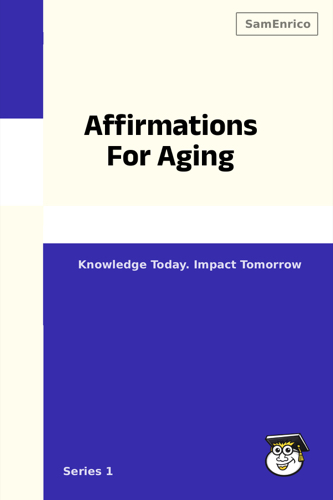
Affirmations For Aging eBook
Embrace getting older with positive, empowering st
Embrace getting older with positive, empowering statements.
Formats
Free sample
Chapter 1: The Unspoken Permission...--The first time you noticed it, you probably dismissed it as a bad day. You looked in the mirror and thought, When did that happen? You forgot a name you have known for twenty years and laughed it off—but the laugh had an edge. You said “I’m too old for that” and meant it as a joke, except it did not feel like a joke anymore. Somewhere along the way, without signing any paperwork or attending any ceremony, you accepted a set of rules you never voted for.
The rules say: You are supposed to slow down. You are supposed to become invisible. You are supposed to apologize for taking up space. You are supposed to be grateful for whatever scraps of attention the world still throws your way. And you are supposed to do all of this quietly, gracefully, without complaining.This chapter is going to ask you to do something radical instead.
It is going to ask you to revoke that agreement.The Silent Contract You Signed Without Knowing It Let us name the thing that most books about aging dance around. There is a voice inside your head—we will call it the Inner Critic throughout this book—that has been rehearsing the same script for years, maybe decades. The script goes something like this: You are not as sharp as you used to be. People are humoring you when they listen. You are becoming a burden.
Your best years are behind you. Do not try anything new because you will embarrass yourself. Do not ask for what you want because you should be grateful for what you have. Do not take up too much space because the young people are busy with real life.Here is what you need to understand about that voice. It is not the truth.
It is not even original. It is the accumulated echo of every ageist stereotype our culture has been broadcasting since you were young enough to believe that old people were other people. The Inner Critic borrowed its language from commercials that sell anti-aging cream by implying that aging is a disease. It borrowed its urgency from workplaces that pushed you out or made you feel obsolete. It borrowed its cruelty from a society that celebrates youth and treats elders as problems to be managed rather than lives to be honored.But here is the more important truth: You have been listening to that voice as if it were your own.
And that is the first thing we are going to change.The Anatomy of Internalized Ageism Before we can dismantle anything, we need to see its structure. Psychologists use a term called internalized ageism. It works exactly the way internalized racism or internalized sexism works. You absorb the dominant culture’s prejudice against your own group, and then you turn that prejudice inward. You start believing the stereotypes about old people as an old person.
And because the stereotypes are everywhere—in movies, in birthday cards, in casual conversation—you never think to question them.Let me give you an example. When a thirty-year-old forgets where they put their keys, they say, “I need more coffee.” When a seventy-year-old forgets where they put their keys, they say, “It’s happening. The memory loss is starting.” Same behavior. Completely different interpretation. The difference is not in the brain.
The difference is in the story you have been told to tell yourself.Internalized ageism shows up in six predictable ways:1. Self-stereotyping. You catch yourself saying things like “I’m having a senior moment” or “What do you expect at my age?” You are doing the culture’s work for it. You are putting yourself in a box and handing over the tape.2. Apologetic occupying of space.
You hesitate to speak in groups. You assume younger people do not want to hear from you. You step aside literally and figuratively, making yourself small so you will not be in the way.3. Defensiveness about aging. You snap when someone offers help you did not ask for.
You insist you are “fine” when you are struggling. You refuse to use the cane or hearing aid or walker because those are old people things—as if you are not, in fact, an old person.4. Acceptance of irrelevance. You stop applying for things. You stop learning new skills.
You tell yourself that your time for impact has passed. You confuse “different” with “less.”5. Fear of being a burden. This is the big one. You hide your needs.
You refuse to ask for help even when you are suffering. You would rather be silently miserable than be that old person who is always asking for something.6. Gratitude for crumbs. You feel honored when someone talks to you like a human being. You are grateful for basic respect as if it were a gift.
You have forgotten that respect is not a gift; it is a baseline.If any of these sound familiar, you are not broken. You are not weak. You are a human being who has been swimming in a culture that treats aging as a tragedy, and you got wet. The question is not whether you internalized these messages. The question is what you are going to do with them now.The One Word That Changes Everything Sophy Burnham, who wrote the bestseller The Wonder of Being Old, spent years interviewing elders who were actually happy.
Not resigned. Not coping. Genuinely, vibrantly happy. And when she asked them to describe old age in one word, the answer was not “decline” or “loss” or “pain.” The answer was “freedom.”Let that land for a moment. Freedom.Not freedom from something—though that is part of it.
Freedom from the ambition treadmill. Freedom from pretending to care about things you never cared about. Freedom from the exhausting performance of youth. But also freedom to. Freedom to nap without guilt.
Freedom to say no to invitations without inventing an excuse. Freedom to wear what you want, say what you think, and spend your time exactly how you choose.The younger version of you could not afford that freedom. You had mortgages and bosses and reputations to protect. You had children who needed you to be a certain way. You had a future that demanded you keep climbing.
That version of you did good work. That version of you built something. But that version of you was also a prisoner in ways you could not see because the bars were made of obligation.Now look at the bars. Many of them are gone. The children have left.
The career has ended or is ending. The reputation you spent decades building? It is built. You do not need to add another brick. You are, for the first time in your adult life, standing in a clearing.
And the only thing keeping you from seeing that clearing as a playground instead of an empty field is a story you have been telling yourself about what aging means.The Permission Slip Here is where this chapter becomes a tool and not just a lecture. I want you to get a piece of paper. A real…
This is the end of the free sample. Get the eBook to keep going. Buy now
About this book
Details
- Author
- Meyer Candace
- Publisher
- SamEnrico
- Language
- English
- Genre
- Non-Fiction, Self-Help, Aging
- Released
- 2026-06-06
- Pages (approx.)
- 127
- Available as
- eBook, Audiobook

Read better in the ZLOADR app
Your eBooks on your phone or tablet. Sign in with your SamEnrico account and start reading.
More by Meyer Candace
 Morning Mindset Reframe GuideMeyer Candace$11.99
 Logical Creativity HandbookMeyer Candace$11.99
 Relationship Anger RestructuringMeyer Candace$11.99
 The Sherman Alexie StoryMeyer Candace$11.99
 Time Restricted EatingMeyer Candace$11.99
 Okinawan Longevity SecretsMeyer Candace$11.99
 Gut Brain Immune TriangleMeyer Candace$11.99
 Pegasus and the Parthenon: Horses of Ancient AthensMeyer Candace$11.99
 The Last Supper: Australia's Death Row Meals and the Final Hours of the CondemnedMeyer Candace$11.99
 The Essential Guide to Contemporary FolkMeyer Candace$11.99
 B2B Sales for Maritime SectorMeyer Candace$12.99
 ROI Calculator for PromotionMeyer Candace$12.99
You may also like
 Hong Kong Handover 1997Dunn Johnnie$11.99
 Zumba For Postnatal Recovery CourseNeal Christian$11.99
 Zumba for BeginnersLadner Nikia$11.99
 YouTube Comment Mining GuideHumes Pandora$12.99
 Worry Box MeditationCarlin Rudy$11.99
 Workplace Stress MeditationNguyen Lynn$11.99
 Workplace Stress and Sleep RepairHawley Ivory$11.99
 Workplace Perfectionism CureDelaney Jeffry$11.99
 Workplace Injustice Anger GuideWallen Isabelle$11.99
 Work Addiction and Burnout LinkGreenwood Ester$11.99
 Women in Yoga and WellnessBeattie Galina$11.99
 Women in Stand Up ComedyChun Evangeline$11.99