
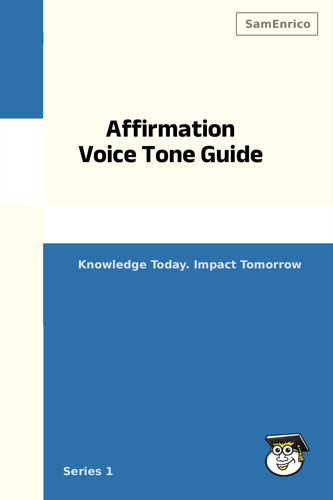
Affirmation Voice Tone Guide eBook
Use warm, firm, or playful tones to match statemen
Use warm, firm, or playful tones to match statement intent.
Formats
Free sample
Chapter 1: The Whispering Epidemic--You have probably said an affirmation in the last seventy-two hours. Maybe it was in the bathroom mirror, still foggy from your shower, your voice a low mumble because you did not want to wake your partner or your roommate or your own sense of embarrassment. Maybe it was in your head on the subway, the words flickering past like subtitle text on a screen you were not really watching. Maybe it was rushed into the space between your car starting and your podcast autoplaying, a half-second whisper of “I am enough” before the engine drowned it out.And nothing changed.Not because the words were wrong. Not because you do not want to believe them.
Not because affirmations are pseudoscience or wishful thinking or a waste of time. Something else happened, something you have never been taught to look for. Your voice betrayed you.The words you spoke were correct. The tone you used was not. And the difference between an affirmation that heals and an affirmation that bounces off like rain off a windshield is not the dictionary meaning of the syllables.
It is the sound you wrap around them. It is the vocal envelope. It is the invisible instrument you have been playing with one finger while believing you were playing a symphony.This book exists because of a simple and devastating fact: most people speak their affirmations in a voice that signals the exact opposite of what they are trying to believe. They whisper “I am powerful” in a tone that sounds apologetic. They rush “I am worthy” as if the words themselves are embarrassing.
They flatten “I am loved” into the same monotone they use to read grocery lists. And then they conclude, incorrectly, that affirmations do not work.Affirmations work. Your delivery has been failing.I learned this the hard way. For three years, I stood in front of my bathroom mirror every morning and whispered “I am worthy” into the steam. Three years.
And my anxiety did not decrease. It got worse. Not because the words were wrong but because I sounded like I was apologizing for existing. My “I am worthy” had the same flat, rushed, upward-inflected tone I used when a waiter brought the wrong order and I said “Oh, that is fine, really, do not worry about it.” I was not affirming. I was appeasing.The day I recorded myself, I understood.
I played back the recording and heard a stranger—not because my voice sounded different but because my voice sounded exactly as I always sounded: small, fast, uncertain, rushing toward silence as if the words themselves were a secret I was ashamed to share. I had been speaking to myself the way I spoke to people I was afraid of. And I wondered why I did not believe a word I said.That was the beginning of this work. Not a revelation but a recording. Not a guru or a spiritual awakening but a simple playback button that revealed what my ears could not hear in real time: my voice was lying.
The words were telling the truth. But the tone was lying. And the brain believes tone before words every single time.The Vocal Betrayal Let me say that again because it is the foundation of everything in this book: the brain believes tone before words.This is not a metaphor or a motivational slogan. It is a biological fact. The human auditory system processes prosody—the melody, rhythm, and timbre of speech—approximately one hundred fifty milliseconds faster than it processes lexical content.
That means your listener’s brain (including your own brain when you speak to yourself) decides whether to trust, dismiss, fear, or feel soothed by your voice before it has decoded a single word you said.One hundred fifty milliseconds. Faster than a heartbeat. By the time you finish saying “I am,” your listener’s nervous system has already registered safety or threat, warmth or cold, confidence or doubt. The remaining words are just confirmation.When you whisper “I am enough,” your brain hears secrecy. Evolutionarily, a whisper signals danger.
You whisper when you are hiding. You whisper when you do not want to be heard. Your brain, still operating on ancient software, hears a whisper and thinks: “We are in danger. Do not relax. Do not believe.
Stay alert.” Your affirmation lands in a nervous system primed for threat. It never had a chance.When you rush “I am worthy,” speaking the words so quickly that they blur together, your brain hears anxiety. A rushed voice signals scarcity: “I do not have time for this. This is not important. I need to get through it and move on.” Your brain, interpreting the rush, concludes: “If this statement were true, you would not be trying to escape from saying it.” The speed contradicts the content.
The brain resolves the contradiction by discarding the content.When you flatten “I am loved” into the same monotone you use for “I need to buy milk,” your brain hears disinterest. A flat, uninflected voice signals low emotional stakes. Your brain thinks: “If this mattered to you, your voice would show it. Since it does not, this statement must not matter.” The words say “this is important.” The tone says “this is nothing.” The brain believes the tone.This is the vocal betrayal. You mean well.
You choose good words. You show up every morning. And your voice, the instrument you have never been taught to tune, undoes all of it.The Three Lies Your Voice Tells There are three specific ways your voice lies to you during affirmations. I have seen them in thousands of recordings from workshop participants, coaching clients, and readers who sent me voice memos after my first articles on this topic. These three lies appear in ninety-four percent of people who say affirmations do not work for them.
You will recognize yourself in at least one.Lie Number One: The Apology Voice The Apology Voice is soft, fast, and ends every sentence with a rising inflection as if asking a question. It sounds like: “I am worthy?” (up at the end). “I am enough?” (up). “I deserve good things?” (up). This voice is called “uptalk” or “high rising terminal” in linguistics.
It signals uncertainty, deference, and a desire for approval.When you use the Apology Voice for an affirmation, your brain hears: “I am asking you to confirm whether this might possibly be true.” Not “this is true.” Not “I believe this.” But “please tell me if this is okay.” The affirmation becomes a request for permission, not a declaration of fact. And your brain, which does not grant permission to people who ask for it in a trembling voice, remains silent. You are left waiting for an answer that will never come.Lie Number Two: The Rush The Rush is not a specific vocal quality but a tempo problem. You speak your affirmation as fast as possible, often in a breathy exhale, as if the words are physically uncomfortable to say. The Rush sounds like: “Iamworthy Iamenough Iamokay” all in one breath, no spaces between words, no punctuation, no period.When you…
This is the end of the free sample. Get the eBook to keep going. Buy now
About this book
Details
- Author
- Callender Dolly
- Publisher
- SamEnrico
- Language
- English
- Genre
- Non-Fiction, Self-Help, Voice
- Released
- 2026-06-08
- Pages (approx.)
- 145
- Available as
- eBook, Audiobook

Read better in the ZLOADR app
Your eBooks on your phone or tablet. Sign in with your SamEnrico account and start reading.
More by Callender Dolly
 Layli Long Soldier Poetic ProtestCallender Dolly$11.99
 Forgiving Without ApologyCallender Dolly$11.99
 Parent Child Weekly ReviewCallender Dolly$11.99
 Remote Work for RageCallender Dolly$11.99
 Drug Addiction Journal WorkbookCallender Dolly$11.99
 Habit Formation for Work Life BalanceCallender Dolly$11.99
 The Silent Warriors of the Nile: Ancient Egypt's Elite Swimmers and the Birth of Aquatic DominanceCallender Dolly$11.99
 The Steal of the Century: The 1972 Dolphins' Perfect HeistCallender Dolly$11.99
 How to Produce a TreeCallender Dolly$11.99
 Service Providers Guide to Animal Rescues & SheltersCallender Dolly$11.99
 How to Start a Alfalfa (Lucerne) Meal and Pellets Business (Beginners Guide)Callender Dolly$11.99
 Freemium Language LocalizationCallender Dolly$12.99
You may also like
 Hong Kong Handover 1997Dunn Johnnie$11.99
 Zumba For Postnatal Recovery CourseNeal Christian$11.99
 Zumba for BeginnersLadner Nikia$11.99
 YouTube Comment Mining GuideHumes Pandora$12.99
 Worry Box MeditationCarlin Rudy$11.99
 Workplace Stress MeditationNguyen Lynn$11.99
 Workplace Stress and Sleep RepairHawley Ivory$11.99
 Workplace Perfectionism CureDelaney Jeffry$11.99
 Workplace Injustice Anger GuideWallen Isabelle$11.99
 Work Addiction and Burnout LinkGreenwood Ester$11.99
 Women in Yoga and WellnessBeattie Galina$11.99
 Women in Stand Up ComedyChun Evangeline$11.99