
Non-FictionSelf-HelpPhysical Touch
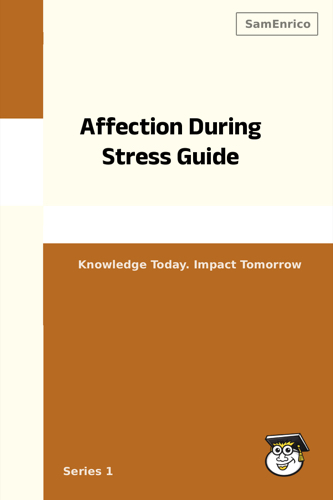
Affection During Stress Guide eBook
Maintains physical touch during difficult times.
by Kern Tajuana
Maintains physical touch during difficult times.
Formats
Free sample
Chapter 1: The Flinch Reflex--–- The argument had been going for forty-seven minutes. Sarah couldn't remember what started it—something about a forgotten appointment, a text message left on read, the usual debris of two overworked people sharing a small apartment. What she remembered was the way her husband reached for her hand across the kitchen table, and the way she snatched hers back as if his fingers were on fire. She saw his face crumble. She felt justified.
She was too angry to be touched. Too stressed. Too overwhelmed. And in that moment, she was absolutely certain that his hand was the last thing on earth she wanted near her skin.This book exists because Sarah was wrong.Not about her feelings. Her feelings were real.
The anger was real. The exhaustion was real. But her instinct—the lightning-fast, gut-level certainty that touch would make everything worse—that instinct was a biological error. A misfiring alarm. A ghost in the neural circuitry that evolved to protect her from saber-toothed tigers but had no idea what to do with a husband who forgot to take out the trash.Every single day, in millions of homes, the same scene plays out.
A couple fights. A parent collapses under the weight of grief. A caregiver runs on empty. A partner withdraws into the cold silence of resentment. And in every single one of those scenes, the stressed human body does the same thing: it flinches away from the very touch that could save it.This chapter is about that flinch.
Where it comes from. Why it feels so real. And why—for most people, most of the time—fighting against it is the bravest and most effective thing you can do for your relationship and your nervous system.The Anatomy of a Flinch Let us begin with a simple experiment you can conduct right now, in the privacy of your own mind. Imagine you are walking down a dark street. It is late.
You are alone. Out of the corner of your eye, you see a sudden movement—a shape, fast and unexpected, heading toward you. Before you have time to think, your body does something remarkable. Your shoulders rise. Your hands come up.
Your breath stops. Your heart slams against your ribs. You have flinched.Now imagine that the shape turns out to be a friend who was jogging to catch up with you. The threat dissolves. But the flinch already happened.
Your body reacted before your brain could consult reality.This is the flinch reflex. It is the most ancient survival circuit in the human nervous system. It bypasses conscious thought entirely. Sensory information travels from your eyes to your thalamus, and from there, a direct high-speed connection fires straight to your amygdala—the brain's alarm system—before the slower, more rational signals ever reach your prefrontal cortex. The neuroscientist Joseph Le Doux, who mapped this circuit in the 1990s, called it the "low road." It is fast, automatic, and frequently wrong.Now here is the crucial insight for this book: the same flinch reflex that jerks your hand away from a hot stove also jerks your body away from your partner's touch during an argument.
The same neural circuitry that makes you duck when a baseball flies toward your face also makes you recoil when your spouse reaches for your shoulder while you are crying. Your nervous system does not distinguish between a physical threat (a falling branch) and a social threat (a partner's angry voice). Both trigger the same alarm. Both produce the same withdrawal response.This is not a metaphor. It is measurable physiology.When your amygdala sounds the alarm, it activates the sympathetic nervous system—the famous fight-or-flight response.
Cortisol and adrenaline flood your bloodstream. Your blood vessels constrict. Your digestion stops. Your peripheral vision narrows. And your skin becomes hypersensitive to touch, but not in a good way.
In this state, even a gentle hand on your arm can feel like sandpaper. Even a loving embrace can feel like a trap.This is why Sarah snatched her hand away. Her amygdala had classified her husband's reaching hand as a threat. Not because he was dangerous. Because her nervous system was in survival mode, and survival mode treats all incoming stimuli—especially unexpected touch—as potential attacks.The 40% Rule and the Lie of the Exhausted Brain The endurance athlete and retired Navy SEAL David Goggins popularized a concept he calls the "40% Rule." The idea is simple: when your mind tells you that you are completely finished, that you have nothing left, that you cannot take one more step—you are actually only 40 percent done.
The remaining 60 percent is locked behind a wall of mental resistance that feels like a brick wall but is actually just a collection of uncomfortable sensations your brain is mislabeling as impossibility.Goggins used this rule to run ultramarathons on broken legs and complete SEAL training despite sickle cell trait. But the principle applies equally to the small, daily heroism of not flinching away from your partner when every cell in your body is screaming for distance.The urge to withdraw from touch during stress feels absolute. It feels like a law of nature, like gravity or the setting sun. But it is not a law. It is a sensation.
And sensations can be overridden.Here is what the research shows: when couples in conflict are instructed to hold hands for twenty seconds, their cortisol levels drop by an average of 27 percent within two minutes. Their blood pressure normalizes. Their heart rates synchronize. And the content of their argument—the thing that felt like an unsolvable crisis moments earlier—frequently becomes manageable or even trivial.This is not magic. This is biology overriding biology.
Oxytocin, the neuropeptide released by skin-to-skin contact, directly inhibits the amygdala's alarm response. It literally turns down the volume on fear. It reduces the reactivity of the sympathetic nervous system. It makes the flinch reflex harder to trigger.But here is the catch: oxytocin requires time to work. A quick peck on the cheek does nothing.
A half-second squeeze of the hand barely registers. The research is remarkably consistent across dozens of studies: meaningful oxytocin release requires sustained, intentional touch. Specifically:A full-body embrace of at least twenty seconds produces a significant and measurable oxytocin spike.Forehead-to-forehead contact of ten seconds activates the trigeminal nerve and the parasympathetic nervous system, lowering heart rate even faster than a hug.A kiss of six seconds (not a peck, not a prolonged make-out session, but a deliberate six-second press of the lips) releases sufficient oxytocin to shift mood.A hand squeeze of three seconds is enough for recognition and connection but not for full oxytocin release—it signals safety without fully activating the parasympathetic response.These durations are not arbitrary. They come from the Touch Research Institute at the University of Miami, led by Tiffany Field, who has spent four decades quantifying exactly how much touch is required to change the human nervous system. Twenty seconds is the threshold.
Six seconds is the minimum for lip-to-lip contact because of the unusually high density of nerve endings in the lips. Ten seconds…
This is the end of the free sample. Get the eBook to keep going. Buy now
About this book
Details
- Author
- Kern Tajuana
- Publisher
- SamEnrico
- Language
- English
- Genre
- Non-Fiction, Self-Help, Physical Touch
- Released
- 2026-06-06
- Pages (approx.)
- 150
- Available as
- eBook, Audiobook

Read better in the ZLOADR app
Your eBooks on your phone or tablet. Sign in with your SamEnrico account and start reading.
More by Kern Tajuana
 Citation Rules for MLA Only PrimerKern Tajuana$11.99
 Expectation Detox HandbookKern Tajuana$11.99
 Upwork Escrow Protection GuideKern Tajuana$11.99
 GST Registration Amendment Process WorkbookKern Tajuana$11.99
 Single Income Career Transition GuideKern Tajuana$11.99
 Child Star Memoir Literary GuideKern Tajuana$11.99
 Work Life Integration GuideKern Tajuana$11.99
 Scott Peterson Death Row LettersKern Tajuana$11.99
 The Silent Conquerors: The Untold Story of the First All-Female Himalayan ExpeditionKern Tajuana$11.99
 The Meroë Plague Chronicles: Kush's Ancient Medical TriumphsKern Tajuana$11.99
 The Great Penguin Highway: A Waddle Across ContinentsKern Tajuana$11.99
 How to Become a Capsule-filling-machine OperatorKern Tajuana$11.99
You may also like
 Hong Kong Handover 1997Dunn Johnnie$11.99
 Zumba For Postnatal Recovery CourseNeal Christian$11.99
 Zumba for BeginnersLadner Nikia$11.99
 YouTube Comment Mining GuideHumes Pandora$12.99
 Worry Box MeditationCarlin Rudy$11.99
 Workplace Stress MeditationNguyen Lynn$11.99
 Workplace Stress and Sleep RepairHawley Ivory$11.99
 Workplace Perfectionism CureDelaney Jeffry$11.99
 Workplace Injustice Anger GuideWallen Isabelle$11.99
 Work Addiction and Burnout LinkGreenwood Ester$11.99
 Women in Yoga and WellnessBeattie Galina$11.99
 Women in Stand Up ComedyChun Evangeline$11.99