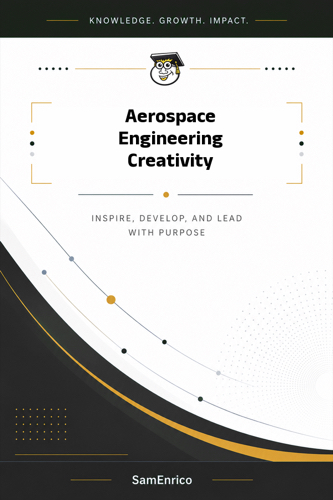
Aerospace Engineering Creativity eBook
Apply innovative approaches to aircraft, spacecraf
Apply innovative approaches to aircraft, spacecraft, and systems design.
Formats
Free sample
Chapter 1: The Permission Problem--–- Every aerospace engineer I have ever met carries a secret. It is not a secret about classified programs or proprietary data. It is a quieter, more personal shame. They believe they are not creative. I have heard this confession from fresh graduates who can derive the Navier-Stokes equations from memory and from grizzled Fellows who have signed off on designs that have flown millions of passengers.
They say it in hushed tones, often after a second drink at a conference bar. "I'm just an analyst," they admit. "I couldn't have come up with something like the SR-71. I'm not that kind of engineer."This confession is a lie. But it is a lie that the aerospace industry has carefully cultivated, fertilized with decades of risk aversion, certification paranoia, and a worship of precedent that borders on the religious.
The lie says that creativity belongs to a special class of engineers—the mavericks, the Skunk Works geniuses, the rare birds who wear Hawaiian shirts to design reviews. The rest of you, the lie whispers, are meant to follow rules, apply formulas, and never, ever color outside the lines.I spent the first seven years of my career believing this lie. I was a structures engineer at a major commercial airframer, the kind of company where the most common phrase in design reviews was "show me where we've done this before." My job was to take existing wing ribs—proven, certified, boring—and tweak them for the next derivative model. I was good at it. I was promoted.
And I was slowly dying inside.The lie broke for me on a Tuesday afternoon in a fluorescent-lit conference room. I was presenting a modest proposal: a new composite rib design that would save eleven pounds per aircraft. Eleven pounds. On a three-hundred-thousand-pound airframe. But eleven pounds, multiplied across a fleet of eight hundred aircraft, over twenty years of fuel burn, added up to real money.
I had done the math. I had built the finite element model. I had run the fatigue analysis. It was solid.My manager, a kind man named Dave who had not had an original idea since the Reagan administration, listened patiently. Then he asked the question that would change my career.
"That's impressive work," he said. "But can you show me where we've flown this before?"I could not. The specific ply stacking sequence I had proposed—a variation on a theme used in Formula One racing but never in commercial transport—had no precedent in our company's forty-year history. Dave shook his head. "Too risky," he said.
"Come back with something we know works."I walked back to my cubicle, defeated but also, for the first time, angry. Not at Dave. He was doing his job. I was angry at the system that had trained me to believe that the absence of precedent was the same as the presence of danger. I was angry at myself for never questioning that assumption.That night, I went home and did something I had not done since graduate school.
I opened a blank notebook—not a spreadsheet, not a CAD model, not a requirements document—and I wrote a question at the top of the first page: "What would I design if I weren't afraid of being wrong?"It took me three hours to fill ten pages. Most of what I wrote was garbage. Wingtip-mounted engines. A fuselage that flexed like a snake. Landing gear that deployed sideways.
Stupid ideas. Embarrassing ideas. Ideas that would have gotten me laughed out of any design review in the company.But buried in the garbage was one idea that would not let go. What if we mounted the engines above the wing instead of below it? The conventional wisdom said this was impossible because ground crews needed access.
But what if the access came from below, through hatches in the wing? What if the engine itself could be lowered on a track? What if...I stopped myself. I was doing it again. I was taking a creative thought and strangling it with constraints before it had a chance to breathe.Six months later, I left that company.
Not because I was brave, but because I could no longer bear the weight of the lie. I joined a small startup working on electric vertical takeoff and landing aircraft—e VTOL, in the industry jargon. We had no precedent. We had no "where we've done this before." We had only physics, ambition, and the terrifying freedom of a blank sheet of paper.That startup failed. Spectacularly.
We ran out of money, our prototype crashed during hover testing (simulated failure became operational failure, as we will discuss in Chapter 9), and I spent three months unemployed, wondering if Dave had been right all along. But in the wreckage of that failure, I learned something that no engineering school had taught me. I learned that creativity is not a personality trait. It is a discipline. It is a set of skills that can be learned, practiced, and mastered—just like finite element analysis, just like aerodynamic optimization, just like control law design.This book is the record of what I learned in the decade that followed.
It is not a collection of inspiration quotes or a celebration of "thinking outside the box." Aerospace engineers do not need to be told to think outside the box. We need to be told which boxes are worth thinking outside of, which constraints are real and which are imaginary, and how to manage the creative debt that every novel design incurs.I have structured this book around a simple premise: the aerospace industry is facing problems that cannot be solved by incremental improvement alone. Sustainable aviation, commercial space, autonomous systems, urban air mobility—these challenges have no precedent. They require engineers who can generate novel solutions while respecting the unforgiving laws of physics and the legitimate demands of safety certification. We do not need fewer analysts.
We need analysts who have learned to be creative. We do not need fewer rules. We need engineers who understand rules deeply enough to know when and how to reinterpret them.This first chapter is about permission. It is about the psychological and institutional barriers that prevent excellent engineers from doing their best work. It is about the difference between incremental improvement and disruptive innovation, and why both have their place.
It is about the three filters that distinguish creative engineering from wishful thinking. And it is about the concept of creative debt—a framework for managing the risks of innovation that will appear throughout this book.If you read only one chapter of this book, I hope it is not this one. The real value is in the methods that follow: morphological analysis, TRIZ, generative design, model-based systems engineering. But you will not use those methods unless you first give yourself permission to try. So let us begin there.The Quiet Crisis of Aerospace Creativity The commercial aviation industry has a dirty secret.
Despite the breathless press releases about "innovation" and "revolutionary design," the fundamental architecture of a passenger aircraft has not changed in over sixty years. Tubes with wings.…
This is the end of the free sample. Get the eBook to keep going. Buy now
About this book
Details
- Author
- Ralston Winter
- Publisher
- SamEnrico
- Language
- English
- Genre
- Non-Fiction, Self-Help, Aerospace Engineering
- Released
- 2026-06-10
- Pages (approx.)
- 154
- Available as
- eBook, Audiobook

Read better in the ZLOADR app
Your eBooks on your phone or tablet. Sign in with your SamEnrico account and start reading.
More by Ralston Winter
 Growth Mindset For Weight LossRalston Winter$11.99
 Foot Note Influence TechniqueRalston Winter$11.99
 The Mexico Follow Up EtiquetteRalston Winter$11.99
 Mindful Dating in Early RecoveryRalston Winter$11.99
 The Pearl of the Levant: The Kidnapping Plot That Shook Ottoman SocietyRalston Winter$11.99
 Understanding Trophoblastic Neoplasms (Gestational Trophoblastic Disease)Ralston Winter$17.99
 VAT Registration ThresholdsRalston Winter$12.99
 African B2C YC GuideRalston Winter$12.99
 Compliance Officer (Data Protection)Ralston Winter$11.99