
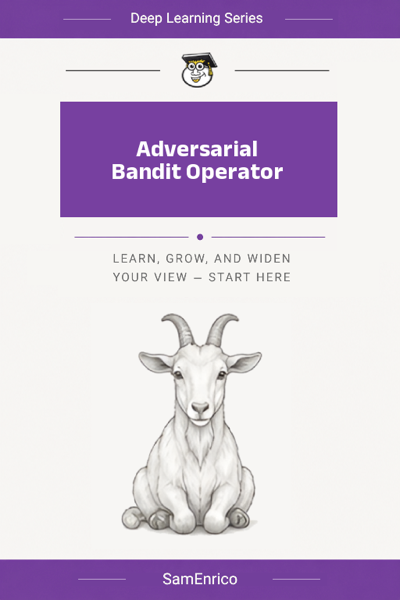
Non-FictionInformativeEducational
Adversarial Bandit Operator eBook
A Coursebook on Adversarial Bandit Operator
A Coursebook on Adversarial Bandit Operator
Formats
Free sample
Chapter 1: The Gambler’s Nightmare...--– The slot machines stretched across the casino floor in silent rows, their polished chrome and blinking lights promising fortune to anyone patient enough to pull the lever. But the old gambler in the corner knew something the others did not: these were not ordinary machines. They did not obey the laws of probability that had been studied for centuries. Each time he pulled a lever, the payout was not determined by a fixed, hidden coin flip. Instead, an invisible operator watched his every move, studied his patterns, and adjusted the rewards specifically to keep him guessing.
The gambler was not playing against chance. He was playing against an adversary.This book is about that gambler. And about you, the reader, who will learn to build algorithms that can survive—and even thrive—against such an adversary. Welcome to the world of the Adversarial Bandit Operator.1.1 A Short Walk Down the Casino Floor To understand why the adversarial setting is so fundamentally different from everything you may have learned about probability and statistics, we must first revisit the classical multi-armed bandit problem. The name itself comes from the colloquial term for a slot machine—a “one-armed bandit”—because it robs gamblers of their coins.
A multi-armed bandit is simply a collection of such machines, each with an unknown probability of paying out. The gambler’s goal is to maximize total winnings over a sequence of pulls by deciding which arm to pull at each time step, using past observations to guide future choices.In the classical formulation, first studied extensively in the 1930s by Thompson and later formalized by Robbins in 1952, each arm’s rewards are assumed to be independent and identically distributed (i.i.d.) according to some fixed but unknown distribution. Arm one might pay out with probability 0.2, arm two with probability 0.5, arm three with probability 0.1. These probabilities never change. The environment is static, random, and crucially fair in the sense that it does not adapt to the gambler’s actions.
Nature flips a coin, but she does not cheat.This stochastic setting has produced elegant algorithms such as the Upper Confidence Bound (UCB) algorithm and Thompson sampling. These algorithms balance exploration (trying arms to learn about them) with exploitation (pulling the arm that currently looks best). They achieve regret—the difference between the gambler’s total reward and the reward of the best fixed arm in hindsight—that grows only logarithmically with time. For a gambler facing truly random machines, the stochastic bandit framework is both beautiful and practical.But here is the problem: most real-world environments are not fair.1.2 Enter the Operator Now imagine a different scenario. You are not in a casino governed by static probabilities.
You are an online retailer testing different pricing strategies for a new product. Your competitor—a savvy, well-funded company—watches your prices in real time. When you lower your price, they immediately lower theirs further. When you raise your price, they hold steady to capture market share. The rewards (sales) are not drawn from a fixed distribution.
They are the result of an active opponent who studies your moves and responds specifically to defeat you.This opponent is the Adversarial Operator.More formally, the Adversarial Operator is a hypothetical entity (or a real competitor, or nature itself when it behaves maliciously) that chooses the rewards or losses for each arm at each time step in an arbitrary manner. The operator may be:Oblivious: It pre-commits to an entire sequence of losses before the game begins, without observing the learner’s actions.Adaptive: It chooses each round’s losses based on everything the learner has done so far.Corrupting: It starts with a “true” loss distribution but flips a fraction of the observations to mislead the learner.Non-stationary: It gradually or abruptly changes the underlying reward structure over time.We will explore each of these variants in depth throughout this book. For now, the key insight is that the operator is not random in the classical sense. There is no stationary distribution to estimate. The concept of an “expected reward” for an arm becomes meaningless because the operator could choose a different value each round, possibly in response to your previous choices.If expected reward is meaningless, how do we even define success?
How can we claim that one algorithm is better than another when the adversary could simply make any algorithm look arbitrarily bad? These questions plagued early researchers in the 1990s until a breakthrough emerged from a surprising place: the theory of prediction with expert advice and the concept of regret.1.3 Regret: The Only Metric That Matters In the stochastic bandit setting, we often measure performance by the difference between the gambler’s expected total reward and the expected reward of the best arm (the one with the highest mean). This notion of “expected optimality” relies on the existence of stable expectations. In the adversarial setting, expectations are not well-defined because the adversary’s choices are not random.Enter regret, a concept that predates adversarial bandits but found its full power in this domain. Regret compares the learner’s actual total loss (or reward) against the loss of the best fixed action in hindsight, after seeing the entire sequence of losses chosen by the adversary.
For a sequence of losses ℓ1,ℓ2,…,ℓn\ell_1, \ell_2, \dots, \ell_nℓ1,ℓ2,…,ℓn, where ℓt(a)\ell_t(a)ℓt(a) is the loss of arm aaa at time ttt, and the learner chooses arm At A_t At at each round, the static regret is defined as:Rn=∑t=1nℓt(At)−mina∈A∑t=1nℓt(a)R_n = \sum_{t=1}^n \ell_t(A_t) - \min_{a \in \mathcal{A}} \sum_{t=1}^n \ell_t(a)Rn=t=1∑nℓt(At)−a∈Amint=1∑nℓt(a)The first term is the learner’s total loss. The second term is the total loss of the single best arm if it had been played every round. Regret answers the question: “How much worse did the learner do compared to the best possible fixed strategy, given that the adversary chose the losses?”Several features of this definition are worth pondering. First, no probabilities are involved. The regret is computed after the fact, based on the actual losses that occurred.
Second, the comparator is the best fixed arm—not the best arm at each round, not a strategy that changes over time. This is a relatively weak comparator, which makes the problem easier than it could be. Later chapters will introduce dynamic regret where the comparator can change each round. Third, regret can be negative? No, because the learner could choose the best arm every round if they knew it in advance, but they do not.
Regret is always non-negative in expectation for reasonable algorithms. The goal is to keep regret as small as possible, ideally growing slower than linearly with nnn.Why is this metric so powerful? Because it allows us to make guarantees that hold for any sequence of losses, even those chosen by an adaptive adversary. If an algorithm achieves a regret bound of O(n)O(\sqrt{n})O(n), then no matter how clever or malicious the operator is…
This is the end of the free sample. Get the eBook to keep going. Buy now
About this book
Details
- Author
- Escalante Ariane
- Publisher
- SamEnrico
- Language
- English
- Genre
- Non-Fiction, Informative, Educational
- Released
- 2026-05-06
- Pages (approx.)
- 156
- Available as
- eBook, Audiobook

Read better in the ZLOADR app
Your eBooks on your phone or tablet. Sign in with your SamEnrico account and start reading.
More by Escalante Ariane
 Discussing Mental Health Needs GuideEscalante Ariane$11.99
 Kegel Exercise ManualEscalante Ariane$11.99
 Letting Go of Terrorist Attack TraumaEscalante Ariane$11.99
 Managing Interruptions for EntrepreneursEscalante Ariane$11.99
 Pattern Recognition for PasswordsEscalante Ariane$11.99
 Childhood Anger Patterns GuideEscalante Ariane$11.99
 Commercial Real Estate ForeclosureEscalante Ariane$11.99
 Missing Milestones Memoir WorkbookEscalante Ariane$11.99
 Body Image JournalEscalante Ariane$11.99
 The Maestro of the Metropolis: Eubie Blake and the Birth of Black BroadwayEscalante Ariane$11.99
 The Deep Sea Pharmacist: Hunting Antibiotic Miracles in the AmazonEscalante Ariane$11.99
 Iron & Ice: The Great Arctic Shipping GambleEscalante Ariane$11.99
You may also like
 Hong Kong Handover 1997Dunn Johnnie$11.99
 Zumba For Postnatal Recovery CourseNeal Christian$11.99
 Zumba for BeginnersLadner Nikia$11.99
 YouTube Comment Mining GuideHumes Pandora$12.99
 Worry Box MeditationCarlin Rudy$11.99
 Workplace Stress MeditationNguyen Lynn$11.99
 Workplace Stress and Sleep RepairHawley Ivory$11.99
 Workplace Perfectionism CureDelaney Jeffry$11.99
 Workplace Injustice Anger GuideWallen Isabelle$11.99
 Work Addiction and Burnout LinkGreenwood Ester$11.99
 Women in Yoga and WellnessBeattie Galina$11.99
 Women in Stand Up ComedyChun Evangeline$11.99