
Non-FictionInformativeEducational
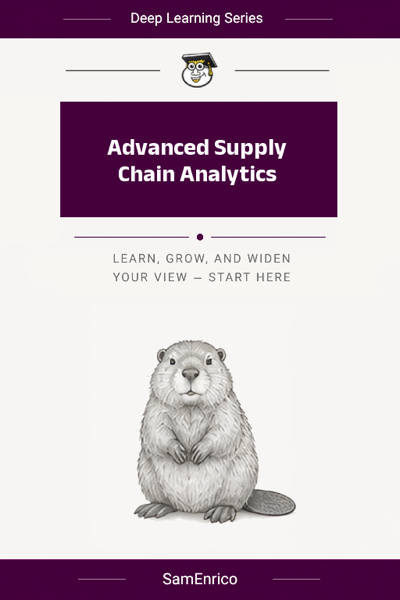
Advanced Supply Chain Analytics eBook
A Coursebook on Advanced Supply Chain Analytics
by Mccoy Isabel
A Coursebook on Advanced Supply Chain Analytics
Formats
Free sample
Chapter 1: The Dashboard Lie–- Every morning, Maria Chen, a supply chain director for a mid-sized consumer goods company, opens her laptop to a dashboard with thirty-seven glowing green metrics. On-time delivery: 94%. Inventory turns: 6.2. Forecast accuracy: 83%. Her boss calls it a “mature analytics operation.” Her team calls it “the lie.” Because Maria knows — and her team knows even more deeply — that those thirty-seven green lights have never once prevented a crisis.
They have never predicted a supplier bankruptcy. They have never stopped a warehouse from running out of a top-selling SKU during peak season. They have never, in five years, told her what to do.Maria’s problem is not a lack of data. Her company has data streaming from ERP systems, warehouse management software, transportation logs, and customer portals. Her problem is not a lack of dashboards.
Her company has hundreds of them, built in Tableau, Power BI, and Excel, each one more colorful than the last. Her problem is that she is drowning in descriptive analytics while her competitors are sailing with predictive and prescriptive intelligence. She has a rearview mirror the size of a billboard. What she needs is a GPS.This is the state of supply chain analytics in most organizations today. According to a 2024 survey by Gartner, 87% of supply chain leaders rate analytics as a “critical priority,” yet only 28% believe their analytics capabilities are “mature.” The gap between reporting and intelligence has never been wider.
This chapter exists to close that gap. It will redefine what you thought you knew about analytics, dismantle the false comfort of dashboard metrics, and build the conceptual foundation for everything that follows in this book.The Analytics Continuum: From Gravestones to GPSBefore you can practice advanced supply chain analytics, you must understand one simple truth: not all analytics are created equal. The industry has settled on a four-level framework that describes how data becomes value. Think of it as a ladder, or better yet, as a progression from looking backward to moving forward.Level 1: Descriptive Analytics — What happened?This is Maria’s dashboard. Descriptive analytics summarize historical data.
Last month’s on-time delivery percentage. Last quarter’s inventory turnover. Yesterday’s warehouse throughput. Descriptive analytics answer factual, backward-looking questions. They are essential.
You cannot manage what you do not measure. But descriptive analytics are the gravestone — they tell you what died, not why, and certainly not how to prevent the next death.Level 2: Diagnostic Analytics — Why did it happen?Diagnostic analytics drill into causality. Why did on-time delivery drop from 94% to 87% last week? Why did inventory turns accelerate in one region but decelerate in another? Diagnostic methods include root cause analysis, correlation testing, and decision trees.
They are the autopsy report — more useful than the gravestone, but still looking at the corpse.Level 3: Predictive Analytics — What will happen?Predictive analytics forecast future states. What will demand be for SKU 447 next month? Which suppliers are likely to experience disruption in the next quarter? Predictive methods include time-series forecasting, regression, machine learning, and Monte Carlo simulation. They are the weather report — not perfect, but infinitely more useful than knowing yesterday’s temperature when deciding whether to carry an umbrella tomorrow.Level 4: Prescriptive Analytics — What should we do?Prescriptive analytics recommend actions.
Given the demand forecast, how much inventory should we hold? Given traffic patterns and delivery windows, which routes should our trucks take? Prescriptive methods include optimization, heuristics, and simulation-based what-if analysis. They are the GPS — telling you not just where traffic is, but which route to take to avoid it.Here is the hard truth that most books and consultants will not tell you: most organizations never get past Level 1. They build dashboards.
They call themselves “data-driven.” And then they wonder why their competitors consistently outperform them during disruptions.This book will take you from Level 1 to Level 4. But the journey requires unlearning as much as learning. And the first thing you must unlearn is the dashboard lie.The Dashboard Lie: Why Being Informed Is Not Being Intelligent Let me be provocative: most supply chain dashboards are not just useless — they are dangerous. Here is why.A dashboard tells you what happened. That is all.
It cannot tell you why it happened. It cannot tell you what will happen next. And it absolutely cannot tell you what to do about it. Yet executives sit in Monday morning meetings, staring at dashboards, and make decisions as if the dashboard has spoken. This is the dashboard lie: the illusion that historical reporting equals decision intelligence.Consider a real example.
A large retailer noticed that inventory turns had declined from 5.2 to 4.8 over six months. The dashboard was clear. The metric was red. The team spent three weeks investigating. They discovered that a single product category — seasonal patio furniture — was driving the entire decline.
Turns had dropped from 6.0 to 3.5 in that category. Why? Because the buyer had over-ordered ahead of a predicted hot summer that never arrived. The dashboard had shown the symptom (lower turns) but not the cause (over-ordering), the prediction (next summer’s demand), or the prescription (adjust order quantities and mark down existing inventory).By the time they completed their investigation, the patio furniture had sat through the entire summer and was now headed to clearance. The dashboard had cost them three weeks of decision time.
A predictive model would have flagged the over-ordering in real time. A prescriptive model would have recommended markdowns before the season ended.The dashboard lie persists because descriptive analytics are easy. They require only data and basic visualization skills. Predictive and prescriptive analytics require statistics, optimization, and computational thinking. Most supply chain organizations have invested in the former while neglecting the latter.
This book exists to correct that imbalance.The Three Organizational Barriers to Advanced Analytics Knowing the analytics continuum is not enough. You must also understand why your organization is stuck at Level 1. After studying dozens of supply chain transformations, I have identified three recurring barriers that no software vendor will admit exists.Barrier 1: The Data Silo Fallacy Most companies believe their problem is a lack of data. They are wrong. Their problem is a lack of integrated, clean, accessible data.
Supply chain data lives in ERP systems (SAP, Oracle), warehouse systems (Manhattan, Blue Yonder), transportation systems (Mercury Gate, TMS), and customer portals (EDI, APIs). These systems rarely talk to each other. The ERP knows what was ordered. The WMS knows what was picked. The TMS knows what was delivered.
But connecting these three facts for a single order requires manual effort in most organizations.The data silo fallacy is the belief that buying more software will solve the integration problem. It will not. Integration is an organizational and architectural challenge, not a procurement exercise. Chapter 3 of this book provides a practical framework for building a data pipeline that actually works. For now, understand this: you have enough data.
You just cannot access it.Barrier 2: The Skills Chasm Supply chain professionals know supply chains. Data scientists know algorithms. These two groups rarely overlap, and they rarely speak the same language. The supply chain manager asks, “Why did my fill rate drop?” The data scientist returns a twenty-page report on random forest hyperparameters. Neither is…
This is the end of the free sample. Get the eBook to keep going. Buy now
About this book
Details
- Author
- Mccoy Isabel
- Publisher
- SamEnrico
- Language
- English
- Genre
- Non-Fiction, Informative, Educational
- Released
- 2026-06-02
- Pages (approx.)
- 159
- Available as
- eBook, Audiobook

Read better in the ZLOADR app
Your eBooks on your phone or tablet. Sign in with your SamEnrico account and start reading.
More by Mccoy Isabel
 Workaholism in TeachingMccoy Isabel$11.99
 Sleep Deprivation Anger LinkMccoy Isabel$11.99
 Self Esteem for Gig Economy WorkersMccoy Isabel$11.99
 Cameron World BuilderMccoy Isabel$11.99
 Elizabeth I's Taxation HandbookMccoy Isabel$11.99
 Anger Management for Restaurant StaffMccoy Isabel$11.99
 ESG Rating Upgrade PremiumMccoy Isabel$11.99
 RV Emergency Preparedness GuideMccoy Isabel$11.99
 Startup Burnout SurvivalMccoy Isabel$11.99
 Silk Road to Empire: The Untold Story of the Spice Traders Who Shaped the WorldMccoy Isabel$11.99
 The Invisible Shield: How a Forgotten Inventor Saved Millions from RadiationMccoy Isabel$11.99
 The Mineral Guide to Zinc-melanteriteMccoy Isabel$11.99
You may also like
 Hong Kong Handover 1997Dunn Johnnie$11.99
 Zumba For Postnatal Recovery CourseNeal Christian$11.99
 Zumba for BeginnersLadner Nikia$11.99
 YouTube Comment Mining GuideHumes Pandora$12.99
 Worry Box MeditationCarlin Rudy$11.99
 Workplace Stress MeditationNguyen Lynn$11.99
 Workplace Stress and Sleep RepairHawley Ivory$11.99
 Workplace Perfectionism CureDelaney Jeffry$11.99
 Workplace Injustice Anger GuideWallen Isabelle$11.99
 Work Addiction and Burnout LinkGreenwood Ester$11.99
 Women in Yoga and WellnessBeattie Galina$11.99
 Women in Stand Up ComedyChun Evangeline$11.99