
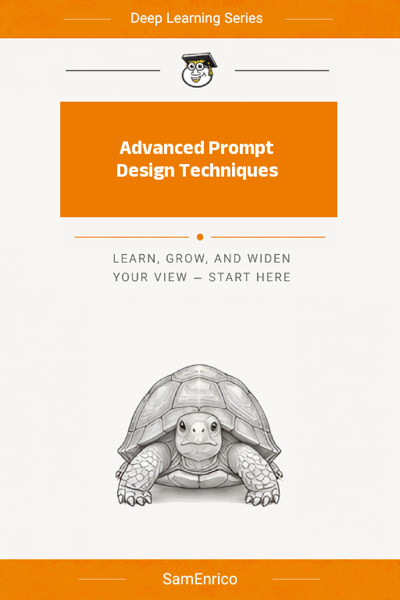
Non-FictionInformativeEducational
Advanced Prompt Design Techniques eBook
A Coursebook on Advanced Prompt Design Techniques
by Gagne Genny
A Coursebook on Advanced Prompt Design Techniques
Formats
Free sample
Chapter 1: The Probabilistic Mirror--–- You sit before a blank screen, fingers hovering over the keyboard. You have a question—something about market trends, a coding problem, a legal document to summarize. You type your query with the same casual confidence you would use when asking a colleague. The model responds. It is eloquent, confident, and utterly convincing.
But sometimes—just often enough to be dangerous—it is wrong in ways that feel almost deliberate. Not wrong like a typo or a miscalculation. Wrong like a dream that makes perfect sense until you wake up.This is not a bug. This is the mirror reflecting its own nature.Before you can design advanced prompts, you must understand what you are actually talking to. The vast majority of prompt engineering guides skip this foundational step.
They hand you templates and tricks without explaining why those templates work or—more critically—why they sometimes fail catastrophically. This chapter dismantles the machine. Not at the level of circuits or CUDA cores, but at the level of ideas: tokenization, embeddings, attention, and the inescapable mathematics of probability that governs everything the model does.By the end of this chapter, you will stop seeing LLMs as "smart" or "stupid," "creative" or "rigid." You will see them for what they are: high-dimensional probability calculators that simulate understanding by predicting the next most plausible token in a sequence. And with that clarity, you will begin to think like an architect rather than a user.The Anthropomorphic Trap We are built to anthropomorphize. Evolution wired us to detect agency, intention, and consciousness in anything that moves or speaks.
When a chatbot says "I think you're right," we instinctively feel that there is an "I" doing the thinking. There is not. There are vectors, weights, and the statistical residue of billions of human documents.This is not merely philosophical pedantry. It is the single greatest source of failed prompts.Consider two approaches to the same task. Approach A: "You are a helpful assistant.
Please summarize this document." Approach B: "Act as a summarization engine with the following constraints: output exactly three sentences, each sentence must begin with a verb, and no sentence may exceed 20 words. The document follows after the delimiter ---." The first approach treats the model as a person who understands helpfulness. The second treats the model as a constrained optimization problem.The second approach wins. Not because the model dislikes being helpful, but because the probabilistic machinery responds to explicit boundaries in ways it cannot respond to vague social cues. The model has no subjective experience of helpfulness.
It has patterns associated with the token sequence "You are a helpful assistant" and a very different set of patterns associated with "output exactly three sentences."This chapter teaches you to see through the anthropomorphic veil. Every time you catch yourself thinking "the model wants," "the model understands," or "the model is confused," you will learn to replace that with "the probability distribution is weighted toward," "the embedding similarity is high for," or "the attention mechanism has drifted."Tokenization: The First Cut Before the model can do anything with your prompt, it must perform an act of violence: it must cut your text into pieces. These pieces are called tokens.Tokenization sounds mundane. It is anything but. The way a model splits text determines what it can and cannot "see." A token is not a word, not a character, and not a syllable.
It is a variable-length chunk that the model's training optimized for efficiency. "The" is often one token. "Unbelievable" might be three: "Un," "belie," "vable." A period with a space after it is one token. A period without a space is another.Here is why this matters for prompt design. If you ask the model to "count the number of words in this sentence," you have already introduced a fundamental ambiguity.
The model does not know what a "word" is in the way you do. It knows tokens. A word like "don't" might be one token or two, depending on the tokenizer. The model's training data contained examples of humans counting "words," but those examples themselves were inconsistent.The practical implication: when precision matters, avoid human-centric units. Do not ask for "the third word." Ask for "the token sequence between the third and fourth spaces." Do not ask for "a 100-word summary." Ask for "a summary of approximately 75 tokens" (since tokens and words have a rough ratio of 1.3:1 in English).More insidiously, tokenization creates boundary effects that can break prompts in unpredictable ways.
Consider a prompt that asks the model to "ignore everything after the marker END." If "END" is tokenized as a single token, the model can recognize it cleanly. But if your prompt contains "END." (with a period), the tokenizer might produce ["END", "."]—two tokens. The model's attention mechanism might pattern-match on the single token "END" but miss the period-separated version. This is why advanced prompt designers use explicit delimiters like ---, ####, or XML tags. These sequences are designed to be tokenized as predictable multi-token patterns that the model's training has seen millions of times.Key insight: The model does not read.
It tokenizes. Design your prompts for the tokenizer, not for the human eye.Embeddings: Where Meaning Becomes Math Once the prompt is tokenized, each token is mapped to a vector—a list of floating-point numbers, typically hundreds or thousands of dimensions long. This vector is called an embedding. The embedding space is the true habitat of the model's "understanding."Here is the revolutionary idea: in this high-dimensional space, semantic relationships become geometric relationships. The vector for "king" minus the vector for "man" plus the vector for "woman" gets you close to the vector for "queen." "Paris" minus "France" plus "Italy" gets you close to "Rome." These are not metaphors.
The model's training actually produces these arithmetic relationships because the statistical patterns in human text encode them.For prompt design, embeddings explain why analogies work and why they fail. When you give the model an example of a desired output, you are not teaching it a rule. You are placing a point in embedding space and saying, "stay near this region." The model's few-shot learning capability—its ability to generalize from examples—emerges from the geometry of the embedding space. Examples that are close in embedding space to the target domain produce strong generalization. Examples that are far away produce weak or misleading generalization.This is why a prompt that says "summarize this scientific paper" followed by an example summary of a news article will underperform a prompt that provides an example summary of a different scientific paper.
The embedding distance between "news article summary" and "scientific paper summary" is small but significant. That distance translates directly into degraded performance.Practical rule: When selecting few-shot examples, prioritize semantic similarity over surface similarity. Two documents about quantum physics, even if one is a textbook and one is a blog post, share embedding proximity. A physics textbook and a chemistry textbook are farther apart. A physics textbook and a recipe are galaxies apart.The Transformer Architecture: Attention Is All You Need The transformer architecture, introduced in the 2017 paper "Attention Is All You Need," is the engine…
This is the end of the free sample. Get the eBook to keep going. Buy now
About this book
Details
- Author
- Gagne Genny
- Publisher
- SamEnrico
- Language
- English
- Genre
- Non-Fiction, Informative, Educational
- Released
- 2026-06-02
- Pages (approx.)
- 144
- Available as
- eBook, Audiobook

Read better in the ZLOADR app
Your eBooks on your phone or tablet. Sign in with your SamEnrico account and start reading.
More by Gagne Genny
 Empowerment AssessmentGagne Genny$11.99
 The Gacy Copycat KillersGagne Genny$11.99
 Benzo and Alcohol ComboGagne Genny$11.99
 The Sobriety Mindfulness PracticeGagne Genny$11.99
 The Protestant Fortress CitiesGagne Genny$11.99
 FCPA Charitable Donation CasesGagne Genny$11.99
 TM For Chronic FatigueGagne Genny$11.99
 Chunking Cheat SheetGagne Genny$11.99
 Workplace People Pleaser RecoveryGagne Genny$11.99
 The Last Stand of the Keystone RebelsGagne Genny$11.99
 The Forgotten War: The 1967 Six-Day War and the Birth of Modern Middle EastGagne Genny$11.99
 The Forgotten Pioneers of the Ice: Antarctica’s Ancient SpacekeepersGagne Genny$11.99
You may also like
 Hong Kong Handover 1997Dunn Johnnie$11.99
 Zumba For Postnatal Recovery CourseNeal Christian$11.99
 Zumba for BeginnersLadner Nikia$11.99
 YouTube Comment Mining GuideHumes Pandora$12.99
 Worry Box MeditationCarlin Rudy$11.99
 Workplace Stress MeditationNguyen Lynn$11.99
 Workplace Stress and Sleep RepairHawley Ivory$11.99
 Workplace Perfectionism CureDelaney Jeffry$11.99
 Workplace Injustice Anger GuideWallen Isabelle$11.99
 Work Addiction and Burnout LinkGreenwood Ester$11.99
 Women in Yoga and WellnessBeattie Galina$11.99
 Women in Stand Up ComedyChun Evangeline$11.99