
Non-FictionInformativeEducational
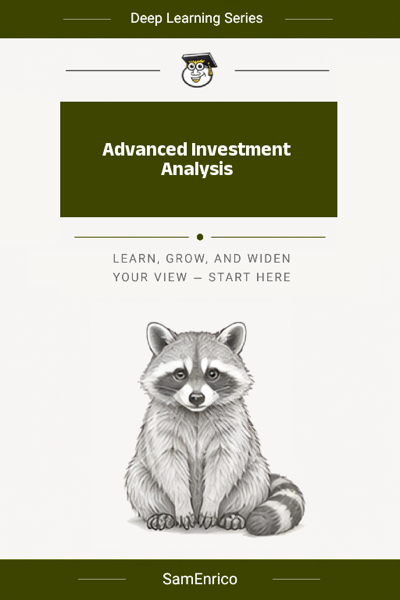
Advanced Investment Analysis
A Coursebook on Advanced Investment Analysis
by Muller Ceola
A Coursebook on Advanced Investment Analysis
Formats
About this book
Free sample
Chapter 1: The Certainty Trap...--The first lesson in advanced investment analysis is not a formula, a model, or a backtest. It is an admission: almost everything you learned as a beginner is, if not wrong, dangerously incomplete. The Capital Asset Pricing Model you memorized for your certification exam assumes investors can borrow at the risk-free rate without limit. The efficient frontier you drew in your introductory course crumbles the moment you input real-world return estimates. The “risk-free” Treasury bill you have used as a baseline for every discount rate calculation carries duration risk, reinvestment risk, and—in extreme scenarios—credit risk.This chapter is not an introduction in the conventional sense.
It is an unlearning. Before we build the multi-factor models, derivative pricing engines, and institutional asset allocation frameworks that comprise the rest of this book, we must first dismantle the foundational assumptions that fail under professional scrutiny. The certainty trap—the belief that financial models produce objective, stable, and actionable truths—is the most expensive illusion in investment management. It has caused pension funds to underestimate tail risk, endowments to overallocate to illiquid assets based on smoothed returns, and portfolio managers to confuse a low R-squared with a good hedge.Consider a concrete example from the 2008 financial crisis. In August 2007, the mean-variance optimizers at a major university endowment ran their annual asset allocation review.
Using historical volatility and correlation inputs from the preceding five years—a period of low volatility and rising correlations among risk assets—the model suggested increasing the allocation to private equity and reducing the allocation to cash. The risk-free rate in their model was the three-month Treasury bill, yielding 5.1 percent at the time. The model’s output suggested a 9.2 percent expected return with 11.4 percent volatility. By March 2009, the endowment had lost 27 percent of its value. The model was not wrong because of bad luck.
It was wrong because its assumptions—stable correlations, a truly risk-free rate, normally distributed returns, and liquid markets for all assets—were violated simultaneously.This chapter is structured as a systematic critique followed by a constructive replacement. We will examine four foundational assumptions that…
This is the end of the free sample. Get the eBook to keep going. Buy now
Contents
- Chapter 1
- Chapter 2
- Chapter 3
- Chapter 4
- Chapter 5
- Chapter 6
- Chapter 7
- Chapter 8
- Chapter 9
- Chapter 10
- Chapter 11
- Chapter 12
Details
- Author
- Muller Ceola
- Publisher
- SamEnrico
- Language
- English
- Genre
- Non-Fiction, Informative, Educational
- Released
- 2026-05-11
- Pages (approx.)
- 153
- Available as
- eBook, Audiobook

Read better in the ZLOADR app
Your eBooks on your phone or tablet. Sign in with your SamEnrico account and start reading.
More by Muller Ceola
 Gacy's Co conspiratorsMuller Ceola$11.99
 Empowerment for ExecutivesMuller Ceola$11.99
 Cocaine Recovery for AthletesMuller Ceola$11.99
 FCPA Gifts Travel EnforcementMuller Ceola$11.99
 Autism Workplace AccommodationsMuller Ceola$11.99
 Overcoming Cam Site AddictionMuller Ceola$11.99
 The Catholic Inquisitors ProfilesMuller Ceola$11.99
 Pattern Recognition ResearchMuller Ceola$11.99
 TM For Expectant MothersMuller Ceola$11.99
 Paddle to the Past: The Prehistoric Canoe Pioneers of EuropeMuller Ceola$11.99
 Crown of the Forgotten: The Secret Coronation of a Lost QueenMuller Ceola$11.99
 The Ghost of Operation AzorianMuller Ceola$11.99
You may also like
 Hong Kong Handover 1997Dunn Johnnie$11.99
 Zumba For Postnatal Recovery CourseNeal Christian$11.99
 Zumba for BeginnersLadner Nikia$11.99
 YouTube Comment Mining GuideHumes Pandora$12.99
 Worry Box MeditationCarlin Rudy$11.99
 Workplace Stress MeditationNguyen Lynn$11.99
 Workplace Stress and Sleep RepairHawley Ivory$11.99
 Workplace Perfectionism CureDelaney Jeffry$11.99
 Workplace Injustice Anger GuideWallen Isabelle$11.99
 Work Addiction and Burnout LinkGreenwood Ester$11.99
 Women in Yoga and WellnessBeattie Galina$11.99
 Women in Stand Up ComedyChun Evangeline$11.99