
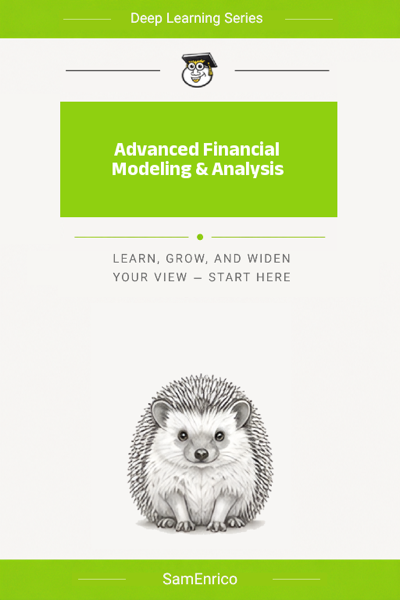
Non-FictionInformativeEducational
Advanced Financial Modeling & Analysis eBook
A Coursebook on Advanced Financial Modeling & Anal
A Coursebook on Advanced Financial Modeling & Analysis
Formats
Free sample
Chapter 1: The Million-Dollar Typo...--–- The email arrived at 4:47 PM on a Friday. The subject line read: "Q3 Forecast — Final for Board." The attached Excel file was pristine. Every cell was formatted correctly. Every formula summed perfectly. Every chart was color-coordinated to match the company's branding.
The analyst who built it had worked 70 hours that week. The FP&A director approved it without a second glance. The CFO presented it to the board on Monday morning. The board approved a $50 million capital expenditure based on the forecast.Six weeks later, the company missed its numbers by $47 million.The model was not wrong because of bad math. The math was flawless.
The model was wrong because of bad design. The analyst had hard-coded a growth assumption of 8% in twelve different places across seven worksheets. When the market shifted to 5%, they changed it in eleven of those places. They missed one. That single cell, buried in a tab named "Assumptions_v3_FINAL(2).xlsx," continued to project 8% growth while the rest of the model assumed 5%.
The mismatch created a $47 million phantom revenue stream that never materialized.This is not a cautionary tale. This is Tuesday in corporate finance.Every day, somewhere in the world, a financial model makes a catastrophic error that costs millions. The error is rarely complex. It is almost never an advanced mathematical mistake. It is almost always a failure of design, structure, and discipline.
The modeler knew how to build a DCF. They knew how to calculate WACC. They knew how to project cash flows. They did not know how to build a model that could not break.This chapter changes that.You will learn why traditional financial models are structurally fragile. You will understand the difference between a "static budget" that is obsolete before it is printed and an "adaptive model" that lives and breathes with the business.
You will master the three-layer architecture that separates inputs, calculations, and outputs—a discipline that eliminates hidden errors and makes models auditable. You will build a driver-based rolling forecast that updates automatically when assumptions change. And you will leave with a validation checklist that would have caught that $47 million error before the board ever saw it.By the end of this chapter, you will no longer be a spreadsheet operator. You will be an adaptive modeler. And you will never again send a model to a board meeting without knowing, with absolute certainty, that it cannot break in the way that broke that Friday afternoon forecast.The Anatomy of a Broken Model Let us dissect the corpse of that $47 million forecast.
It died from five distinct diseases, each common, each preventable, and each directly caused by poor model design.Disease One: Hard-Coded Constants. The analyst typed "0.08" directly into twelve different formulas across seven worksheets. This is the financial modeling equivalent of using a saw to cut a board while balancing it on your knee. It works until it doesn't. When the assumption needed to change, the analyst had to find every instance manually.
Manual processes produce errors. Errors produce bad decisions. Bad decisions produce fired analysts.Disease Two: No Separation of Concerns. The model intermingled inputs, calculations, and outputs on the same sheets. Assumptions lived next to formulas.
Formulas lived next to charts. A change intended for an input value accidentally overwrote a calculation cell. The formula disappeared. The number stayed the same—a zombie cell that appeared alive but was dead to future updates.Disease Three: Fragmented Logic. The same calculation appeared in multiple places.
Revenue was calculated once on the income statement, again on the cash flow worksheet, and a third time in a summary dashboard. When the revenue formula needed adjustment, the analyst had to remember all three locations. They remembered two. The third became a silent time bomb.Disease Four: No Error Detection. The model had no built-in checks.
The balance sheet did not automatically verify that assets equaled liabilities plus equity. The cash flow statement did not confirm that ending cash matched the balance sheet. The model was mathematically correct only by accident, not by design.Disease Five: Immutable Time Horizon. The model projected exactly five years. Adding a sixth year required inserting columns, copying formulas, checking references, and praying nothing broke.
This friction discouraged rolling forecasts. The model became static while the business moved.These five diseases are not rare. They are the default state of most financial models built in corporations today. They are accepted as normal because everyone has seen them. But normal is not the same as correct.
And correct is not the same as excellent.The Static Budget Lie Before we build the solution, we must understand the enemy. The enemy is the Static Budget.The Static Budget is a fixed financial plan created once per year, usually in a three-month cycle of negotiation and political theater. It projects revenues, costs, and profits for the next twelve months, often down to the month or week. It is approved by leadership, loaded into the ERP system, and treated as truth for the entire fiscal year.The Static Budget is also a lie.It is not a lie in the sense of intentional deception. It is a lie in the sense of structural impossibility.
No business can predict twelve months of performance with precision. Markets shift. Competitors react. Supply chains break. Customers change their minds.
Interest rates move. Yet the Static Budget freezes a single set of assumptions in time and forces the organization to manage against a fictional future.The damage from Static Budgets is well documented. They encourage sandbagging (managers hide potential upside to make targets easier to hit). They discourage agility (updating the budget is so painful that teams wait for the annual cycle). They create perverse incentives (spending the remaining budget in December to avoid cuts next year).
They reward forecast accuracy over business performance (hitting the wrong target is celebrated; missing it while adapting to market realities is punished).Consider the alternative. Imagine a forecast that updates every month, automatically extending its horizon to always show the next eighteen months. Imagine assumptions that live in one place and propagate everywhere instantly. Imagine a model that welcomes new data daily and recalibrates its projections without manual intervention. Imagine a budget that is never finalized because it is never finished—it is always becoming more accurate.This is the Adaptive Model.The Adaptive Model Defined The Adaptive Model is a financial forecasting system built on four foundational principles:Principle One: Rolling Time Horizons.
The Adaptive Model does not end. It projects forward a fixed number of periods (typically 12-24 months) and automatically adds a new period as each current period completes. If you forecast 18 months ahead, January's forecast covers February through July of next year. When February ends, the forecast rolls forward to cover March through August. The horizon stays constant; the periods advance.Principle Two: Driver-Based Logic.
The Adaptive Model does not project line items directly. Instead, it projects a small set of operational drivers—units sold, price per unit, cost per unit, headcount, days sales outstanding—and calculates financial statements from these drivers. If units sold increase by 10%, revenue increases by 10%, variable costs increase proportionally, working…
This is the end of the free sample. Get the eBook to keep going. Buy now
About this book
Details
- Author
- Wolford Cecille
- Publisher
- SamEnrico
- Language
- English
- Genre
- Non-Fiction, Informative, Educational
- Released
- 2026-05-11
- Pages (approx.)
- 156
- Available as
- eBook, Audiobook

Read better in the ZLOADR app
Your eBooks on your phone or tablet. Sign in with your SamEnrico account and start reading.
More by Wolford Cecille
 The Spending Accountability PartnerWolford Cecille$11.99
 Parent Hospital Stay GuideWolford Cecille$11.99
 Self Hypnosis For NBA Free ThrowsWolford Cecille$11.99
 Chris Rock TamborineWolford Cecille$11.99
 Infidelity Dream MeaningWolford Cecille$11.99
 The Networking Pivot After LayoffWolford Cecille$11.99
 The Gap Year Money StressWolford Cecille$11.99
 Teaching Anxiety MeditationWolford Cecille$11.99
 Anapanasati in Palliative CareWolford Cecille$11.99
 The Royal Affair: Queen Victoria and Her Forbidden LoveWolford Cecille$11.99
 Anansi’s Double Game: The Spider’s Shadow WarWolford Cecille$11.99
 The Great African Music Heist: How a Band of Rebels Stole Country's SoulWolford Cecille$11.99
You may also like
 Hong Kong Handover 1997Dunn Johnnie$11.99
 Zumba For Postnatal Recovery CourseNeal Christian$11.99
 Zumba for BeginnersLadner Nikia$11.99
 YouTube Comment Mining GuideHumes Pandora$12.99
 Worry Box MeditationCarlin Rudy$11.99
 Workplace Stress MeditationNguyen Lynn$11.99
 Workplace Stress and Sleep RepairHawley Ivory$11.99
 Workplace Perfectionism CureDelaney Jeffry$11.99
 Workplace Injustice Anger GuideWallen Isabelle$11.99
 Work Addiction and Burnout LinkGreenwood Ester$11.99
 Women in Yoga and WellnessBeattie Galina$11.99
 Women in Stand Up ComedyChun Evangeline$11.99