
Non-FictionInformativeEducational
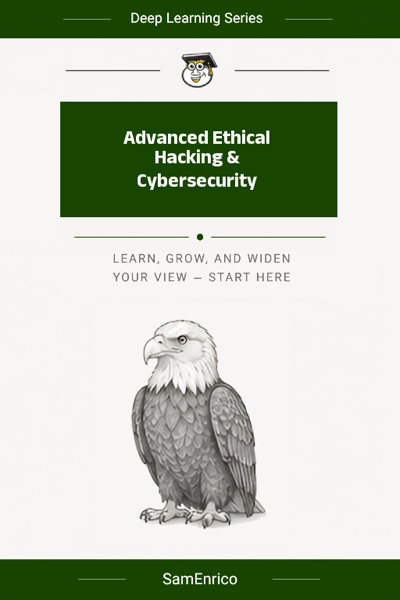
Advanced Ethical Hacking & Cybersecurity eBook
A Coursebook on Advanced Ethical Hacking & Cyberse
A Coursebook on Advanced Ethical Hacking & Cybersecurity
Formats
Free sample
Chapter 1: The Ethical Edge...–- The fluorescent lights of the corporate security operations center hummed monotonously as Sarah, a freshly minted penetration tester, stared at her screen. She had run every automated scanner in her arsenal—Nessus, Open VAS, Nikto—against the target e-commerce platform. The results were pristine. Zero critical vulnerabilities. Her report was nearly complete, destined to declare the system "secure." But something gnawed at her.
Something the scanners couldn't see. She picked up her phone, dialed the client's project manager, and asked a simple question: "What's the name of your lead developer?" Thirty minutes later, after finding the developer's personal blog, identifying his favorite pizza place from a social media post, and crafting a convincing voicemail to the help desk, Sarah had a domain administrator's password hash. No scanner would have found that path. The system wasn't insecure because of a missing patch or a misconfigured firewall. It was insecure because of thinking—the gap between what automated tools can detect and what an adaptive attacker can achieve.
This book exists to bridge that gap.The Myth of the Automated Penetration Test The cybersecurity industry has sold a dangerous lie: that running the right software makes you secure. Vendors promise that their vulnerability scanners will "find everything." Compliance frameworks suggest that checking boxes equals safety. But ask any organization that has suffered a breach—from Target to Equifax to Colonial Pipeline—whether their scanners had flagged the entry point. In almost every case, the answer is no. The breach didn't come from a missing patch that a scanner would have found.
It came from a logic flaw, a misconfiguration that seemed benign, a social engineering target, or a chain of seemingly low-risk issues that no single tool could connect.This chapter establishes the philosophical, legal, and environmental foundation for everything that follows. It is the most important chapter in this book because it reorients how you think about security testing. Without this mindset, the technical skills you learn in subsequent chapters become dangerous—either because you will rely too heavily on automation (missing the real vulnerabilities) or because you will operate without the ethical and legal boundaries that separate a security professional from a criminal.What "Advanced" Actually Means Before we write a single line of code or launch a single scan, we must define what makes this book "advanced." The answer is not the difficulty of the techniques. The answer is the approach.A beginner runs tools. An intermediate tester understands what the tools do.
An advanced ethical hacker knows when not to run tools, what the tools miss, and how to think like an adversary who has no constraints. Advanced testing is not about memorizing every exploit. It is about structured creativity—the ability to generate novel attack paths that no scanner would ever discover.Consider this analogy. A beginner cook follows a recipe exactly. An intermediate cook understands why the recipe works—why you brown the meat before adding liquid, why you rest the dough.
An advanced chef looks at a refrigerator of random ingredients and creates a dish that has never existed before, adapting to constraints, substituting missing components, and anticipating how flavors interact. Ethical hacking is the same. The adversary does not have a recipe. They have a goal—access, data, money, disruption—and they will adapt. Your job as an ethical hacker is to think like that adversary before they arrive.This book will teach you tools.
It will teach you Metasploit, Burp Suite, Nmap, Hashcat, Cobalt Strike, Ghidra, and dozens more. But the tools are the ingredients. The methodology and mindset are the kitchen. Most cybersecurity books are cookbooks—collections of recipes. This is a coursebook on how to build your own kitchen and design your own recipes.The Three Tiers of Security Assessment One of the most common sources of confusion in cybersecurity is the difference between three related but fundamentally distinct activities: vulnerability assessments, penetration tests, and Red Team exercises.
Understanding these differences is not academic pedantry. It determines what you promise to a client, what you deliver, how you bill, how you write your report, and—most critically—how much legal liability you assume.Vulnerability Assessment: The Baseline A vulnerability assessment is exactly what it sounds like: an inventory of potential weaknesses. You run scanners, review configurations, check patch levels, and produce a list of findings. You do not exploit anything. You do not prove impact.
You simply identify what might be a problem.Vulnerability assessments are appropriate for:Organizations establishing a baseline security posture Compliance requirements that mandate regular scanning (PCI DSS, HIPAA)Environments where exploitation would cause unacceptable disruption Early-stage security programs with limited maturity The output is a list of CVEs (Common Vulnerabilities and Exposures) with severity scores, sorted by risk. The limitation is obvious: many "critical" findings in a scanner are not exploitable in practice, and many exploitable flaws appear as "informational" or are missed entirely. Scanners cannot chain vulnerabilities. They cannot understand business logic. They cannot test authentication bypasses that require understanding how the application should behave.
A vulnerability assessment tells you what is supposed to be vulnerable. It does not tell you what an attacker can actually do.Penetration Test: Proving Impact A penetration test goes a step further. You actively exploit vulnerabilities to demonstrate impact. You do not just report that a server is missing a patch; you prove that you can execute remote code and read sensitive files. You do not just note that a password policy is weak; you crack hashes and log in as a domain user.A penetration test answers the question: "Given these vulnerabilities, what can an attacker actually achieve?" The answer might be "access to a low-privilege user account with no sensitive data" (low impact) or "full domain administrator compromise with access to customer PII" (critical impact).
The difference determines whether the client spends 10,000onremediationor10,000 on remediation or 10,000onremediationor1 million.Penetration tests are appropriate for:Organizations that have passed vulnerability assessments and want to validate controls Applications or networks that handle sensitive data (healthcare, financial, government)Pre-audit validation (e.g., before a PCI DSS assessment)Insurance requirements for cyber liability policies The output is a report that includes proof-of-concept exploits, screenshots of compromised systems, and a clear chain of attack. The critical distinction is exploitation. You do not stop at identification. You break in.Red Team Exercise: Testing Detection and Response A Red Team exercise is fundamentally different. The goal is not to find as many vulnerabilities as possible.
The goal is to test the organization's detection and response capabilities—how quickly they identify an active intrusion, how effectively they contain it, how well their incident response plan works when real pressure is applied.In a Red Team exercise, you act like a real adversary. You use evasion techniques. You move slowly. You attempt to avoid triggering alerts. You might spend days or weeks on a single engagement, mimicking the tactics, techniques, and procedures (TTPs) of known threat actors like APT29 (Cozy Bear) or FIN7.
The client's security operations center (SOC) knows you are operating (usually within a defined timeframe and scope), but they do not know when you will start or what you…
This is the end of the free sample. Get the eBook to keep going. Buy now
About this book
Details
- Author
- Sandlin Sheilah
- Publisher
- SamEnrico
- Language
- English
- Genre
- Non-Fiction, Informative, Educational
- Released
- 2026-05-07
- Pages (approx.)
- 153
- Available as
- eBook, Audiobook

Read better in the ZLOADR app
Your eBooks on your phone or tablet. Sign in with your SamEnrico account and start reading.
More by Sandlin Sheilah
 Dream of Dead PeopleSandlin Sheilah$11.99
 Social Media Shop AddictionSandlin Sheilah$11.99
 Self Hypnosis For Darts AccuracySandlin Sheilah$11.99
 Anapanasati for AnxietySandlin Sheilah$11.99
 Financial Stress And ParentsSandlin Sheilah$11.99
 Building Relationships With VendorsSandlin Sheilah$11.99
 Eritrean Conscript EscapeSandlin Sheilah$11.99
 Elder Parent Caregiving GuideSandlin Sheilah$11.99
 Bridge Crossing AnxietySandlin Sheilah$11.99
 Pyramus and Thisbe: The Wall That Could Not DivideSandlin Sheilah$11.99
 The Silent Archer: Empress Wu Zetian's Secret MarksmanSandlin Sheilah$11.99
 How to Produce a Bicycle Crank and ChainwheelSandlin Sheilah$11.99
You may also like
 Hong Kong Handover 1997Dunn Johnnie$11.99
 Zumba For Postnatal Recovery CourseNeal Christian$11.99
 Zumba for BeginnersLadner Nikia$11.99
 YouTube Comment Mining GuideHumes Pandora$12.99
 Worry Box MeditationCarlin Rudy$11.99
 Workplace Stress MeditationNguyen Lynn$11.99
 Workplace Stress and Sleep RepairHawley Ivory$11.99
 Workplace Perfectionism CureDelaney Jeffry$11.99
 Workplace Injustice Anger GuideWallen Isabelle$11.99
 Work Addiction and Burnout LinkGreenwood Ester$11.99
 Women in Yoga and WellnessBeattie Galina$11.99
 Women in Stand Up ComedyChun Evangeline$11.99