
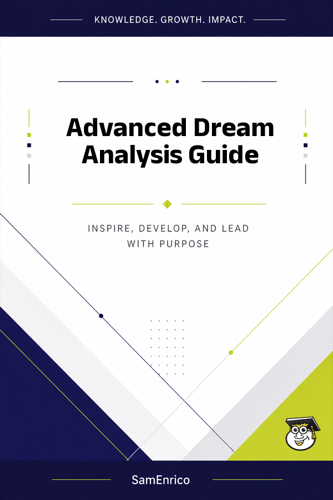
Non-FictionSelf-HelpAdvanced Dreaming
Advanced Dream Analysis Guide eBook
Deepen your understanding of dream symbolism with
Deepen your understanding of dream symbolism with this journaling workbook.
Formats
Free sample
Chapter 1: The Vanishing Key...--–- You wake up gasping. The dream was vivid—a house on fire, a conversation with a dead relative, a chase through endless hallways. You know it meant something. You can feel the residue of meaning clinging to your chest like morning humidity. But by the time you reach the bathroom, the details are already dissolving.
By the time you pour your coffee, only the emotion remains. By the time you sit down to journal—if you journal at all—all that is left is a ghost: "I had a dream about something. It was important. I think."This is not a personal failing. It is a biological fact, and understanding this fact is the first and most essential step in advanced dream analysis.
You cannot analyze what you cannot remember. You cannot integrate what has evaporated. And you cannot build a relationship with your unconscious if the letters it sends you turn to blank paper before you can read them.This chapter exists to solve that single problem: the vanishing of the dream. By the time you finish these pages and complete the workbook exercises that follow, you will have moved from forgetting ninety percent of your dreams to remembering multiple dreams per night with vivid, actionable detail. You will have built the foundation upon which every other technique in this book rests.
Without the raw material of the remembered dream, all analysis is guesswork. With it, you become a collector of your own unconscious data.The Forgetting Curve and the Dream The science of memory is unforgiving. In 1885, German psychologist Hermann Ebbinghaus described what he called the "forgetting curve"—a mathematical depiction of how quickly learned information disappears from the brain when no effort is made to retain it. His research showed that within one hour, humans forget approximately fifty percent of new information. Within twenty-four hours, that number climbs to seventy percent.
But dreams decay far faster than ordinary memories.Modern sleep research has refined our understanding of why this happens. During REM (rapid eye movement) sleep—the stage during which the most vivid, narrative dreams occur—the brain operates under a radically different neurochemical regime than during wakefulness. The neurotransmitter acetylcholine, which facilitates dreaming, surges to its highest levels. But norepinephrine, a neurotransmitter critical for memory fixation and consolidation, drops to near zero. The hippocampus, your brain's primary memory-encoding structure, is partially offline during REM sleep.
This means your brain is actively generating complex, emotionally charged, narratively structured experiences while simultaneously disabling the very system required to remember them.From an evolutionary perspective, this makes sense. If you remembered every dream with perfect clarity, you would struggle to distinguish dream memories from waking memories. Your brain sacrifices dream recall for the sake of cognitive hygiene. The cost, however, is that the wisdom of your unconscious arrives in a format that your conscious mind is poorly equipped to retain.The numbers are stark. Research consistently shows that within five to ten minutes of waking, approximately fifty percent of a dream's content is lost.
Within fifteen minutes, that number reaches ninety percent. This is not a matter of effort or intelligence. The most disciplined, psychologically sophisticated person will forget their dreams at the same rate as a beginner unless they intervene with specific techniques during that narrow window of opportunity.The good news is that the window, though narrow, is also powerful. The first sixty seconds after waking are what dream researchers call the "golden minute." During this window, dream memories are still accessible to the waking brain, held in a fragile form of short-term memory that has not yet been overwritten by the demands of the day. What you do in that minute determines whether the dream survives.Most people, unfortunately, do the worst possible thing.
They lie in bed, trying to "replay" the dream in their minds, often falling back into a half-sleep that erases the memory further. Or they sit up, reach for their phone, and flood their brain with notifications, light, and language—all of which immediately overwrite the delicate trace of the dream. Or they simply roll over, assuming they will remember later, and lose the dream forever.This chapter offers a different way.The Pillow Prompt: Setting Intention Before Sleep The first intervention begins before you close your eyes. It is a technique called the Pillow Prompt, derived from decades of research into memory encoding and the reticular activating system (RAS) of the brain.The RAS is a network of neurons located in your brainstem that acts as a filter for incoming sensory information. It determines what you pay attention to and what you ignore.
When you set a specific intention before sleep—when you tell your brain, "Tonight, I want to remember my dreams"—the RAS primes itself to notice dream content as it occurs. You are not forcing your brain to do anything unnatural. You are simply telling your existing attentional system what to prioritize.The Pillow Prompt is not a vague affirmation. It is a specific, written, one-sentence instruction delivered to your unconscious in the moments before sleep. Here is how you do it:Take your workbook and turn to the Pillow Prompt page, which contains a blank line at the top of each nightly entry.
Write a single, concrete intention for the night ahead. Examples include:"Tonight, I will remember where I was going in my dream.""Tonight, I will recall the face of the person I was speaking to.""Tonight, I will remember the dominant emotion of my dream.""Tonight, I will wake up with at least one clear image from my dreams."Notice the specificity. "I want to remember my dreams" is too vague; it gives your RAS nothing concrete to filter for. "I will remember the color blue if it appears" is specific. "I will recall the name of the person I am with" is specific.
The more concrete your prompt, the more effective it becomes.Write the prompt. Then read it aloud to yourself, softly. Then place the workbook beside your bed—open to that page, pen ready—and close your eyes. Do not try to force the dream. Simply trust that you have given your unconscious an instruction.
Then sleep.The Pillow Prompt works through multiple mechanisms. First, it leverages the Zeigarnik effect, a psychological phenomenon in which unfinished tasks or open questions are remembered more readily than completed ones. By leaving your unconscious with an open instruction, you create a state of mild, productive tension that carries into sleep. Second, it establishes a ritual that tells your brain: "Dreams matter to me. This is important." The act of writing and speaking the prompt is a commitment device, a public declaration to yourself that you are serious about this work.Most people who begin using the Pillow Prompt notice results within three to five nights.
By the end of the first week, dream recall typically doubles. By the end of the second week, many users report remembering multiple dreams per night, including fragments from different REM cycles. The Pillow Prompt alone is not a complete solution, but it is the necessary precondition for everything that follows.The Golden Minute…
This is the end of the free sample. Get the eBook to keep going. Buy now
About this book
Details
- Author
- Ellison Lavona
- Publisher
- SamEnrico
- Language
- English
- Genre
- Non-Fiction, Self-Help, Advanced Dreaming
- Released
- 2026-06-07
- Pages (approx.)
- 149
- Available as
- eBook, Audiobook

Read better in the ZLOADR app
Your eBooks on your phone or tablet. Sign in with your SamEnrico account and start reading.
More by Ellison Lavona
 Mental Health Financing GuideEllison Lavona$11.99
 The Stress First Couple RuleEllison Lavona$11.99
 Emotional Release BreathingEllison Lavona$11.99
 Listening In Software Dev GuideEllison Lavona$11.99
 The Panama HatEllison Lavona$11.99
 Joyful Relationships Through GratitudeEllison Lavona$11.99
 The Sex Trafficking HotelEllison Lavona$11.99
 Jackie Robinson 42Ellison Lavona$11.99
 The Great Pine Heist: How a Lumber Baron Outsmarted the LawEllison Lavona$11.99
 Marlborough's Gambit: The War That Redrew EuropeEllison Lavona$11.99
 Mozart's Fire: The Genius Who Lit Up ViennaEllison Lavona$11.99
 Supermajority Voting DefenseEllison Lavona$12.99
You may also like
 Hong Kong Handover 1997Dunn Johnnie$11.99
 Zumba For Postnatal Recovery CourseNeal Christian$11.99
 Zumba for BeginnersLadner Nikia$11.99
 YouTube Comment Mining GuideHumes Pandora$12.99
 Worry Box MeditationCarlin Rudy$11.99
 Workplace Stress MeditationNguyen Lynn$11.99
 Workplace Stress and Sleep RepairHawley Ivory$11.99
 Workplace Perfectionism CureDelaney Jeffry$11.99
 Workplace Injustice Anger GuideWallen Isabelle$11.99
 Work Addiction and Burnout LinkGreenwood Ester$11.99
 Women in Yoga and WellnessBeattie Galina$11.99
 Women in Stand Up ComedyChun Evangeline$11.99