
Non-FictionInformativeEducational
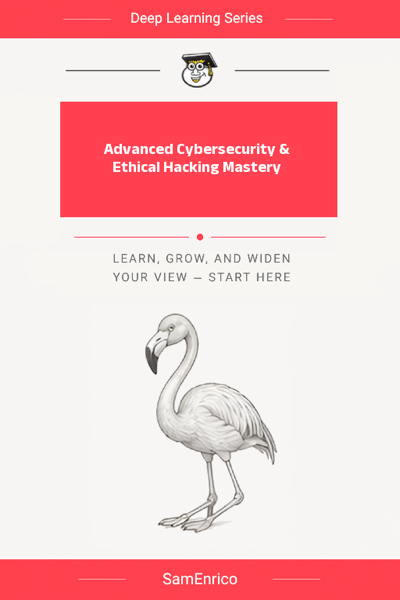
Advanced Cybersecurity & Ethical Hacking Mastery eBook
A Coursebook on Advanced Cybersecurity & Ethical H
by Toledo Sudie
A Coursebook on Advanced Cybersecurity & Ethical Hacking Mastery
Formats
Free sample
Chapter 1: The Ethical Divide...--–- The rain hadn’t stopped for three days, but Mark didn’t notice. He sat in his cramped studio apartment, the glow of three monitors painting his face in shades of blue and green. On one screen, a terminal scrolled lines of hexadecimal data. On another, a half‑finished phishing campaign waited for a final click. His phone buzzed again—his mother, for the fifth time.
He silenced it. Tonight was the night.Mark wasn’t a criminal. At least, that’s what he told himself. He was a third‑year computer science student who had discovered that the university’s grading system stored student records in an unencrypted database. For weeks, he had wrestled with the knowledge.
He could change his grades. He could sell access on the dark web. He could expose the vulnerability and become a hero. But every path carried consequences he hadn’t fully considered.Twenty miles away, Sarah, a senior penetration tester at a global security firm, was finishing her own late‑night session. She had just gained root access to a client’s critical financial server—not to steal, but to prove a point.
Her report, due in the morning, would show exactly how a single misconfigured firewall rule could lead to a seven‑figure loss. She felt no thrill, only the quiet satisfaction of a job done well. She had signed a Rules of Engagement document, a Non‑Disclosure Agreement, and a scope statement that limited her to specific IP ranges. Every keystroke was authorized, documented, and billable.Mark and Sarah possessed remarkably similar technical skills. Both could navigate a Linux file system blindfolded.
Both understood the intricacies of TCP handshakes and SQL injection. Both could write Python scripts that bypassed basic authentication. Yet one was on the verge of committing multiple felonies, while the other was building a career that commanded a six‑figure salary and the trust of Fortune 500 companies.The difference between them was not talent or intelligence. It was the ethical divide—an invisible line that separates the hacker from the cracker, the security professional from the cybercriminal. Crossing that line is rarely a single dramatic moment.
It is a series of small choices, each one nudging the actor toward either integrity or ruin.What This Chapter Will Teach You By the end of this chapter, you will understand what it truly means to be an ethical hacker. You will learn the legal frameworks that separate authorized testing from computer crime, the contracts that protect both tester and client, and the psychological traits that distinguish constructive curiosity from destructive intrusion. More importantly, you will be forced to confront your own ethical boundaries before you ever write a line of exploit code. This is not a chapter about tools or techniques. It is about identity, responsibility, and the often‑blurry line between right and wrong in the digital world.The Hacker Spectrum: From White Hat to Black Hat The popular media often portrays hackers as hooded figures typing furiously in dark rooms.
Reality is far more nuanced. The security community broadly categorizes hackers by their intent and authorization, often using the metaphor of hat colors derived from old Western films.White Hat (Ethical Hacker)A white hat hacker operates with explicit permission from the system owner. Their goal is to identify vulnerabilities so they can be fixed before malicious actors exploit them. White hats follow a strict code of conduct: they work within defined scope, respect data confidentiality, disclose findings responsibly, and never cause unnecessary damage. Sarah, from our opening story, is a white hat.
Most professional penetration testers, security consultants, and internal red team members fall into this category.Black Hat (Malicious Hacker)A black hat hacker breaks into systems without authorization. Their motives vary—financial gain, espionage, vandalism, or simply ego. They do not report vulnerabilities; they exploit them. Mark, had he chosen to alter grades or sell access, would have become a black hat. The legal consequences range from fines to decades in federal prison.Gray Hat Gray hats occupy the murky middle.
They typically discover vulnerabilities without permission but then report them to the owner—sometimes demanding a fee, sometimes acting altruistically. The classic example is someone who scans random websites, finds a SQL injection flaw, and emails the webmaster with proof. Technically, the initial scan was unauthorized, making it illegal in most jurisdictions. Yet the gray hat often believes they are helping. The law disagrees.
Many gray hats have faced prosecution despite their good intentions.Other Shades The spectrum also includes blue hats (external security contractors hired to test a system before launch), red hats (aggressive hackers who target black hats, often using illegal methods), and green hats (novices who seek mentorship but inadvertently cause damage through inexperience). Understanding these distinctions is not academic trivia—it directly affects your legal exposure and career trajectory.The Legal Landscape: What You Can and Cannot Do Before you ever run a port scan or launch a phishing simulation, you must understand the laws that govern computer security testing. Ignorance is not a defense. These laws vary by country, but they share common principles.United States: The Computer Fraud and Abuse Act (CFAA)The CFAA (18 U.S.C. § 1030) is the primary federal computer crime statute in the United States.
Enacted in 1986 and amended many times since, it criminalizes unauthorized access to computers, including:Accessing a computer without authorization to obtain classified information Accessing a computer without authorization to commit fraud Transmitting malware that causes damage Trafficking in passwords or similar access credentials The key phrase is "without authorization." What does that mean in practice? Courts have interpreted it inconsistently, but the clear lesson is this: if you do not have written, explicit permission from the system owner, you are likely violating the CFAA. In the famous case of United States v. Nosal (2016), the Ninth Circuit ruled that an employee who used his credentials to access data for non‑business purposes had violated the CFAA, even though he had legitimate login rights. The scope of authorization matters as much as its existence.Penalties under the CFAA are severe.
Misdemeanor convictions can bring up to one year in prison. Felonies—involving financial gain, damage over $5,000, or national security—carry sentences of 10 to 20 years. Civil suits can also result in massive fines.Europe: The General Data Protection Regulation (GDPR) and National Laws Europe does not have a single computer crime statute comparable to the CFAA. Instead, individual countries have their own laws (e.g., the UK’s Computer Misuse Act 1990, Germany’s Penal Code Section 202a). However, the GDPR (Regulation (EU) 2016/679) significantly impacts security testing, particularly when personal data is involved.Under GDPR, organizations have a legal obligation to implement "appropriate technical and organizational measures" to ensure data security.
Penetration testing is a recognized part of fulfilling that obligation. But testers must be careful: if you discover personal data during a test, you cannot retain, copy, or disclose it unless explicitly authorized. Breaches of GDPR can result in fines up to €20 million or 4% of global annual turnover—whichever is higher.Other Jurisdictions Most countries have enacted computer crime laws. Canada has the Criminal Code sections…
This is the end of the free sample. Get the eBook to keep going. Buy now
About this book
Details
- Author
- Toledo Sudie
- Publisher
- SamEnrico
- Language
- English
- Genre
- Non-Fiction, Informative, Educational
- Released
- 2026-05-04
- Pages (approx.)
- 150
- Available as
- eBook, Audiobook

Read better in the ZLOADR app
Your eBooks on your phone or tablet. Sign in with your SamEnrico account and start reading.
More by Toledo Sudie
 Self Hypnosis For Triathlon TransitionToledo Sudie$11.99
 Drug Dependency Twelve Step AdaptationToledo Sudie$11.99
 Dream Psychology PrimerToledo Sudie$11.99
 Caregiving WorkbookToledo Sudie$11.99
 Building Relationship With InvestorsToledo Sudie$11.99
 Richard Pryor WartsToledo Sudie$11.99
 Anapanasati for GriefToledo Sudie$11.99
 The Disability Income StressToledo Sudie$11.99
 Vomiting Emetophobia MeditationToledo Sudie$11.99
 The Timbuktu Scholars: Architects of Knowledge in the Golden Age of MaliToledo Sudie$11.99
 The Last Voyage of the Demeter: The Ship That Drove Men MadToledo Sudie$11.99
 How to Produce a Bicycle FrameToledo Sudie$11.99
You may also like
 Hong Kong Handover 1997Dunn Johnnie$11.99
 Zumba For Postnatal Recovery CourseNeal Christian$11.99
 Zumba for BeginnersLadner Nikia$11.99
 YouTube Comment Mining GuideHumes Pandora$12.99
 Worry Box MeditationCarlin Rudy$11.99
 Workplace Stress MeditationNguyen Lynn$11.99
 Workplace Stress and Sleep RepairHawley Ivory$11.99
 Workplace Perfectionism CureDelaney Jeffry$11.99
 Workplace Injustice Anger GuideWallen Isabelle$11.99
 Work Addiction and Burnout LinkGreenwood Ester$11.99
 Women in Yoga and WellnessBeattie Galina$11.99
 Women in Stand Up ComedyChun Evangeline$11.99