
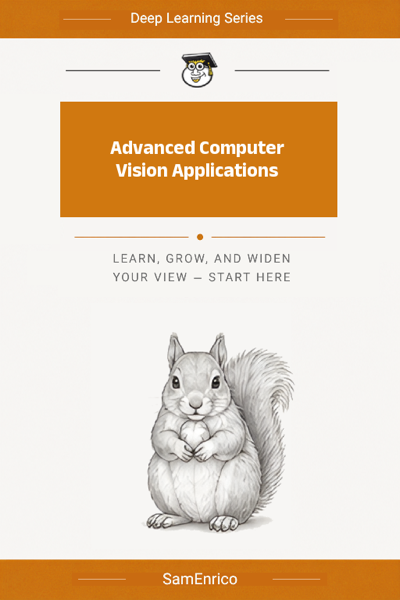
Advanced Computer Vision Applications
A Coursebook on Advanced Computer Vision Applicati
A Coursebook on Advanced Computer Vision Applications
Formats
About this book
Free sample
Chapter 1: The Cathedral of Pixels– For most of human history, seeing was believing. A photograph captured a moment, a painting rendered a scene, and the human eye—that miraculous sphere of jelly and nerve—was the ultimate arbiter of reality. Then came the computer, and with it, a strange and wonderful inversion: the machine began to see, and what it saw was not light, but numbers. This chapter is not an introduction in the usual sense—a gentle ramp of definitions and handshakes. It is a foundational descent into the cathedral of pixels, where we will unlearn the comfortable illusion that images are pictures and relearn the powerful truth that they are data.
We will build, from first principles, the mathematical and physical scaffolding upon which all advanced computer vision rests: how light becomes numbers, how numbers become coordinates, how a single camera can be coaxed into revealing the three-dimensional structure of the world, and finally, how multiple cameras can work together to reconstruct reality in metric 3D. By the end of this chapter, you will not merely understand camera calibration—you will have performed it, triangulated 3D points from multiple views, and begun to see the world not as a scene, but as a geometry waiting to be computed.1.1 The Digital Sensorium: From Photons to Integers Every computer vision pipeline, no matter how deep or Byzantine, begins with the same primitive act: the conversion of light into integers. A digital image sensor—typically a CMOS or CCD chip—is an array of millions of microscopic light-sensitive wells called photodiodes. When photons strike a photodiode, they generate electrons via the photoelectric effect; the number of electrons accumulated during an exposure window is proportional to the intensity of light falling on that pixel location. This analog voltage is then amplified, quantized, and converted into a digital number, typically an 8-bit integer (0 to 255) for standard images, though modern sensors use 10-bit, 12-bit, or even 16-bit for high dynamic range (HDR) applications.But this seemingly straightforward process is riddled with subtle complexities that can derail an advanced vision system.
The first is sampling. According to the Nyquist-Shannon sampling theorem, to faithfully reconstruct a continuous signal (the real-world scene), you…
This is the end of the free sample. Get the eBook to keep going. Buy now
Contents
- Chapter 1
- Chapter 2
- Chapter 3
- Chapter 4
- Chapter 5
- Chapter 6
- Chapter 7
- Chapter 8
- Chapter 9
- Chapter 10
- Chapter 11
- Chapter 12
Details
- Author
- Sallee Bryanna
- Publisher
- SamEnrico
- Language
- English
- Genre
- Non-Fiction, Informative, Educational
- Released
- 2026-05-06
- Pages (approx.)
- 121
- Available as
- eBook, Audiobook

Read better in the ZLOADR app
Your eBooks on your phone or tablet. Sign in with your SamEnrico account and start reading.
More by Sallee Bryanna
 Emotional Spending WorkbookSallee Bryanna$11.99
 Wish Fulfillment DreamsSallee Bryanna$11.99
 Student Loan Stress SolutionSallee Bryanna$11.99Student Loan Stress SolutionSallee Bryanna$11.99
 Self Hypnosis For Skiing GuideSallee Bryanna$11.99
 The 5 Minute NetworkerSallee Bryanna$11.99
 Peruvian Asylum Seeker StorySallee Bryanna$11.99
 Press Release Timing GuideSallee Bryanna$11.99
 Concentrating the Mind BreathSallee Bryanna$11.99
 OCD Thought Labeling MeditationSallee Bryanna$11.99
 Sir William Hamilton: The Kiwi Visionary Who Conquered the SkiesSallee Bryanna$11.99
 Montcalm's Last Stand: The Fall of Quebec in 1759Sallee Bryanna$11.99