
Non-FictionInformativeEducational
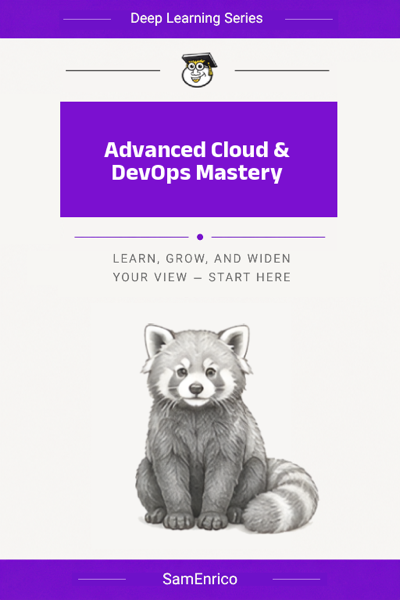
Advanced Cloud & DevOps Mastery eBook
A Coursebook on Advanced Cloud & DevOps Mastery
A Coursebook on Advanced Cloud & DevOps Mastery
Formats
Free sample
Chapter 1: The Three Ways...-- The pager screamed at 2:13 AM on Black Friday. Alex Chen, senior platform engineer at Swift Retail, stared at the dashboard as three consecutive alarms lit up like a Christmas tree in July. The checkout service had collapsed. Again. The CI/CD pipeline had run perfectly—green checks across all five hundred tests, zero linting errors, security scans passed, deployment logs pristine.
And yet, fifty thousand customers were seeing a spinning cursor instead of a confirmation page.Alex had been at Swift Retail for eighteen months, hired specifically to fix this. The company had done everything the cloud vendors told them to do. They had microservices. They had Kubernetes. They had a fully automated pipeline that could deploy thirty times per day.
They had monitoring dashboards that would make a NASA engineer dizzy. None of it mattered. Every time the business got busy—holiday sales, flash discounts, even a viral social media post—the system found a new and creative way to fail.The problem, Alex had come to realize, was not technical. The problem was cultural. And culture, as it turns out, cannot be deployed via a YAML file.The Fallacy of the Perfect Pipeline For the past decade, the Dev Ops movement has sold organizations a seductive promise: automate everything, and your problems will disappear.
Buy the right CI/CD tools. Containerize your applications. Move to Kubernetes. Adopt infrastructure as code. These are all necessary steps, but they are not sufficient.
In fact, they can make things worse.Consider Swift Retail's journey. Three years ago, the company deployed once per month via a manual process that required a change advisory board approval, four signatures, and a prayer. Deployments took six hours and failed roughly forty percent of the time. Today, they deploy forty-seven times per day with a ninety-eight percent success rate by pipeline metrics. And yet, customer-facing outages have increased, not decreased.
The mean time to detect a problem has dropped from hours to minutes, but the mean time to resolve has stayed stubbornly flat.What happened? The organization optimized for the wrong thing.The technology industry has become obsessed with what we might call "pipeline fetishism"—the belief that building a sophisticated CI/CD system is synonymous with Dev Ops maturity. It is not. A pipeline is a mechanism for moving code from a developer's laptop to production. That is all.
If the organization that surrounds that pipeline is broken, the pipeline will merely accelerate the delivery of broken outcomes.This chapter introduces a different framework: The Three Ways. First articulated in The Phoenix Project and later refined in The Dev Ops Handbook, The Three Ways are not a tool or a process. They are principles—an operating system for high-performance technology organizations. They are: Flow (the fast and predictable movement of work from development to operations), Feedback (the rapid and actionable flow of information from operations back to development), and Continuous Learning (the systematic extraction of lessons from every success and failure).You cannot buy The Three Ways from AWS. You cannot install them via Helm chart.
But without them, no amount of technical sophistication will save you.First Way: Flow – From Dev to Ops Flow is the principle of optimizing the movement of work from left to right—from the moment an idea enters the development process to the moment it delivers value to a customer. In manufacturing, this is called lean production. In software, it means minimizing the time between code commit and production release while maximizing the percentage of releases that succeed.Flow, however, is not merely about speed. Speed without predictability is chaos. A system that deploys fifty times per day but fails ten times per day has not achieved Flow; it has achieved noise.
True Flow requires three enabling conditions: small batch sizes, visible work limits, and fast handoffs.Small Batch Sizes: The most counterintuitive discovery from lean manufacturing applies directly to software. Large batches—releases that contain hundreds of changes, pull requests that modify dozens of files, features that take months to develop—move slowly and fail catastrophically. Small batches move quickly and fail gracefully. A team that deploys ten changes per day, each affecting a single function, will recover from a bad deployment faster than a team that deploys one massive change per week, even if the massive change succeeds ninety-nine percent of the time. Why?
Because when a small batch fails, the blast radius is small, and the root cause is obvious. When a large batch fails, the investigation becomes a forensic audit.At Google, engineers commit code directly to trunk an average of once per day. Each commit triggers automated tests that run in minutes. If a commit breaks the build, the author fixes it immediately—not because they are virtuous, but because the system makes it impossible to proceed otherwise. This is small batch processing at industrial scale.Visible Work Limits (Kanban): The second enabling condition of Flow is making work visible.
Most engineering teams operate on a pull system masked as a push system. A product manager pushes requirements to a tech lead, who pushes tasks to developers, who push completed work to QA, who pushes approved changes to operations. At each handoff, work queues grow. At each queue, waiting time multiplies.The alternative is a pull system, often implemented via Kanban boards with explicit work-in-progress (WIP) limits. A developer does not "start" a new task until they have capacity.
A QA engineer does not accept a new build until they have finished testing the previous one. Work is pulled, not pushed. The result is reduced cycle time, improved predictability, and the elimination of the "almost done but waiting for review" purgatory that consumes so much engineering energy.Alex introduced Kanban at Swift Retail with aggressive WIP limits: no more than three items per developer, no more than two items in code review, no more than one item in QA. Within two weeks, lead time for small features dropped from twelve days to four. Within a month, the team was deploying twice as often with half the error rate.
The work did not change; the visibility of the work changed.Fast Handoffs: The third condition is the elimination of batched handoffs. A handoff occurs whenever work moves from one person or team to another. Each handoff introduces delay, ambiguity, and the opportunity for miscommunication. The goal of Flow is not to eliminate handoffs—some specialization is necessary—but to make them instantaneous and low-friction.The most effective technique for fast handoffs is the creation of cross-functional teams that contain all the skills necessary to deliver value independently. An "end-to-end" feature team that includes developers, QA, product management, and operations support can deploy without waiting on a central platform team, a separate QA department, or a change advisory board.
The team may still use shared infrastructure and common tooling, but the decision authority resides within the team.This is not an argument for anarchy. Centralized governance still has a role for security, compliance, and architectural standards. But the default should be team autonomy, with escalation as the exception. When Swift Retail reorganized its product catalog team into a cross-functional unit with its…
This is the end of the free sample. Get the eBook to keep going. Buy now
About this book
Details
- Author
- Strain Dorthy
- Publisher
- SamEnrico
- Language
- English
- Genre
- Non-Fiction, Informative, Educational
- Released
- 2026-06-02
- Pages (approx.)
- 160
- Available as
- eBook, Audiobook

Read better in the ZLOADR app
Your eBooks on your phone or tablet. Sign in with your SamEnrico account and start reading.
More by Strain Dorthy
 Freudian Dream DecoderStrain Dorthy$11.99
 Spending Freeze for CouplesStrain Dorthy$11.99
 Press Release Word CountStrain Dorthy$11.99
 Rock Climbing Fear Hypnosis GuideStrain Dorthy$11.99
 Networking for New GraduatesStrain Dorthy$11.99
 Medical Debt Coping PlanStrain Dorthy$11.99
 Spontaneity for LeadersStrain Dorthy$11.99
 Rwandan Genocide SurvivorStrain Dorthy$11.99
 The Lost City of Atlantis: Secrets Beneath the WavesStrain Dorthy$11.99
 Panic Attack Intervention GuideStrain Dorthy$11.99
 The Marid’s Bargain: A Djinn’s Unfinished VowStrain Dorthy$11.99
 The Bloodhound and the Blackout: How a Dog Solved the Great New York Power MysteryStrain Dorthy$11.99
You may also like
 Hong Kong Handover 1997Dunn Johnnie$11.99
 Zumba For Postnatal Recovery CourseNeal Christian$11.99
 Zumba for BeginnersLadner Nikia$11.99
 YouTube Comment Mining GuideHumes Pandora$12.99
 Worry Box MeditationCarlin Rudy$11.99
 Workplace Stress MeditationNguyen Lynn$11.99
 Workplace Stress and Sleep RepairHawley Ivory$11.99
 Workplace Perfectionism CureDelaney Jeffry$11.99
 Workplace Injustice Anger GuideWallen Isabelle$11.99
 Work Addiction and Burnout LinkGreenwood Ester$11.99
 Women in Yoga and WellnessBeattie Galina$11.99
 Women in Stand Up ComedyChun Evangeline$11.99