
Non-FictionInformativeEducational
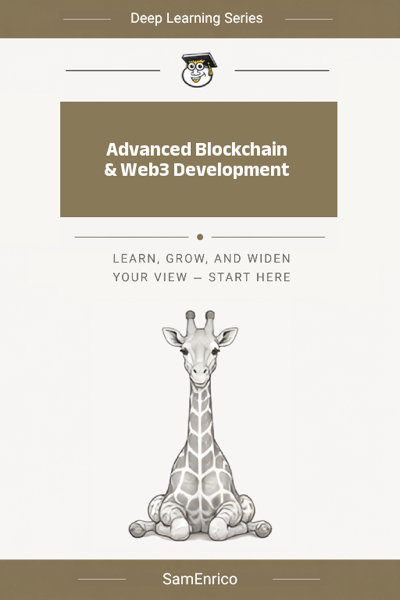
Advanced Blockchain & Web3 Development eBook
A Coursebook on Advanced Blockchain & Web3 Develop
by Dabney Oren
A Coursebook on Advanced Blockchain & Web3 Development
Formats
Free sample
Chapter 1: The Billion-Dollar Checklist...--When the head of engineering at a Fortune 500 logistics company asked me to review their blockchain proof of concept, I expected to find smart contract bugs or consensus flaws. Instead, I found a beautifully architected Hyperledger Fabric network with nine validating nodes, sophisticated chaincode, and a meticulous audit trail. The team had spent eight months and $2.3 million building it. The problem? A shared Google Sheet with six columns of data would have solved the exact same business problem faster, cheaper, and with fewer operational headaches.
No one had asked the fundamental question: Do you actually need a blockchain?That conversation haunted me. It still haunts me every time I see another headline announcing a "groundbreaking blockchain solution" for something like coffee bean traceability or concert ticket sales. The vast majority of blockchain projects fail not because the technology is immature—though it often is—but because decision-makers never performed a basic triage. They fell in love with the hammer and saw every business problem as a nail.This chapter exists to prevent you from becoming that engineer. Before you write a single line of Solidity, Rust, or Move, before you provision a single validator node or fund a testnet wallet, you need to answer one question with brutal honesty: What specific trust or coordination problem am I solving that cannot be solved with a database, a shared spreadsheet, or an existing API?If you cannot answer that question in one sentence, stop reading.
Go back to requirements gathering. Come back when you have the answer. If you can answer it—and if that answer genuinely points to blockchain—then you are ready to understand the topology decision that will determine every architectural choice that follows.The Blockchain Triage: When to Say No Let me save you three months of prototyping. Here are the only scenarios where blockchain adds genuine value. The list is shorter than you think.Blockchain is the right tool when you need credibly neutral coordination among mutually distrusting parties who do not share a central authority.
That is the entire value proposition compressed into a single phrase. Break it down: "credibly neutral" means no single participant can change the rules retroactively. "Mutually distrusting" means participants have opposing incentives and would not trust a centralized database controlled by any one of them. "No central authority" means no existing trusted third party can mediate disputes.Real-world examples that fit this pattern include: Bitcoin (strangers exchanging value without a bank), Uniswap (traders providing liquidity without a central exchange), and Maker DAO (borrowers and lenders coordinating without a bank). Notice what these share: adversarial participants, no trusted intermediary, and transaction history that must be immutable and auditable by all.Now consider scenarios where blockchain fails.
Supply chain tracking between long-term partners with contracts and legal recourse? A shared database with API access works fine. Medical records within a hospital system? The hospital already controls the data; blockchain adds complexity without solving any trust gap. Voting systems?
The real problem is voter identity and ballot secrecy, not immutable ledgers. Land registry? The state already maintains the authoritative record; a database with cryptographic audit logs achieves the same goal at 0.1 percent of the cost.I have seen teams waste millions on blockchain projects that should have been Postgre SQL databases with a few foreign key constraints. Do not join their ranks.The Topology Decision Matrix Once you have confirmed that blockchain is genuinely necessary, your next decision is choosing the topology. Three major categories exist, and each makes fundamentally different trade-offs across security, performance, and decentralization.Public (Permissionless) Blockchains: Ethereum, Solana, Bitcoin, and similar networks allow anyone to read, write, and validate.
No permission required. Benefits include maximum decentralization, transparent rules, and the strongest security guarantees (attackers would need to control a majority of hash power or stake). Drawbacks include slower transaction finality, higher costs (gas fees or compute unit prices), and limited privacy (all transactions are public). Use public blockchains when your participants do not trust each other and no single entity should control the system. De Fi protocols, DAOs, and censorship-resistant assets belong here.Consortium (Permissioned but Decentralized) Blockchains: Hyperledger Fabric, Corda, and Quorum operate with known participants who share control.
New members must be approved by existing members. Benefits include faster transactions (since validators are known and few in number), retained auditability (all transactions are logged immutably), and selective privacy (transactions can be visible only to relevant parties). Drawbacks include reduced decentralization (consortium members could collude) and trust assumptions (you must trust the consortium not to change the rules). Use consortium blockchains when you have a known group of enterprises who need shared audit trails but do not fully trust each other. Banking consortia, supply chain networks among trusted partners, and regulatory reporting systems fit here.Private (Centralized) Blockchains: A single entity controls all nodes.
This is rarely useful. If one company controls every validator, you have a distributed database with cryptographic hashes—but none of the trust guarantees that make blockchains valuable. A standard database with Merkle tree audit trails and write-once-read-many permissions achieves identical properties at a fraction of the operational cost. The only legitimate use case for private blockchains is legacy integration (your enterprise requires blockchain branding for regulatory or marketing reasons) or regulatory sandboxes (you need to experiment with the pattern before migrating to consortium). If you find yourself building a private blockchain, stop and ask whether a database would suffice.
It almost certainly would.The Decision Rule: Use public blockchains for credible neutrality among untrusted parties. Use consortium blockchains for shared audit trails among known but distrusting entities. Avoid private blockchains unless you have an explicit, documented reason that cannot be satisfied by a database.The Web 2.5 Bridge: Pragmatic Decentralization Now let me make a confession that might shock you. I do not believe in pure Web3 applications.The industry spent years evangelizing fully decentralized applications where every component—from the frontend to the database to the compute layer—lives on a blockchain or distributed network. That vision is noble but impractical for mainstream adoption.
Blockchain transactions are slow, expensive, and public. Asking users to wait fifteen seconds for a button click to register or pay five dollars for a simple action is not a path to mass adoption.The solution is Web 2.5: a pragmatic hybrid architecture where decentralized logic handles value and identity, while centralized services manage everything else. Your smart contracts on Ethereum or Solana settle transfers and enforce rules. Your backend (running on AWS or a VPS) handles order books, user sessions, and push notifications. Your database stores user profiles and preferences.
Your frontend looks and feels like a traditional web application, with blockchain interactions happening invisibly in the background.Consider a decentralized exchange built this way. Settlement—the actual transfer of assets—happens on-chain via smart contracts, ensuring that no central entity can steal funds. But the order book (the list of buy and sell orders) lives off-chain, because storing every order on-chain would cost millions in gas fees. User authentication might use traditional email and password plus wallet connection, giving users the option of self-custody without forcing it on every casual trader. This is not purity; this is pragmatism.The…
This is the end of the free sample. Get the eBook to keep going. Buy now
About this book
Details
- Author
- Dabney Oren
- Publisher
- SamEnrico
- Language
- English
- Genre
- Non-Fiction, Informative, Educational
- Released
- 2026-05-11
- Pages (approx.)
- 140
- Available as
- eBook, Audiobook

Read better in the ZLOADR app
Your eBooks on your phone or tablet. Sign in with your SamEnrico account and start reading.
More by Dabney Oren
 Ankle Pain Meditation GuideDabney Oren$11.99
 Press Release GlossaryDabney Oren$11.99
 The Wishlist Only RuleDabney Oren$11.99
 Martial Arts Flow State HypnosisDabney Oren$11.99
 The Financial Self Care GuideDabney Oren$11.99
 Greek Mother Migration TaleDabney Oren$11.99
 Gladdening the Mind BreathDabney Oren$11.99
 Building Internal Company NetworksDabney Oren$11.99
 Generalized Anxiety Daily SitDabney Oren$11.99
 The Queen's Gambit: The Rise and Fall of Elizabeth HolmesDabney Oren$11.99
 The Domino Effect: How One Bankruptcy Toppled a Nation’s Housing MarketDabney Oren$11.99
 The Tongue of the World: The Polyglot Kings of MaliDabney Oren$11.99
You may also like
 Hong Kong Handover 1997Dunn Johnnie$11.99
 Zumba For Postnatal Recovery CourseNeal Christian$11.99
 Zumba for BeginnersLadner Nikia$11.99
 YouTube Comment Mining GuideHumes Pandora$12.99
 Worry Box MeditationCarlin Rudy$11.99
 Workplace Stress MeditationNguyen Lynn$11.99
 Workplace Stress and Sleep RepairHawley Ivory$11.99
 Workplace Perfectionism CureDelaney Jeffry$11.99
 Workplace Injustice Anger GuideWallen Isabelle$11.99
 Work Addiction and Burnout LinkGreenwood Ester$11.99
 Women in Yoga and WellnessBeattie Galina$11.99
 Women in Stand Up ComedyChun Evangeline$11.99