
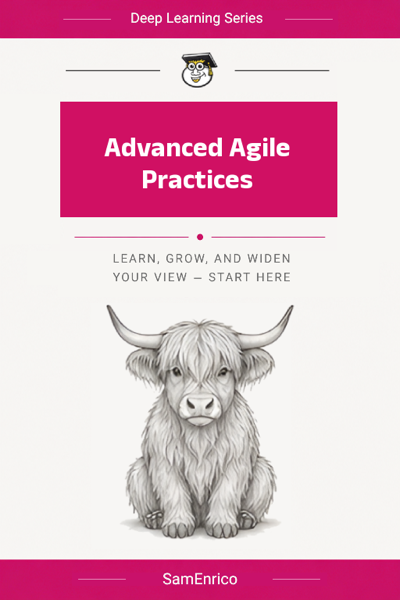
Non-FictionInformativeEducational
Advanced Agile Practices eBook
A Coursebook on Advanced Agile Practices
by Salas Tyree
A Coursebook on Advanced Agile Practices
Formats
Free sample
Chapter 1: The Zombie Scrum--– “We did everything right.”The words hung in the stale air of the conference room like a verdict. Sarah, the director of engineering at a mid-sized financial technology company, had just finished presenting her team’s quarterly results to the executive staff. The slide behind her showed a beautiful Jira dashboard—velocity trending upward for six consecutive sprints, burndown charts that hugged the ideal line like a faithful shadow, story point completion rates that would make any certified Scrum trainer weep with pride.Her CEO, a pragmatic woman named Elena who had built the company from twelve people to four hundred, glanced at the slide and then back at Sarah. “That’s a lovely chart,” Elena said. “Now tell me why we lost our largest customer yesterday.”The room fell silent.“They wanted the payment reconciliation feature,” Elena continued, her voice flat.
“The one they asked for in January. The one they said they’d pay an extra two million dollars for if we could deliver it by April. It’s September, Sarah. We lost them to a competitor who built the feature in six weeks.”Sarah’s mouth opened, then closed. She wanted to say something about dependencies, about technical debt, about the QA bottleneck, about the compliance review that took three weeks.
She wanted to explain that her team had followed every rule in the Agile playbook. They had standups. They had sprint planning. They had retrospectives. They had a beautiful Definition of Done that included code review, unit testing, integration testing, performance testing, security scanning, and documentation updates.
They had done everything right.But the feature hadn’t shipped.This scene—or something terribly close to it—plays out in software organizations every single day. It’s become so common that the industry has a name for it now.Zombie Scrum.The term first gained traction in the late 2010s, coined by Agile coaches who noticed a disturbing pattern: teams that performed all the ceremonies of Scrum with religious fidelity but delivered none of the outcomes of agility. Zombie Scrum teams stand up every morning. They point their stories with planning poker. They burndown their charts.
They close their sprints with a retrospective. And then they do it all again, the same way, producing the same results—which is to say, producing nothing of value at all.Zombie Scrum is not a failure of effort. It is a failure of understanding. These teams are not lazy. They are not incompetent.
They are trapped in a system that rewards activity over outcome, compliance over competence, process over progress. They have confused the map for the territory. They have mistaken the ceremonies of agility for agility itself.If you suspect your team might be a zombie Scrum team, you’re in good company. According to a 2022 survey by the Agile Alliance and Digital.ai, approximately sixty-seven percent of organizations that have adopted Scrum report that their teams are “mechanically compliant” with Scrum practices but have not seen measurable improvements in delivery speed, quality, or customer satisfaction. The Standish Group’s CHAOS Report, which has tracked software project outcomes for nearly three decades, found that organizations using “Agile-but-not-agile” methods show no statistically significant improvement in success rates over waterfall.
None. Zero. After millions of dollars in training, certification, and consulting, they are exactly where they started—except now they have more meetings.The Great Imposter Let’s be precise about what Zombie Scrum is and isn’t.Zombie Scrum is not a lack of process. Most zombie Scrum teams have more process than genuinely agile teams. They have scripts for everything.
They have templates for meeting agendas. They have checklists for release readiness. They have Jira workflows with twenty-seven statuses and required fields that must be populated before a ticket can move from “In Progress” to “Code Review.” They have Definition of Done documents that run to four pages.Zombie Scrum is not a lack of tools. Zombie Scrum teams often have better tooling than genuinely agile teams. They have enterprise Jira with all the plugins.
They have Confluence wikis organized by sprint number going back three years. They have automated reporting dashboards that refresh every hour. They have invested heavily in the infrastructure of process.Zombie Scrum is not a lack of training. Most zombie Scrum teams have completed official certification courses. They have Scrum Masters with impressive acronyms after their names—CSM, PSM, SAFe Agilist, Le SS Practitioner.
They have attended workshops on story splitting, estimation techniques, and facilitation skills. They have the credentials to prove they know what they’re doing.Zombie Scrum is a lack of adaptability.The core problem is elegantly simple: zombie Scrum teams follow the rules even when the rules no longer make sense. They hold daily standups even when everyone already knows what everyone is working on. They estimate story points even when no one uses the estimates for anything. They run two-week sprints even when stories consistently take one week to complete and then sit idle for another week waiting for the next sprint to begin.
They hold retrospectives even when the same action items have been on the board for six months.The rules have become the goal. The ceremonies have become the work.This is not agility. This is theater.The Seven Symptoms of Zombie Scrum How do you know if your team has become a zombie Scrum team? Look for these seven symptoms. If you recognize more than three, the diagnosis is confirmed.Symptom One: The Standup That Never Ends The daily standup, in its pure form, is supposed to answer three questions: What did I do yesterday?
What will I do today? What’s blocking me? It’s supposed to take fifteen minutes. It’s supposed to be a coordination tool, not a status report.In zombie Scrum teams, the standup takes forty-five minutes. People report on tasks in excruciating detail.
The Scrum Master facilitates with the precision of a flight controller. Someone mentions a blocker, and the team launches into a problem-solving session while everyone else waits. The meeting ends with no clearer understanding of what will ship this week than when it started.The standup has become a ritual. It happens at the same time, in the same room, with the same people saying the same things. No one questions it because “that’s what Agile teams do.”Symptom Two: The Pointless Points Story points, in their original formulation, were a relative estimation technique.
Teams would compare the effort of a new story to a reference story and assign a number—1, 2, 3, 5, 8, 13. The numbers weren’t supposed to map to hours or days. They were supposed to help teams understand relative complexity and uncertainty.In zombie Scrum teams, story points have become a performance metric. Managers track velocity (points completed per sprint) and compare teams. Velocity charts are presented in quarterly business reviews.
Engineers are evaluated based on whether their team’s velocity is trending upward.The result is predictable and tragic. Teams inflate their estimates. They break stories into smaller pieces to generate more points. They avoid risky work that might reduce their velocity. They engage in what the Agile community calls “velocity…
This is the end of the free sample. Get the eBook to keep going. Buy now
About this book
Details
- Author
- Salas Tyree
- Publisher
- SamEnrico
- Language
- English
- Genre
- Non-Fiction, Informative, Educational
- Released
- 2026-05-06
- Pages (approx.)
- 147
- Available as
- eBook, Audiobook

Read better in the ZLOADR app
Your eBooks on your phone or tablet. Sign in with your SamEnrico account and start reading.
More by Salas Tyree
 Listening In Manufacturing GuideSalas Tyree$11.99
 Retirement Stress Relationship GuideSalas Tyree$11.99
 Morning Breath Wake UpSalas Tyree$11.99
 Bipolar And Nutrition GuideSalas Tyree$11.99
 Art Therapy Without MaterialsSalas Tyree$11.99
 Joyful Minimalism Declutter GuideSalas Tyree$11.99
 Dream Dialogue JournalSalas Tyree$11.99
 The Memory WardSalas Tyree$11.99
 Pele King SoccerSalas Tyree$11.99
 Silicon Serpent: The Untold Rise of the First Female Tech MogulSalas Tyree$11.99
 The Bard and the Ballad: Shakespeare’s Global StageSalas Tyree$11.99
 The Ballot Box Bombshell: How a Single Vote Changed HistorySalas Tyree$11.99
You may also like
 Hong Kong Handover 1997Dunn Johnnie$11.99
 Zumba For Postnatal Recovery CourseNeal Christian$11.99
 Zumba for BeginnersLadner Nikia$11.99
 YouTube Comment Mining GuideHumes Pandora$12.99
 Worry Box MeditationCarlin Rudy$11.99
 Workplace Stress MeditationNguyen Lynn$11.99
 Workplace Stress and Sleep RepairHawley Ivory$11.99
 Workplace Perfectionism CureDelaney Jeffry$11.99
 Workplace Injustice Anger GuideWallen Isabelle$11.99
 Work Addiction and Burnout LinkGreenwood Ester$11.99
 Women in Yoga and WellnessBeattie Galina$11.99
 Women in Stand Up ComedyChun Evangeline$11.99