
Non-FictionHealth & WellnessAdoption
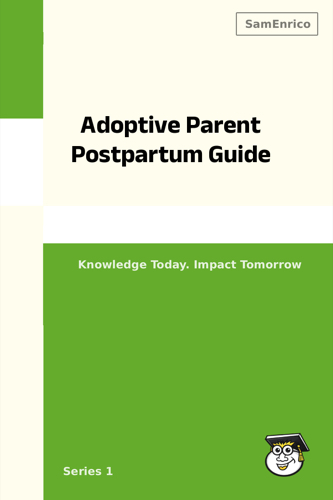
Adoptive Parent Postpartum Guide eBook
Supports bonding and self care for parents who did
by Vines Ahmad
Supports bonding and self care for parents who did not give birth.
Formats
Free sample
Chapter 1: The Silent Crash...--–- You have waited for this moment for years. Perhaps you endured the漫长 infertility treatments, the home studies, the background checks, the waiting lists, the legal fees, the uncertainty, the last-minute disruptions. You prepared the nursery, read the books, attended the trainings, and told yourself that once the child arrived, everything would make sense. The love would come. The exhaustion would feel meaningful.
The emptiness you carried through the long years of waiting would finally be filled.Then the child arrived. And within days – sometimes hours – you felt something you never expected: nothing. Or worse: irritation. Regret. Numbness.
A quiet, horrifying voice in your head whispering, What have I done?If that is you, you are not broken. You are not a monster. You are not failing. You are having a normal, predictable, biological and psychological response to a sudden, seismic shift that no one warned you about. This chapter exists to give you that warning – and to give you permission to stop pretending you are fine.The Myth of the Instant Bond We live in a culture that loves adoption stories with tidy endings.
The movie montage: the airport reunion, the tearful embrace, the child running into the arms of their new parents, the screen fading to soft music and a title card that reads, "And they lived happily ever after." These stories are poison. Not because they are lies – but because they are half-truths. Yes, there are moments of joy. Yes, many adoptive parents eventually form deep, lasting bonds with their children. But the path from placement to attachment is rarely a straight line.
It is more often a bramble-filled, fog-covered, disorienting maze.The first lie you have been sold is that love should be instantaneous. The second lie is that if it is not, something is wrong with you. Neither is true.Consider the research: Post-Adoption Depression Syndrome (PADS) affects between 25 and 40 percent of adoptive parents – rates comparable to postpartum depression among birth mothers. One in four. Perhaps one in three.
You are reading this sentence, and statistically, if you are in a room with two other adoptive parents, one of you is struggling in silence. But because no one talks about it, each of you believes you are alone.This chapter shatters that silence. We will name the phenomenon, explain its biological and psychological roots, introduce you to a family who will walk with us through this entire book, and give you your first tool for surviving the fog.Defining the Invisible Postpartum Before we go any further, a critical clarification. Throughout this book, the word "postpartum" will be used differently than it is in the medical literature. In clinical terms, postpartum refers to the period following childbirth.
But you did not give birth – and yet your body, your brain, your nervous system, and your emotions are behaving as if you did. You are exhausted in ways you cannot explain. You are irritable over small things. You cry at commercials. You forget your own phone number.
You feel raw, exposed, and fundamentally unmoored.Here is the truth that changes everything: Postpartum is not a biological event. It is a caregiving event. Your nervous system does not care whether a baby emerged from your body. Your nervous system cares whether you are suddenly responsible for a small, vulnerable human who needs you 24 hours a day, who does not yet trust you, who may actively reject you, and whose safety now rests entirely on your shoulders. That shock – the sudden, total immersion into caregiving – triggers the same hormonal and neurological cascade that birth parents experience.
Your cortisol spikes. Your sleep fragments. Your oxytocin – the bonding hormone – starts at a lower baseline because there was no labor to kickstart it. But your brain is still capable of building it. (We will teach you how in Chapter 3.)The difference is that birth parents have a cultural script.
They are expected to be tired. They are expected to be overwhelmed. They are given permission to order takeout, ignore visitors, and wear sweatpants for six weeks straight. You, on the other hand, are expected to be grateful. You chose this.
You waited for this. Therefore, you should be happy. That expectation is the cruellest sentence ever written about adoption.So let us rewrite it now: You can be grateful for your child and exhausted by parenting them. You can be overjoyed to finally be a parent and grieving the life you lost. You can love your child and still feel numb.
All of these can be true at once. That is not hypocrisy. That is being human.The Biological Shock of Sudden Caregiving Let us get specific about what is happening inside your body. You may not feel like you are undergoing a biological event – after all, you did not push a human being out of your pelvis – but your body is responding to the sudden arrival of full-time caregiving as a stressor of the highest order.Cortisol: Your primary stress hormone has likely doubled or tripled since placement. Why?
Because your nervous system has detected a radical increase in demand and a radical decrease in predictability. You do not know when the child will wake up. You do not know what will trigger a meltdown. You do not know if you are "doing it right." That uncertainty keeps your sympathetic nervous system (fight-or-flight) chronically activated. You are living in a low-grade emergency, 24 hours a day.Oxytocin: This is the bonding hormone, the neurochemical that makes eye contact feel good, that makes skin-to-skin contact calming, that turns a crying infant into a reason to approach rather than flee.
In birth parents, oxytocin surges during labor, birth, and breastfeeding. In adoptive parents, there is no such surge. Your baseline oxytocin may be significantly lower in the first days and weeks after placement. But – and this is crucial – your brain is still capable of building it. The pathways are different, and the timeline is longer, but the capacity is intact.
Chapter 3 is entirely dedicated to teaching you how to manually stimulate oxytocin through specific, repeatable behaviors. For now, know this: low oxytocin does not mean you cannot bond. It means you will need to bond differently.Sleep deprivation: This is the silent amplifier of every other problem. Adopted children – especially those who have experienced trauma, neglect, or multiple placements – often have profoundly disrupted sleep. Night terrors, nightmares, bedwetting, and "vigilance sleeping" (waking every 45–60 minutes to check that the caregiver is still present) are common.
You are not a bad parent if your child does not sleep. You are a parent of a child whose nervous system has learned that sleep is dangerous. And you are a human being who cannot regulate emotions, make decisions, or feel love when you are running on three hours of broken sleep. We will devote all of Chapter 8 to the radical, non-negotiable priority of sleep. For now, accept this: Sleep deprivation is the number one predictor of attachment failure.
Not trauma. Not the child's history. Sleep.The travel and legal stress: Many adoptive parents arrive at placement after significant travel – sometimes internationally, sometimes across state lines. You have likely navigated time zone changes, unfamiliar…
This is the end of the free sample. Get the eBook to keep going. Buy now
About this book
Details
- Author
- Vines Ahmad
- Publisher
- SamEnrico
- Language
- English
- Genre
- Non-Fiction, Health & Wellness, Adoption
- Released
- 2026-06-10
- Pages (approx.)
- 140
- Available as
- eBook, Audiobook

Read better in the ZLOADR app
Your eBooks on your phone or tablet. Sign in with your SamEnrico account and start reading.
More by Vines Ahmad
 Anticipatory Grief Physical PainVines Ahmad$11.99
 Aggressive Driving Legal ConsequencesVines Ahmad$11.99
 Breast Health After MenopauseVines Ahmad$11.99
 Backorder Prediction AIVines Ahmad$11.99
 Negotiation and Influence GuideVines Ahmad$11.99
 Constraints for PilotsVines Ahmad$11.99
 The Whitechapel Ripper: Jack the Ripper and the Birth of Forensic ScienceVines Ahmad$11.99
 The Silk and Gold Weavers of Axum: Africa's Forgotten Fashion DynastyVines Ahmad$11.99
 How to Produce a Conveyor SystemVines Ahmad$11.99
 How to Produce Paint Brush Cleaning SolutionsVines Ahmad$11.99
 Cougars: Puma ConcolorVines Ahmad$11.99
 Argentina University Degree Recognition HandbookVines Ahmad$12.99
You may also like
 Hong Kong Handover 1997Dunn Johnnie$11.99
 Zumba For Postnatal Recovery CourseNeal Christian$11.99
 Zumba for BeginnersLadner Nikia$11.99
 YouTube Comment Mining GuideHumes Pandora$12.99
 Worry Box MeditationCarlin Rudy$11.99
 Workplace Stress MeditationNguyen Lynn$11.99
 Workplace Stress and Sleep RepairHawley Ivory$11.99
 Workplace Perfectionism CureDelaney Jeffry$11.99
 Workplace Injustice Anger GuideWallen Isabelle$11.99
 Work Addiction and Burnout LinkGreenwood Ester$11.99
 Women in Yoga and WellnessBeattie Galina$11.99
 Women in Stand Up ComedyChun Evangeline$11.99