
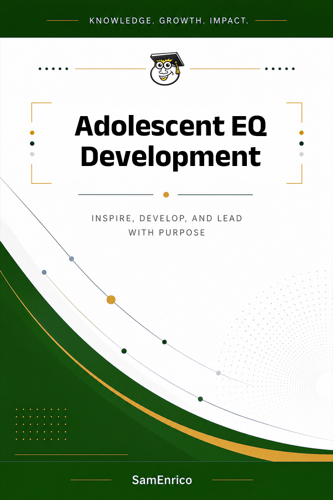
Adolescent EQ Development eBook
Supports teens through emotional volatility with v
Supports teens through emotional volatility with validation and skills.
Formats
Free sample
Chapter 1: The Construction Zone--–- Let’s start with a question that might sound strange: What if the most confusing, exhausting, and emotionally chaotic years of your life aren’t a sign that something is wrong with you—but proof that everything is working exactly as it should?Think about that for a moment.Everywhere you look, adults are telling you to calm down, to think before you act, to stop overreacting, to get a grip. Your teachers want you to focus. Your parents want you to be reasonable. Your friends want you to be fun and easy to be around. And underneath all of that, you’re expected to figure out who you are, what you believe, and what you want to do with your life.Oh, and you’re supposed to do all of this while your brain is literally tearing itself apart and rebuilding from scratch.Welcome to adolescence.
Welcome to the construction zone.The Straight-A Student Who Fell Apart Let me tell you about a student I’ll call Marcus. Marcus is seventeen years old. He has a 4.2 GPA. He takes AP Chemistry, AP Calculus, and AP English. He’s been playing violin since he was six.
Last month, he got a 1520 on the SAT.Last week, his girlfriend broke up with him via text message.Marcus didn’t go to school for two days. He didn’t eat. He re-read the text message approximately four hundred times. He drafted seventeen replies, deleted all of them, and then sent one at 2:00 AM that said “ok” even though he was not okay. He cried in the bathroom between third and fourth period.
He almost failed a quiz in a class where he’d never gotten below an A.His IQ didn’t help him at all.Here’s the thing about Marcus. He’s not weak. He’s not dramatic. He’s not broken. He’s a perfectly normal teenager with a perfectly normal brain that is doing exactly what it evolved to do.
The problem is that nobody ever taught him how his brain works. Nobody told him that his emotional alarm system is running at full power while his impulse control system is still under construction. Nobody gave him a single tool for the moment when his entire nervous system lights up like a Christmas tree.This book is going to give you those tools.The Great Brain Remodel Let’s talk about what’s actually happening inside your skull. I promise to keep the science simple and useful.You have two parts of your brain that matter most for this conversation. The first is the amygdala.
The amygdala is about the size and shape of an almond, and you have one on each side of your brain. Its job is to detect threats. It’s the fire alarm. It doesn’t think. It doesn’t reason.
It just screams, “DANGER! DANGER! DO SOMETHING NOW!”The amygdala is amazing at its job. It can process a potential threat in milliseconds—faster than you can blink. That’s why you can snatch your hand back from a hot stove before you even feel the burn.
That’s why you can flinch at a sudden loud noise before you know what it was.But here’s the problem. The amygdala isn’t very smart. It can’t tell the difference between a hungry tiger and a rude text message. It can’t distinguish between someone actually rejecting you and someone just being too busy to reply. To your amygdala, social exclusion activates the same neural pathways as physical pain.
No, seriously—brain scans show that being left out lights up the same regions as getting punched.Your amygdala is fully developed and firing on all cylinders by the time you’re about twelve to fourteen years old.Now let’s talk about the second player: the prefrontal cortex. This is the part of your brain right behind your forehead. It’s the CEO. It’s the brake pedal. It handles planning, impulse control, decision-making, and reasoning.
It’s the part that says, “Maybe I shouldn’t send this text” or “Let me take three breaths before I respond.”The prefrontal cortex is wonderful. It’s what makes humans different from almost every other animal on the planet. But here’s the catch: your prefrontal cortex won’t be fully developed until you’re in your mid-twenties. Twenty-five. That’s not a typo.So let me summarize.
Your emotional alarm system—the part that screams DANGER—has been fully operational for years. Your brake pedal—the part that says CHILL OUT—won’t be finished for almost another decade.This is not a design flaw. This is not a mistake. This is how human beings have evolved. The emotional chaos of adolescence exists for a reason.
Your brain is pruning away the neural connections you don’t need and strengthening the ones you use most. You are becoming who you are. And that process is messy, loud, and uncomfortable.But here’s what nobody tells you: you can build temporary brakes. You can learn to drive so skillfully that the construction zone doesn’t wreck your life. That’s what emotional intelligence is.
It’s not about not having feelings. It’s about not being destroyed by them.Why Your Phone Is Actually an Emotional Training Device Let’s talk about the rectangular object that is probably within three feet of you right now.Adults love to complain about phones. They say phones are destroying your attention span. They say social media is making you depressed. They say you need to put the phone down and go outside.And here’s the thing: they’re not wrong.
But they’re also not telling you the full story.Your phone is the most powerful emotional training device ever invented. Every notification, every like, every comment, every view count, every time someone leaves you on read—these are all real-time emotional triggers. Your phone is giving you thousands of tiny experiments in validation, rejection, envy, and belonging.When you post a photo and watch the likes roll in, you are training your brain to seek external approval. When you see someone’s vacation pictures while you’re sitting in your bedroom on a Tuesday, you are training your brain to compare your behind-the-scenes to everyone else’s highlight reel. When you send a risky text and then check your phone seventeen times in the next hour, you are training your brain to crave uncertainty the same way a gambler craves the next card.Your phone is not evil.
It’s a tool. But it’s a tool that was designed by some of the smartest people in the world to exploit your brain’s vulnerabilities. And nobody gave you the manual.This book will give you that manual. By the time you finish Chapter 7, you’ll understand exactly why scrolling before bed spikes your anxiety. You’ll know how to use your phone as a tool instead of a torture device.
You’ll have a script for the “texting pause”—the twenty-minute waiting period that has saved more friendships than any other skill…
This is the end of the free sample. Get the eBook to keep going. Buy now
About this book
Details
- Author
- Marion Earnestine
- Publisher
- SamEnrico
- Language
- English
- Genre
- Non-Fiction, Self-Help, Teen Psychology
- Released
- 2026-06-08
- Pages (approx.)
- 139
- Available as
- eBook, Audiobook

Read better in the ZLOADR app
Your eBooks on your phone or tablet. Sign in with your SamEnrico account and start reading.
More by Marion Earnestine
 Widow Self Worth RecoveryMarion Earnestine$11.99
 Equifax's Canadian Breach ImpactMarion Earnestine$11.99
 Global Vaccine Alliance GAVIMarion Earnestine$11.99
 The People Pleasing in Relationships CureMarion Earnestine$11.99
 Hops & Empire: The Rise of the Pilsner KingsMarion Earnestine$11.99
 Understanding MumpsMarion Earnestine$17.99
 Meta SWOT Analysis GuideMarion Earnestine$12.99
 AI Financial Data ValidationMarion Earnestine$12.99
 Training ConsultantMarion Earnestine$11.99
 How to Become a Cloth FramerMarion Earnestine$11.99
You may also like
 Self Esteem Workbook for TeensRawlings Torie$11.99
 Recurring Dreams in Teens GuideForney Frankie$11.99
 The Teen Confidence WorkbookRoby Cecila$11.99
 Adolescent Body Image RescueRitter Vannesa$11.99
 Teen Self Esteem Workbook GuideBermudez Leisa$11.99
 Teen Anger Family SolutionsPride Charlsie$11.99
 The Empathy for Teenagers GuideMaher Adelaida$11.99