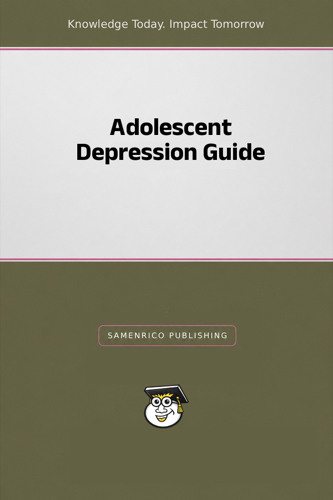
Adolescent Depression Guide eBook
Focuses on teen MDD with social withdrawal, irrita
Focuses on teen MDD with social withdrawal, irritability, and school avoidance.
Formats
Free sample
Chapter 1: The Closed Bedroom Door--The first time my son told me to “get the hell out of his room,” I cried in my car for twenty minutes. The tenth time, I screamed back. The fiftieth time, I sat down outside his door, leaned my head against the wood, and whispered, “I’m not leaving. And I’m not fighting. I’m just going to sit here until you’re ready.” He opened the door seven minutes later.
That seven minutes taught me something no therapist, no book, and no well-meaning relative had been able to teach me: my son was not giving me a hard time. He was having a hard time. Everything changed when I stopped asking “What is wrong with you?” and started asking “What has happened to you, and what do you need from me right now?”This book is those seven minutes, stretched into a roadmap.If you are reading these words, you are likely living in a state of quiet desperation. You wake up every morning unsure which version of your teenager will emerge—the one who used to laugh at breakfast or the one who now stares through you as if you are a ghost. You have probably said things you regret.
You have probably cried in places no one could see. You have probably wondered if you are a bad parent, if you missed something, if you could have prevented this. Let me stop you right there: you are not a bad parent. You are a parent navigating something that no parenting book prepared you for. Teenage depression, particularly the specific constellation of symptoms this book calls “The Trifecta”—social withdrawal, irritability, and school refusal—does not look like the depression you recognize from movies, from your own past, or from your grandmother’s descriptions of “the blues.”This chapter is your first lifeline.
It will help you distinguish between normal teenage moodiness and clinical depression. It will introduce you to the Trifecta, the three-symptom cluster that should trigger immediate concern. And it will name the single greatest obstacle to getting your teen help: the parental blind spot that causes most of us to look for sadness when we should be looking for anger.Let us begin with the question every parent asks.The Question That Keeps You Up at Night“Is this normal?”You have asked yourself this question a hundred times. Maybe you have asked your spouse, your sister, your child’s pediatrician. You have watched your teenager retreat to their bedroom immediately after school, close the door, and not emerge until the next morning’s fight about getting dressed.
You have been met with eye rolls, slammed doors, and monosyllabic answers that feel like stones dropped into an empty well. You have told yourself that all teenagers are moody. You have remembered your own adolescence as a time of confusion and emotional chaos. You have hoped—prayed, really—that this is just a phase.Here is the truth that will save you months or years of suffering: not all teenage moodiness is depression, but all teenage depression is moody. The overlap is what makes detection so difficult.
A normally developing adolescent may experience irritability, withdrawal, and school resistance as part of the push-pull of individuation—the natural process of separating from parents and establishing an independent identity. But in typical development, these symptoms are episodic, situation-specific, and do not cause significant functional impairment. Your teen might be grumpy after a fight with a friend but still complete their homework. They might retreat to their room for an hour but emerge for dinner. They might complain about school but still attend.Clinical depression is different.
It is persistent, pervasive, and paralyzing.The Three Markers of MDDMajor Depressive Disorder (MDD) in adolescents is diagnosed using the same clinical criteria as adult depression, with one crucial difference: in teens, irritability can substitute for depressed mood as a core symptom. This means your teen does not need to say “I feel sad” to be depressed. They may never say those words. Instead, they may snap at you over breakfast, withdraw from every family activity, and insist that nothing is wrong while everything clearly is.The three markers that separate MDD from normal moodiness are duration, intensity, and functional loss.Duration means the symptoms occur most of the day, nearly every day, for at least two consecutive weeks. This is not a bad week after a breakup or a few days of sulking after a disappointing grade.
This is a sustained pattern of emotional distress that does not lift even when something good happens. Parents often tell me, “But he seemed fine at his friend’s birthday party.” Depression is not a constant state. Teens with MDD can experience brief periods of relief, particularly when engaged in highly stimulating activities like video games or time with peers. The question is not whether they ever smile. The question is whether the dark mood returns quickly and reliably once the stimulation ends.Intensity means the emotional pain interferes with basic functions.
A moody teenager might be unpleasant to be around but still shower, eat, and sleep reasonably well. A depressed teenager might stop showering for days. They might forget to eat or eat compulsively. They might sleep twelve hours and still wake up exhausted, or lie awake until 3 AM staring at the ceiling. The intensity is not just about feeling bad—it is about the collapse of basic self-care.Functional loss is the most concrete marker and the easiest for parents to observe.
Has your teen stopped doing things they used to love? Have their grades dropped significantly? Have they lost friends or stopped making any effort to see the ones they have? Do they no longer care about their appearance, their hobbies, or their future? Functional loss means the depression has moved from internal suffering to external disability.
This is when you know, without a doubt, that something is seriously wrong.The Trifecta: When Withdrawal, Irritability, and School Refusal Converge Throughout this book, you will encounter what I call “The Trifecta.” It is the specific three-symptom cluster that most reliably predicts adolescent MDD and that most consistently confuses parents. The Trifecta is: social withdrawal, irritability, and school refusal.These three symptoms rarely appear in typical teen development all at once. A normally developing teen might be irritable for a week. They might withdraw after a social embarrassment. They might resist going to school on a Monday morning.
But when all three are present simultaneously, and when they persist for more than two weeks, the probability of clinical depression is high enough to warrant immediate professional evaluation.Here is why the Trifecta is so dangerous: each symptom feeds the others. Social withdrawal increases irritability because the teen loses practice with social navigation and becomes more sensitive to perceived slights. Irritability increases school refusal because the teen cannot tolerate the frustration of academic demands. School refusal increases withdrawal because the teen falls further behind their peers and feels increasingly ashamed. Breaking any one of these three symptoms helps break all three—but the longer they cycle together, the harder they are to interrupt.Later chapters will give you specific tools for…
This is the end of the free sample. Get the eBook to keep going. Buy now
About this book
Details
- Author
- Eldridge Lanie
- Publisher
- SamEnrico
- Language
- English
- Genre
- Non-Fiction, Health & Wellness, Teen Mental Health
- Released
- 2026-06-08
- Pages (approx.)
- 125
- Available as
- eBook, Audiobook

Read better in the ZLOADR app
Your eBooks on your phone or tablet. Sign in with your SamEnrico account and start reading.
More by Eldridge Lanie
 Upsell And Cross Sell GuideEldridge Lanie$12.99
 SRS Research StudiesEldridge Lanie$11.99
 CBT Persistent DepressionEldridge Lanie$11.99
 Family Calendar Sync GuideEldridge Lanie$11.99
 Karrie Webb Australian TrailEldridge Lanie$11.99
 Loma Linda Adventist LongevityEldridge Lanie$11.99
 Second Pet After LossEldridge Lanie$11.99
 Mind Reading Anger FallacyEldridge Lanie$11.99
 The Celtic Rhythms of the Colonies: Hurling’s Hidden Dance Revolution in 18th-Century AustraliaEldridge Lanie$11.99
 The Last Crown of the Sun: How a Forgotten Dynasty Fought to Survive in the 21st CenturyEldridge Lanie$11.99
 How to Produce Waterproof TileboardEldridge Lanie$11.99
 Service Providers Guide to Sewer CleaningEldridge Lanie$11.99