
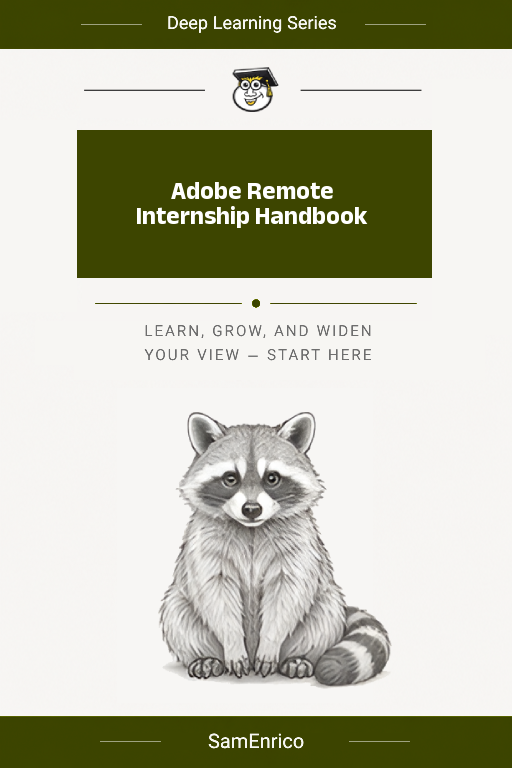
Non-FictionVirtual Work ExperienceCreative Guide
Adobe Remote Internship Handbook eBook
Land a virtual internship at Adobe. Creative cloud
by Betts Kory
Land a virtual internship at Adobe. Creative cloud skills, portfolio review, and remote design collaboration.
Formats
Free sample
Chapter 1: The Virtual Studio Door--–- You have already lost your first internship opportunity. Not because your portfolio is weak. Not because you lack talent. But because you are thinking about remote work the way 97% of applicants do: as a compromise rather than an advantage.The numbers are brutal. Last year, Adobe received over 47,000 applications for approximately 300 remote internship positions across design, product, and marketing.
That is a 0.6 percent acceptance rate. More than 44,000 of those applicants were eliminated before a human being ever saw their work. Their portfolios sat in digital darkness. Their carefully crafted cover letters evaporated into algorithmic silence.This chapter is not about making you feel doomed. It is about making you understand why the old rules no longer apply and what you must do differently starting today.The candidates who survived that first algorithmic cull did not simply have better grades or fancier schools on their resumes.
They understood something that most applicants never figure out: remote hiring at Adobe favors candidates who demonstrate what this book calls intentional distributed design—the ability to collaborate asynchronously, manage your own attention, and deliver creative work without someone standing over your shoulder. You must prove these skills before you even get the job.Let us begin by dismantling the most dangerous myth in creative remote work.The Myth of the Zoom Internship When most students imagine a remote internship, they picture something like this: waking up ten minutes before a meeting, joining a video call in their pajamas, sitting passively while someone talks at them, then logging off and doing minimal work. This is not a remote internship. This is a video call with extra steps.Adobe did not pivot to remote internships because of the pandemic and then forget to pivot back. The company made a strategic decision that distributed work is the future of creative collaboration.
Adobe's internship programs—including the Student Athlete Micro-Internship, Project Spartan, and the Adobe Digital Academy—have been deliberately redesigned for a world where interns may never set foot in San Jose, Seattle, or New York.Here is what Adobe looks for in a remote intern, based on analysis of their job postings, recruiter talks, and feedback from former interns:Asynchronous communication skills – Can you write a clear status update that does not require a follow-up email? Can you leave a useful Loom video comment on a teammate's design?Comfort with ambiguity – Remote work means fewer spontaneous clarifications. You must be willing to make decisions with incomplete information and course-correct later.Self-documenting work habits – Do you name your layers? Do you leave notes in shared files? Do you update project trackers without being reminded?Proactive visibility – Remote interns do not get "seen" by accident.
You must learn to make your work visible to managers who are not walking past your desk.These are not soft skills. They are remote-specific competencies, and they are entirely learnable. But they require you to stop thinking like an in-person intern who happens to be on Zoom and start thinking like a distributed creative professional.Reverse-Engineering Adobe's Internship Models To land a remote internship at Adobe, you must understand what the company actually needs from its interns. The good news is that Adobe is unusually transparent about its internship programs. Let us look at three real examples and extract the hidden requirements.The Student Athlete Micro-Internship This program pairs student athletes with Adobe teams for short-term, project-based work.
The hidden requirement here is time management under severe constraint. Student athletes have practices, games, travel, and coursework. Adobe does not expect them to work nine-to-five. Instead, the company expects them to communicate their availability clearly, deliver on explicit deadlines, and ask for help before things fall apart.What this means for you: Even if you are not a student athlete, you must demonstrate that you can work in unpredictable blocks of time. Your portfolio and resume should show examples of projects completed while you were juggling other commitments—and more importantly, how you communicated progress along the way.Project Spartan Project Spartan was an internal Adobe initiative focused on rapid prototyping and cross-functional collaboration.
Interns in this program worked alongside engineers, product managers, and marketers. The hidden requirement here is translational communication—the ability to explain design decisions to non-designers without condescension or jargon.What this means for you: Your portfolio case studies should not only show what you designed but also how you socialized those designs with stakeholders. Include a sentence or two about how you incorporated feedback from a developer or presented alternatives to a product manager.The Adobe Digital Academy This program focuses on career switchers and non-traditional candidates. The hidden requirement is learning velocity—the ability to pick up new tools and workflows quickly without hand-holding.What this means for you: Demonstrate learning velocity in your application. If you taught yourself After Effects in six weeks, say so.
If you migrated a team from Sketch to Figma, document that process. Adobe wants interns who will not get stuck waiting for training.The common thread across all three programs is simple: Adobe trusts its remote interns to work independently. Your job in the application process is to prove that you are worthy of that trust before you have ever completed a single task for the company.The Psychological Shift: From Commuting to Logging In Here is something no other internship guide will tell you. The hardest part of remote work is not technical. It is psychological.When you commute to a studio or office, the physical environment does half the work of focusing for you.
You put on certain clothes. You ride a certain train. You walk through a certain door. Your brain understands: Now we are working.When you work remotely, that environmental scaffolding disappears. Your bed is twenty feet away.
Your phone is in your pocket. Your roommates or family may not understand that you are "at work" even though you are at home.This is why the first chapter of this book focuses on what we call the psychological shift. You must stop thinking about remote work as "working from home" and start thinking about it as "logging into a global team."The Ritual of Starting Every successful remote creative has a ritual. It might be making coffee in a specific mug. It might be a five-minute stretching routine.
It might be reviewing yesterday's work log before opening Slack. The specific ritual does not matter. What matters is that you have one.Your ritual serves one purpose: it tells your brain that the workday has begun, regardless of where your body is located.The Reality of Global Teams Adobe employs designers in San Francisco, Seattle, New York, Austin, Lehi (Utah), Noida (India), and Bucharest (Romania). Your internship team may span four time zones. This means you will rarely have everyone online at the same time.The psychological shift here is from real-time collaboration to asynchronous handoffs.
You will leave work for a teammate in India. You will wake up to feedback from a manager in California. You will review a designer's work in Romania before you eat lunch.This is not a bug. It is a feature. Adobe intentionally builds distributed teams…
This is the end of the free sample. Get the eBook to keep going. Buy now
About this book
Details
- Author
- Betts Kory
- Publisher
- SamEnrico
- Language
- English
- Genre
- Non-Fiction, Virtual Work Experience, Creative Guide
- Released
- 2026-05-26
- Pages (approx.)
- 153
- Available as
- eBook, Audiobook

Read better in the ZLOADR app
Your eBooks on your phone or tablet. Sign in with your SamEnrico account and start reading.
More by Betts Kory
 Self Talk For Fitness MotivationBetts Kory$11.99
 Fertility and Surrogacy GuideBetts Kory$11.99
 Nature Walking MindfulnessBetts Kory$11.99
 The Caregiver Art Therapy WorkbookBetts Kory$11.99
 Nightmare Processing for Cancer PatientsBetts Kory$11.99
 Whispers in the Dust: The Forgotten Ballads of the Black Dust BowlBetts Kory$11.99
 Customer Service TeammateBetts Kory$11.99
 Universal Health ServicesBetts Kory$12.99
 Understanding Okamuto–satomura SyndromeBetts Kory$17.99
 How to Become a Drier Operator IiiBetts Kory$11.99
You may also like
 Hong Kong Handover 1997Dunn Johnnie$11.99
 Zumba For Postnatal Recovery CourseNeal Christian$11.99
 Zumba for BeginnersLadner Nikia$11.99
 YouTube Comment Mining GuideHumes Pandora$12.99
 Worry Box MeditationCarlin Rudy$11.99
 Workplace Stress MeditationNguyen Lynn$11.99
 Workplace Stress and Sleep RepairHawley Ivory$11.99
 Workplace Perfectionism CureDelaney Jeffry$11.99
 Workplace Injustice Anger GuideWallen Isabelle$11.99
 Work Addiction and Burnout LinkGreenwood Ester$11.99
 Women in Yoga and WellnessBeattie Galina$11.99
 Women in Stand Up ComedyChun Evangeline$11.99