
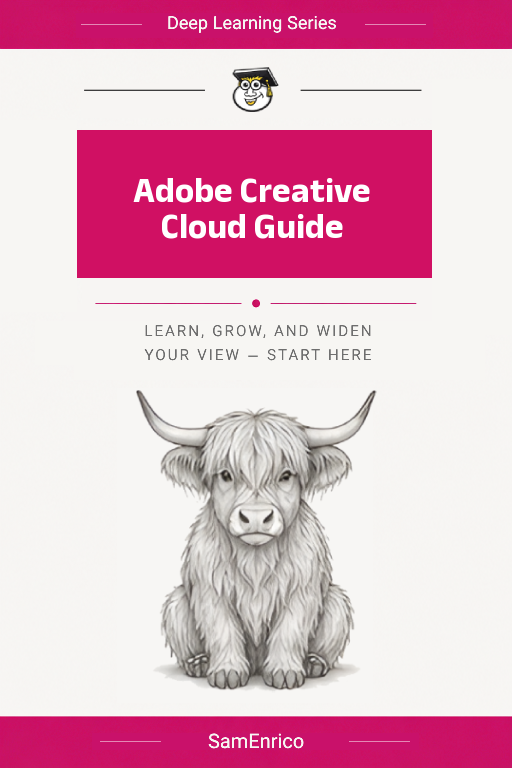
Non-FictionStrategic AtlasRetention Strategy
Adobe Creative Cloud Guide eBook
Learn forced cloud transition, frequent updates, a
Learn forced cloud transition, frequent updates, and integration lock-in that converted pirates to subscribers.
Formats
Free sample
Chapter 1: The 2013 Earthquake--May 6, 2013, began like any other Monday for the creative industry. Designers opened their email, photographers culled through weekend shoots, and agency owners prepared for another week of client revisions. Then the announcement hit. Adobe, the company whose software had defined professional creativity for a quarter century, declared that it would never again sell a perpetual license. Creative Suite 6—CS6—would be the last version anyone could buy and own forever.
From that day forward, the only way to access Photoshop, Illustrator, In Design, and every other Adobe tool would be a monthly subscription called Creative Cloud.The backlash was immediate and ferocious. Forums exploded with thousands of angry posts. Petitions circulated demanding Adobe reverse course. Long-time users calculated what they would pay over five, ten, or twenty years and discovered that the new model would cost them three to five times more than buying upgrades every two to three years under the old system. Commentators predicted a mass exodus to alternatives like Corel, Pixelmator, and GIMP.
One particularly prescient critic wrote, “Adobe is trading a generation of customer goodwill for a short-term stock pop.”That critic was wrong about the stock pop—and right about everything else.Within six months of the announcement, Adobe’s share price had dropped approximately six percent. Wall Street hated uncertainty, and the transition from perpetual licenses to subscriptions created nothing but uncertainty. Analysts downgraded the stock. Competitors rushed out press releases touting their one-time-purchase models. For a brief moment, it looked as though the creative industry might fracture, with professionals migrating to cheaper, owned-forever alternatives while Adobe’s revenue cratered.That moment passed.
And then something remarkable happened.By 2015, Adobe’s stock had not only recovered but surpassed its pre-announcement high. By 2018, it had doubled. By 2020, it had quadrupled. As of 2026, Adobe’s market capitalization exceeds $200 billion—more than ten times what it was on the morning of May 6, 2013. The company that critics said had committed suicide by subscription had instead engineered one of the most successful business pivots in software history.The question that haunts every Creative Cloud subscriber today is not whether Adobe won—it obviously did—but how.
And more importantly, what did the creative industry lose in the process?The Death of Ownership To understand the magnitude of what Adobe did in 2013, you must first understand what came before. Creative Suite was not merely a collection of applications. It was an economic institution. For twenty-five years, the “buy once, own forever” model had governed professional software. You paid a substantial upfront fee—1,299for Photoshopalone,1,299 for Photoshop alone, 1,299for Photoshopalone,2,599 for the Master Collection—and in return, you received a box containing installation discs, a printed manual, and a license key that never expired.
You could install that software on two machines. You could use it for five years or fifteen. You could pass it to a colleague when you upgraded. You owned it the same way you owned a table saw or a camera lens.The upgrade cycle was equally predictable. Every eighteen to twenty-four months, Adobe released a new version with enough new features to tempt professionals to spend another 199to199 to 199to599.
Not everyone upgraded every time. Some skipped a version. Some waited until a client demanded a file format their older version couldn’t open. But the economics were clear: you paid a significant lump sum, then smaller periodic fees when you chose to upgrade. You were in control.
You decided when to spend and when to wait.That control is precisely what Adobe decided to eliminate.The internal logic, pieced together from later interviews with Adobe executives and financial analysts who covered the company, reveals a coldly rational calculation. The perpetual license model had three structural problems that Adobe believed were unsolvable without destroying it entirely.First, revenue was unpredictable. In the year following a major release, upgrade sales generated healthy cash flow. But in the second year, as the upgrade cycle matured, revenue would decline. Adobe’s financial planning resembled a roller coaster rather than a smooth climb.
Wall Street valued predictability above all else, and Adobe’s boom-bust cycle depressed its valuation relative to subscription-based competitors like Salesforce.Second, a massive portion of Adobe’s potential user base was not paying at all. Internal estimates, confirmed by industry analysts, suggested that for every legitimate copy of Creative Suite in use, three pirated copies were running somewhere in the world. Students in developing countries, freelancers just starting out, even some Western professionals who simply refused to pay the high upfront cost—all of them used cracked versions downloaded from torrent sites or shared via USB drives. Adobe was spending millions on development while a 75% piracy rate turned its software into a de facto free product for the majority of its users.Third, and most devastating, the upgrade model incentivized stagnation. When a user was happy with CS4 and saw no compelling reason to pay for CS5, Adobe received exactly zero dollars from that user until possibly CS6.
The company had to convince customers to spend money every two years. If it failed to do so—if the new features were not impressive enough, if the economy was weak, if users simply felt their current tools were sufficient—Adobe’s revenue would crater.The subscription model solved all three problems simultaneously. Recurring revenue became perfectly predictable. The 50monthlyfee(or50 monthly fee (or 50monthlyfee(or20 for students) was low enough that even former pirates could afford it, converting free users into paying customers overnight. And because the subscription never ended, Adobe no longer had to convince anyone to upgrade.
It only had to convince them not to cancel—a much lower bar, and one that the company could engineer through the lock-in mechanisms that subsequent chapters of this book will dissect in brutal detail.The Salesforce Blueprint Adobe did not invent the software-as-a-service model. Salesforce had been selling subscriptions to its customer relationship management software since 1999. But Salesforce sold to businesses, not individual creatives. It hosted everything on its own servers, meaning users never downloaded or installed anything. The idea of applying the subscription model to desktop software—software that ran on a user’s own computer, that stored files locally, that had been sold as a perpetual product for decades—was audacious bordering on insane.Adobe’s then-CEO Shantanu Narayen, who had been with the company since 1998 and took the top job in 2007, was the driving force behind the pivot.
According to later accounts from employees who worked on the transition, Narayen had become convinced as early as 2010 that the perpetual model was dying. The rise of cloud computing, the increasing power of web-based applications, and most importantly, the changing expectations of younger users who were accustomed to paying for Spotify and Netflix rather than buying CDs and DVDs—all of these pointed toward a future where ownership was obsolete.Narayen reportedly spent months studying Salesforce’s financials and speaking with its executives about the mechanics of subscription businesses. He learned that the key metric was not revenue but annual recurring revenue, that customer acquisition costs had to be carefully managed, and that churn—the rate at which subscribers canceled—was the single most important variable in determining…
This is the end of the free sample. Get the eBook to keep going. Buy now
About this book
Details
- Author
- Higgins Tiffany
- Publisher
- SamEnrico
- Language
- English
- Genre
- Non-Fiction, Strategic Atlas, Retention Strategy
- Released
- 2026-05-30
- Pages (approx.)
- 143
- Available as
- eBook, Audiobook

Read better in the ZLOADR app
Your eBooks on your phone or tablet. Sign in with your SamEnrico account and start reading.
More by Higgins Tiffany
 State Privacy Law PatchworkHiggins Tiffany$11.99
 Pharmacist Imposter SyndromeHiggins Tiffany$11.99Pharmacist Imposter SyndromeHiggins Tiffany$11.99
 The Teen Self Esteem Podcast GuideHiggins Tiffany$11.99
 Instagram Carousel MasteryHiggins Tiffany$11.99
 The Narcissistic Abuse Self EsteemHiggins Tiffany$11.99
 The Shield of the Sun: The Military Genius of the Aksumite EmpireHiggins Tiffany$11.99
 Understanding Prinzmetal's Variant AnginaHiggins Tiffany$17.99
 Courier Success SpecialistHiggins Tiffany$11.99
 Executive Summary for Strategic PlansHiggins Tiffany$12.99
 How to Start a Ballet Dancers - Independent BusinessHiggins Tiffany$11.99
You may also like
 Hong Kong Handover 1997Dunn Johnnie$11.99
 Zumba For Postnatal Recovery CourseNeal Christian$11.99
 Zumba for BeginnersLadner Nikia$11.99
 YouTube Comment Mining GuideHumes Pandora$12.99
 Worry Box MeditationCarlin Rudy$11.99
 Workplace Stress MeditationNguyen Lynn$11.99
 Workplace Stress and Sleep RepairHawley Ivory$11.99
 Workplace Perfectionism CureDelaney Jeffry$11.99
 Workplace Injustice Anger GuideWallen Isabelle$11.99
 Work Addiction and Burnout LinkGreenwood Ester$11.99
 Women in Yoga and WellnessBeattie Galina$11.99
 Women in Stand Up ComedyChun Evangeline$11.99