
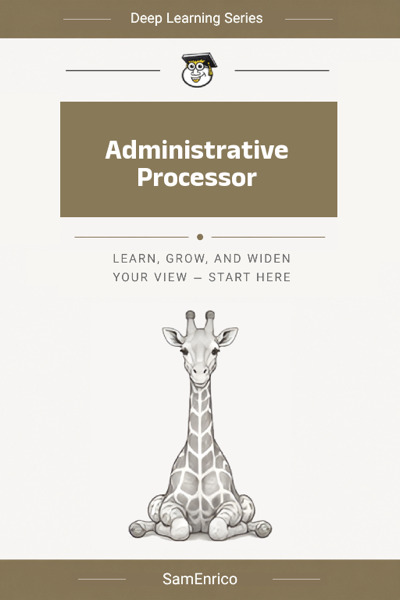
Administrative Processor eBook
A Coursebook on Administrative Processor
A Coursebook on Administrative Processor
Formats
Free sample
Chapter 1: The Clerk’s Last Day...--–- Eleanor Vance had been sorting mail for thirty-seven years when the robot arrived. Not a physical robot—no clanking arms or blinking lights—but a piece of software that sorted, scanned, and routed incoming correspondence in four seconds flat. Her morning task, the one that had taken ninety minutes each day for nearly four decades, simply vanished. No farewell party. No gold watch.
Just a quiet notification that her workflow had been “optimized.”Eleanor’s story opens thousands of administrative offices across the country. Her job didn’t disappear because she was bad at it—she was excellent. Her job disappeared because the question had shifted from “Who can do this task?” to “What pattern can be automated?” The administrative professional who survives and thrives in the coming decade will not be the one who fights automation. It will be the one who learns to manage it, to design around it, and to step into the gaps where human judgment remains irreplaceable.This book is for that person.The Administrative Processor: A Coursebook on Integrated Systems, Law, and Efficiency is not a traditional office procedures manual. It is not a law school casebook.
It is a hybrid—a deliberate fusion of two worlds that have rarely spoken to one another. On one side stands the rich tradition of administrative law: the rules, agencies, and due process protections that govern how regulations are made and disputes are resolved. On the other side stands the practical craft of administrative professionalism: the records management, digital tools, and workflow design that keep organizations running. Most textbooks choose one lane or the other. This book insists that you need both.The argument is simple but radical: the most valuable administrative professional of the 21st century is not a clerk, not a secretary, not a paralegal, and not a lawyer.
It is a processor—someone who processes information, workflows, and regulatory requirements with equal skill. A processor knows how to track a proposed rule through the Federal Register, how to redact a document under the Freedom of Information Act, and how to automate an approval workflow in Microsoft 365 or Google Workspace. A processor understands bounded rationality, litigation holds, and the Anti-Deficiency Act. A processor can sit at the intersection of law, technology, and human decision-making and make all three work together.This chapter dismantles the outdated archetype of the passive clerk and builds in its place a new identity for administrative work. It traces the historical arc from the Industrial Revolution to the age of artificial intelligence.
It introduces the core framework that will guide every subsequent chapter: the Strategic-Tactical Bridge. And it offers a self-assessment so you can see where you stand on the spectrum from clerk to processor—and, more importantly, how to move forward.The Clerk’s Inheritance: A Brief History of Paper To understand where administrative work is going, we must first understand where it came from. The modern administrative office is a surprisingly recent invention, and its history explains many of the habits and frustrations that still haunt us.Before the Industrial Revolution, most clerical work was done by men in cramped counting houses. Ledgers were handwritten. Correspondence was dictated to a single scribe.
The word “clerk” came from the Latin clericus, meaning a learned person—someone who could read and write when most people could not. Clerks were valuable precisely because their skills were scarce.The mid-19th century changed everything. The typewriter (patented in 1868), the telephone (1876), and the vertical filing cabinet (1890s) transformed the office from a quiet scriptorium into a noisy factory of information. Frederick Winslow Taylor’s principles of scientific management—time-motion studies, standardized processes, separation of planning from execution—were applied to clerical work just as ruthlessly as to factory floors. The goal was efficiency.
The method was fragmentation: break every task into its smallest parts, measure each part, and optimize relentlessly.This era gave us the stereotype of the passive clerk: someone who files what they are told to file, types what they are told to type, and never asks why. The clerk’s virtue was obedience. The clerk’s vice was curiosity. In a Taylorist office, asking “Why do we do this?” was not a sign of intelligence. It was insubordination.The 20th century layered new technologies onto this Taylorist foundation: the photocopier (1959), the fax machine (1964), the personal computer (1970s), and email (1990s).
Each new tool promised to eliminate paper. Each new tool produced more paper than ever before. By the 1990s, the average administrative professional spent 40 percent of their workday on paper-related tasks: filing, retrieving, copying, collating, and distributing.Then came the internet, the cloud, and the smartphone. Paper began—slowly, unevenly—to recede. But the habits of the Taylorist office did not disappear.
They calcified. Many administrative professionals today are digital clerks, not paper clerks. They click and type instead of filing and typing. But the underlying posture—passive, reactive, task-oriented—remains unchanged. They process inputs and produce outputs without designing the system that connects them.The processor breaks this mold.Defining the Administrative Processor The term “processor” is deliberately chosen.
It echoes computing (where a processor executes instructions), manufacturing (where a processor transforms raw materials into finished goods), and information science (where a processor applies rules to data). But an administrative processor is not a machine. The processor is a designer of systems and an executor of tasks within those systems—and, crucially, someone who knows when to be one and when to be the other.Let us define the Administrative Processor through six core competencies. These competencies will recur throughout the book, each developed in depth in subsequent chapters.Competency 1: Systems Thinking The processor sees beyond individual tasks to the system that connects them. Where a clerk sees an email to be answered, a processor sees an input to a workflow.
Where a clerk sees a form to be filed, a processor sees a piece of data that must be categorized, stored, and made retrievable for future decisions. Systems thinking is the ability to map processes, identify bottlenecks, and design improvements that affect the whole chain, not just one link.Competency 2: Legal Literacy The processor understands the basic architecture of administrative law. They know what the Administrative Procedure Act is and why it matters. They can distinguish rulemaking from adjudication. They recognize when a record is subject to a FOIA request and when it is shielded by an exemption.
They are not lawyers, but they know enough to spot legal risks before those risks become lawsuits.Competency 3: Information Governance The processor treats information as an asset that must be managed across its entire lifecycle: creation, use, retention, and disposition. They design taxonomies that serve both human retrieval and legal discovery. They understand retention schedules, litigation holds, and the difference between vital records and disposable ones. They know how to protect information from unauthorized access, loss, and premature destruction.Competency 4: Workflow Automation The processor uses digital tools not as glorified typewriters but as workflow engines. They build automated rules in email systems.
They create approval chains in document management platforms. They use Robotic Process Automation (RPA) for high-volume, rules-based tasks. They know which…
This is the end of the free sample. Get the eBook to keep going. Buy now
About this book
Details
- Author
- Dodge Babette
- Publisher
- SamEnrico
- Language
- English
- Genre
- Non-Fiction, Informative, Educational
- Released
- 2026-06-02
- Pages (approx.)
- 160
- Available as
- eBook, Audiobook

Read better in the ZLOADR app
Your eBooks on your phone or tablet. Sign in with your SamEnrico account and start reading.
More by Dodge Babette
 The Lullaby From Room 4Dodge Babette$11.99
 Journalist Deadline PressureDodge Babette$11.99
 USO Entertainers MemoirDodge Babette$11.99
 Pilot Flight Instructor StressDodge Babette$11.99
 Galileo's Defiance: The Birth of Modern ScienceDodge Babette$11.99
 Freemium Async CommunicationDodge Babette$12.99
 How to Produce Binder RingsDodge Babette$11.99
 Ultimate Handbook Guide to Colombo : (Brazil) Travel GuideDodge Babette$11.99