
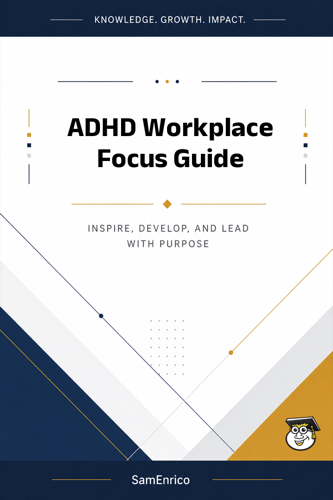
Non-FictionSelf-HelpADHD at Work
ADHD Workplace Focus Guide eBook
Builds systems and accommodations for attention re
Builds systems and accommodations for attention regulation.
Formats
Free sample
Chapter 1: The Sensory Assault--–- The first time Maria realized her office was making her sick, she was crying inside a supply closet. Not because of a family emergency or a performance review. Because of the lights. The fluorescent tubes above her cubicle had been flickering for three days. No one else noticed.
Her manager walked past twice an hour and saw nothing. But for Maria, each flicker was a small, electric knife slicing through her ability to think. By Thursday afternoon, she had written zero emails, completed zero tasks, and spent forty-seven minutes researching "how to become a freelance beekeeper" on her phone. She wasn't lazy. She wasn't unmotivated.
She was under sensory assault.This chapter is for every person who has ever walked into an open-plan office and felt their brain short-circuit within ten minutes. For everyone who has been told they're "too sensitive" or "easily distracted" or "dramatic about noise." For every ADHD professional who has secretly wondered if they're just not cut out for office work. You are not broken. Your environment is.The modern workplace is designed by neurotypical people, for neurotypical people, under neurotypical assumptions. Those assumptions include: background noise is ignorable, overhead lighting is neutral, open sightlines encourage collaboration, and a chair is a chair.
For the ADHD brain, each of these assumptions is a lie. The sensory landscape of a typical office is a minefield of dysregulation, and most of us have been told to just "get over it" or "try harder." This chapter will show you exactly why that advice fails and, more importantly, how to rebuild your sensory environment so it works for your neurology.The Two Faces of Sensory Dysregulation Before we can fix the problem, we need to understand how it shows up. There is no single "ADHD sensory experience." Instead, most of us fall into one of two camps, and some of us bounce between both depending on the day, the task, or our stress levels.The Hyper-Arousal Profile: Too Much Input If you have ever felt physically exhausted after a trip to the grocery store, or come home from a networking event and needed to lie down in a dark room for an hour, you may be hyper-arousal dominant. Your nervous system is like a microphone with the gain turned up too high. Every sound, every light, every movement registers as important, and your brain tries to process all of it simultaneously.
The result is overwhelm, irritability, and a desperate need for escape.The hyper-arousal brain does not filter. Neurotypical brains have a remarkable ability called sensory gating—they can sit in a coffee shop and ignore the espresso machine, the conversation at the next table, and the traffic outside, focusing instead on their laptop screen. The ADHD brain's sensory gating is inconsistent at best and nonfunctional at worst. You hear everything. You see everything.
You feel the tag on your shirt, the hum of the air conditioner, the way your chair leans slightly to the left. And because you cannot filter, your brain exhausts itself trying to process an endless stream of irrelevant data.Common signs of hyper-arousal in the workplace include: feeling rage when a coworker eats chips at their desk, being unable to think during meetings because someone is tapping a pen, needing to wear headphones even in a quiet room, feeling physically tired after two hours of "normal" office work, and experiencing a powerful urge to hide in a bathroom stall just to get silence.The Sensory-Seeking Profile: Too Little Input On the other end of the spectrum is sensory seeking. If you have ever found yourself clicking a pen repeatedly, or spinning in your chair, or needing loud music to focus, you may be sensory-seeking dominant. Your nervous system is understimulated. It craves input the way a hungry stomach craves food, and when it doesn't get enough, it will create its own—often in ways that look like fidgeting, restlessness, or distraction.The sensory-seeking brain is bored by silence.
Not the pleasant boredom of a lazy Sunday, but a crawling, unbearable understimulation that makes it impossible to sit still or focus on anything. You may find yourself checking your phone not because you care about notifications, but because the act of scrolling provides a tiny hit of sensory input. You may turn on music, then turn it off, then turn it on again, never quite finding the right level. You may talk to yourself, hum, tap your feet, or perform small physical rituals just to feel something.Common signs of sensory seeking in the workplace include: needing music or podcasts to concentrate (but getting distracted by lyrics), constantly adjusting your posture or chair, doodling during meetings as a focus tool, feeling sluggish or foggy in quiet environments, and reaching for snacks or drinks not out of hunger but out of a need for oral stimulation.The Fluctuating Profile: Both, Depending on the Day Many ADHD professionals will recognize themselves in both descriptions. On a well-rested, low-stress day, you might be sensory-seeking—needing background music and movement to get into flow.
On an exhausted, overworked day, the exact same stimuli that helped you focus become unbearable. You have no tolerance for music. The sound of a keyboard makes you want to scream. You have moved from seeking input to being assaulted by it.This fluctuation is normal. It is not a sign that your strategies are failing.
It is a sign that your sensory needs are dynamic, and your environment must be flexible enough to accommodate both states. A workplace that works for ADHD is not one that finds a single perfect setting. It is one that allows you to adjust your inputs throughout the day as your nervous system shifts.The Hidden Costs of Sensory Mismatch Most professionals with undiagnosed or unmanaged ADHD have learned to tolerate sensory discomfort. They grit their teeth through meetings. They ignore the flickering light.
They tell themselves that everyone finds open offices annoying. But the costs are not minor. They are catastrophic.The Cognitive Cost Every sensory distraction is a context switch. Research suggests that after a distraction, it takes an average of twenty-three minutes to return to full focus. For the ADHD brain, with its already-compromised executive function, that number can be forty minutes or more.
If you experience five sensory distractions per hour—a ringing phone, a passing conversation, a flickering light, a notification, a coworker asking a "quick question"—you may never achieve deep focus at all. Your entire day becomes a series of shallow, interrupted attempts at work, none of which reach completion.The Emotional Cost Sensory overwhelm does not just reduce productivity. It produces genuine emotional distress. The ADHD nervous system interprets sensory overload as a threat. Your amygdala activates.
Cortisol rises. You enter a low-grade fight-or-flight state that makes it impossible to think clearly, regulate your emotions, or respond patiently to colleagues. You become irritable. You snap at people. You feel a constant, low-level anger that you cannot explain or control.
Then you feel shame about the anger. Then you feel exhausted from the shame.The Physical Cost Sensory dysregulation is not "all in your head." It manifests physically. Jaw…
This is the end of the free sample. Get the eBook to keep going. Buy now
About this book
Details
- Author
- Worthington Yee
- Publisher
- SamEnrico
- Language
- English
- Genre
- Non-Fiction, Self-Help, ADHD at Work
- Released
- 2026-06-07
- Pages (approx.)
- 145
- Available as
- eBook, Audiobook

Read better in the ZLOADR app
Your eBooks on your phone or tablet. Sign in with your SamEnrico account and start reading.
More by Worthington Yee
 LTC Insurance For Farmers GuideWorthington Yee$11.99
 The Catholic Index CensorsWorthington Yee$11.99
 Gacy's Relationship with His FatherWorthington Yee$11.99
 Cocaine and Pregnancy GuideWorthington Yee$11.99
 Pattern Recognition in NatureWorthington Yee$11.99
 THC and Memory SleepWorthington Yee$11.99
 Sexual Addiction Faith RecoveryWorthington Yee$11.99
 TM Consistency ChallengeWorthington Yee$11.99
 The Unseen Playbook: How Vince Lombardi's Leadership Transformed a Team and a NationWorthington Yee$11.99
 The Hollow Hill: Where the Tuatha Dé Danann SleptWorthington Yee$11.99
 Napoleon's March: The Maestro of War and MusicWorthington Yee$11.99
 The Dancer's Guide to GuapachaWorthington Yee$11.99
You may also like
 Hong Kong Handover 1997Dunn Johnnie$11.99
 Zumba For Postnatal Recovery CourseNeal Christian$11.99
 Zumba for BeginnersLadner Nikia$11.99
 YouTube Comment Mining GuideHumes Pandora$12.99
 Worry Box MeditationCarlin Rudy$11.99
 Workplace Stress MeditationNguyen Lynn$11.99
 Workplace Stress and Sleep RepairHawley Ivory$11.99
 Workplace Perfectionism CureDelaney Jeffry$11.99
 Workplace Injustice Anger GuideWallen Isabelle$11.99
 Work Addiction and Burnout LinkGreenwood Ester$11.99
 Women in Yoga and WellnessBeattie Galina$11.99
 Women in Stand Up ComedyChun Evangeline$11.99