
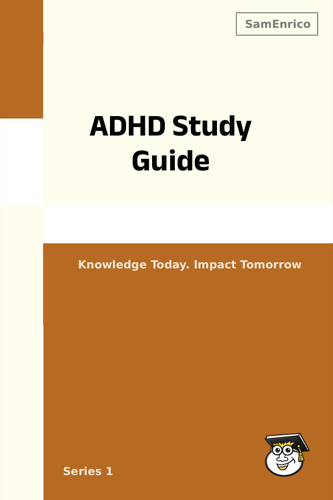
ADHD Study Guide eBook
Adapt strategies for attention regulation during s
by Casper Brain
Adapt strategies for attention regulation during study sessions.
Formats
Free sample
Chapter 1: The Leaking Bucket--–- The first time I forgot my own birthday, I was twenty-three. Not someone else’s birthday—mine. I had stared at a calendar for three full minutes, watching the little square with the number fourteen inside it, and felt absolutely nothing. No recognition. No “oh right, that’s me.” Just the hollow, humming confusion of a brain that had deleted its own file.
I called my mother that afternoon, not to wish her well, but to ask: “When was I born?” She laughed. Then she realized I wasn’t joking. Then she got very quiet.That moment—sitting on a dorm room floor, phone in hand, surrounded by three half-read textbook chapters and a cold cup of coffee—was the first time I understood that my memory wasn’t just “bad.” It was broken in a specific, mechanical way. I could study for four hours straight and remember nothing. I could read the same paragraph seven times and still flip the page as if I’d never seen it.
I could walk into a final exam having reviewed the material the night before and feel my mind go white, like a screen losing signal.For years, I believed this was a character flaw. I told myself I was lazy, undisciplined, perhaps not cut out for school. My professors seemed to agree. “You’re intelligent,” they would say, the word hanging in the air like a polite prelude to the real sentence: “so why can’t you perform?” I had no answer. I only knew that every study session felt like trying to fill a bucket with a hole in the bottom.
I would pour in focus, time, effort—and watch it drain away while I stood there, helpless.This chapter is about that hole. It is about the specific, neurological reason why your attention crashes during study sessions, why information seems to evaporate the moment you look away, and why “just try harder” has never worked for you. More importantly, this chapter is about what you can do about it. The solution is not to become a different person. The solution is to stop using your brain for storage.The RAM Analogy: Why Your Brain Is Not a Hard Drive Let’s start with a concept from computer science, because it maps almost perfectly onto the ADHD study problem.
Every computer has two kinds of memory: long-term storage (the hard drive) and short-term workspace (RAM, or Random Access Memory). The hard drive holds everything—old photos, system files, that novel you started writing in 2017. It’s slow, stable, and vast. RAM, by contrast, is fast, tiny, and volatile. It holds only what you are working on right now: the browser tab you’re reading, the sentence you’re typing, the calculation you’re halfway through.
If the power goes out, RAM empties instantly. The hard drive keeps your files. RAM forgets everything.Here is the most important sentence in this book: Your ADHD brain has perfectly fine long-term storage, but your RAM is broken.Not smaller, necessarily, although research suggests working memory capacity is reduced in ADHD by about 20-30 percent compared to neurotypical peers (Barkley, 2012). The bigger problem is reliability. Neurotypical RAM holds three or four “tabs” open at once—the question, the answer, the time limit, the due date—and keeps them stable for minutes at a time.
Your ADHD RAM holds maybe one or two tabs, and those tabs flicker. They go blank without warning. They close themselves when you blink. They randomly replace the thing you were just thinking about with a lyric from a song you heard three days ago.This is why you can read a paragraph, reach the end, and have no memory of the beginning. Your RAM dumped the first sentence while you were reading the second.
This is why you can walk into a room and instantly forget why you went there. The doorway acted like a power surge, and your RAM reset. This is why you can study for two hours, close the book, and feel like you’ve learned nothing. The information never made it from RAM into long-term storage because your RAM couldn’t hold it long enough for the transfer to complete.Let me be explicit about what this is not. This is not a problem with intelligence.
High-IQ individuals with ADHD show the same working memory deficits as everyone else with the condition. This is not a problem with effort. Effort does not fix a hardware limitation, any more than trying harder fixes a broken leg. And this is not a moral failure. The shame you have carried—the quiet belief that you are somehow lazier or less disciplined than your peers—is based on a false premise.
You have been trying to run modern software on faulty hardware, and no amount of self-criticism will install more RAM.The Blinky Light Problem: What Actually Happens During a Study Session Let me give you a concrete example. You sit down to study for a biology exam. The chapter is about cellular respiration—mitochondria, ATP, the Krebs cycle. You open the book to page 142. In a neurotypical brain, here is what happens: the student reads “Mitochondria are the powerhouses of the cell.” Their RAM holds that sentence while they read the next sentence: “They convert glucose into ATP.” Their brain connects the two sentences because both are still active in RAM.
Then they read: “This process requires oxygen.” Now all three ideas sit in RAM together, forming a small network of related information. After several sentences, the brain begins the work of transferring that network into long-term storage. The student closes the book and, hours later, can recall the basic outline of cellular respiration.Here is what happens in your ADHD brain. You read: “Mitochondria are the powerhouses of the cell.” Your RAM holds this. Good.
You read: “They convert glucose into ATP.” While you are reading the second sentence, the first sentence is still in RAM—but it’s flickering. The connection is weak. You finish the second sentence and glance at a notification on your phone. Just a glance. But that glance is enough.
The power flickered. The first sentence is gone. You look back at the page and read: “This process requires oxygen.” Now you have sentence three in RAM, but sentence one has evaporated. You have no context. You keep reading, but you’re building on sand.
By the time you finish the page, you have read every word, but your RAM never held more than one sentence at a time. The sentences never connected. The network never formed. You close the book and remember nothing.This is the Blinky Light Problem. Your working memory is not just too small; it is intermittent.
It fails randomly, without warning, and the failures cascade. Each time your RAM drops a thought, you lose the thread. Each time you lose the thread, you have to re-read, re-start, or guess. Each time you re-read, you waste time and build frustration. By the end of a two-hour study session, you have spent maybe twenty minutes actually learning and a hundred minutes spinning your wheels…
This is the end of the free sample. Get the eBook to keep going. Buy now
About this book
Details
- Author
- Casper Brain
- Publisher
- SamEnrico
- Language
- English
- Genre
- Non-Fiction, Self-Help, ADHD
- Released
- 2026-06-08
- Pages (approx.)
- 127
- Available as
- eBook, Audiobook

Read better in the ZLOADR app
Your eBooks on your phone or tablet. Sign in with your SamEnrico account and start reading.
More by Casper Brain
 Failure Tolerance TrainingCasper Brain$11.99
 End Of Life Conversations GuideCasper Brain$11.99
 Shift Work and Mental HealthCasper Brain$11.99
 TM for Shift WorkersCasper Brain$11.99
 The Mother's Stage NameCasper Brain$11.99
 Weight Loss Plateau ChecklistCasper Brain$11.99
 CPR for FarmsCasper Brain$11.99
 The Wright Brothers: Taking Flight into the Modern AgeCasper Brain$11.99
 The Clockwork Universe: Huygens and the Birth of PrecisionCasper Brain$11.99
 The Essential Guide to ChoralCasper Brain$11.99
 Jumia Sales Velocity vs Amazon Sales Rank PrimerCasper Brain$12.99
 Price Negotiation Tactics for ChinaCasper Brain$12.99
You may also like
 Hong Kong Handover 1997Dunn Johnnie$11.99
 Zumba For Postnatal Recovery CourseNeal Christian$11.99
 Zumba for BeginnersLadner Nikia$11.99
 YouTube Comment Mining GuideHumes Pandora$12.99
 Worry Box MeditationCarlin Rudy$11.99
 Workplace Stress MeditationNguyen Lynn$11.99
 Workplace Stress and Sleep RepairHawley Ivory$11.99
 Workplace Perfectionism CureDelaney Jeffry$11.99
 Workplace Injustice Anger GuideWallen Isabelle$11.99
 Work Addiction and Burnout LinkGreenwood Ester$11.99
 Women in Yoga and WellnessBeattie Galina$11.99
 Women in Stand Up ComedyChun Evangeline$11.99