
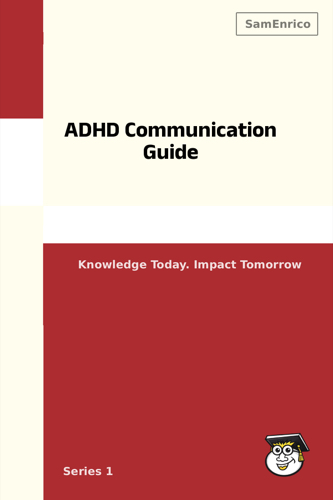
ADHD Communication Guide eBook
Ask for clarification without interrupting.
Ask for clarification without interrupting.
Formats
Free sample
Chapter 1: The Bad Listener Lie--–- My wife once drew a cartoon of me. In it, I had two giant ears, a mouth that was moving even though no one else was in the frame, and a thought bubble above my head that contained nothing but a spinning loading symbol—the kind you see on a frozen You Tube video. She titled it "The Listener Who Wasn't." When she showed it to me, I laughed. Then I felt sick. Because she wasn't being cruel.
She was being accurate.I had spent years believing I was a good listener. I made eye contact. I nodded at appropriate intervals. I said "mm-hmm" and "right" and "I see what you mean." By every external measure of listening—the performative ones, the ones we're taught in business communication seminars and relationship advice columns—I was acing the test. And yet, conversation after conversation, my wife would look at me with that particular exhaustion and say, "You didn't hear a word I said, did you?"I would protest.
I would replay the last thirty seconds in my head—except I couldn't, because there was nothing there. The words had entered my ears and then evaporated, like water on a hot skillet. I had been attending. I had not been processing. And I didn't know there was a difference.This chapter is about that difference.
It is about the single most damaging lie that people with ADHD are told about themselves: that interrupting and missing information means you are a bad listener, a self-centered conversationalist, or someone who simply doesn't care enough to pay attention. That lie has probably cost you relationships, job opportunities, and more nights of self-loathing than you can count. It is time to retire it.The Two-Channel Problem Every conversation you have ever struggled with can be understood through a simple framework: listening is not one skill but two. Think of them as two separate radio channels playing simultaneously in your brain.Channel One: Attention. This is the ability to point your focus at a speaker.
To look in their direction. To stop scrolling on your phone. To refrain from walking away mid-sentence. Attention is the gateway to listening—the front door of the house. Most people with ADHD have no trouble with attention in the way that non-ADHD people assume.
We can make eye contact. We can sit still (mostly). We can nod. We have learned, through years of social conditioning and shame, to perform attention flawlessly. The problem is that attention is only the beginning.Channel Two: Processing.
This is the ability to decode the sounds coming out of the speaker's mouth, hold them in your working memory long enough to make meaning, connect those meanings to relevant context from your own life, and formulate a response—all while continuing to receive new incoming sounds. Processing is the furniture inside the house. You can open the front door (attention) and still find an empty room with nowhere to sit (processing failure). Worse, you can stand in that empty room, nod politely, and convince everyone—including yourself—that you are fully present.Here is what most people, including many therapists, get wrong: they assume that if attention is present, processing must be happening. This is false.
For the ADHD brain, attention and processing are like two computers that run on different operating systems. They can be connected, but the connection is slow, unreliable, and prone to crashing without warning.I have sat across from my wife, looking directly into her eyes, watching her mouth form words, and heard absolutely nothing. Not because I wasn't trying. Not because I didn't care. But because my processing channel had silently switched off, like a circuit breaker tripping under a load it couldn't handle.
And then, five seconds later, the circuit would reset—just in time for me to realize I had missed everything and needed to ask her to repeat herself. Which I would do. And she would sigh. And the shame cycle would begin again.The Shame Cycle: A Complete Map Let me draw you a map of the terrain you have been walking for years. I want you to see the whole loop, because once you see it, you can start to step off it.Step One: The Misunderstanding.
Someone says something to you. Your processing lags, or your working memory drops the information, or a single trigger word sends you down an associative rabbit hole (vacation → beach → sunburn → aloe plant → I need to water my plants). By the time you return your attention to the speaker, they have moved on. You have missed something important. You feel the first flicker of panic.Step Two: The Interruption.
You need that missing information. You cannot wait for a natural pause because (a) the speaker may not pause for another thirty seconds, and (b) if you wait that long, you will forget what you needed to ask. Your brain, correctly identifying a threat to your understanding of the conversation, urges you to speak now. You interrupt. You say something like, "Wait, what did you say about the deadline?" Or worse, you don't even ask—you just guess what they meant and respond to your guess, creating confusion that will have to be untangled later.Step Three: The Perception of Rudeness.
The speaker stops. Their face changes. Maybe they sigh. Maybe they say, "I was just getting to that." Maybe they say nothing, but you feel the temperature of the conversation drop. They perceive your interruption as a sign that you don't value what they have to say—that your thought is more important than theirs.
This perception is not malicious. It is the default interpretation in neurotypical conversational culture, where turn-taking is a sacred rule and interrupting is a violation of respect.Step Four: Social Anxiety Increases. Now you feel it. The hot wash of shame. You didn't mean to be rude.
You were trying to understand. But the impact of your interruption is indistinguishable from rudeness from the outside, and the speaker's reaction confirms what you have always feared: you are bad at this. You are broken. You are the person who interrupts. Your anxiety about the next conversation spikes immediately, even as the current one continues.Step Five: The Next Conversation Starts with Higher Stress.
Days or hours later, you enter another important conversation. But you are not neutral. You are carrying the weight of every previous interruption, every sigh, every moment of seeing someone's face fall when you cut them off. Your baseline stress is higher. And higher stress makes processing harder.
Your working memory shrinks further under pressure. Your auditory processing slows down. The very mechanism that caused the interruption in the first place is now amplified by the shame of having interrupted before.Step Six: Return to Step One. You miss something again. You interrupt again.
The cycle spins.This is not a moral failure. It is a neurological feedback loop. And it is running in the background of every conversation you have ever felt bad about.What the Shame Cycle Steals From You Before we go any further, I want to name the losses. Because shame is not abstract. It…
This is the end of the free sample. Get the eBook to keep going. Buy now
About this book
Details
- Author
- Drake Kristen
- Publisher
- SamEnrico
- Language
- English
- Genre
- Non-Fiction, Self-Help, ADHD
- Released
- 2026-06-11
- Pages (approx.)
- 150
- Available as
- eBook, Audiobook

Read better in the ZLOADR app
Your eBooks on your phone or tablet. Sign in with your SamEnrico account and start reading.
More by Drake Kristen
 Religious Guilt DeconstructionDrake Kristen$11.99
 Senior Divorce Financial GuideDrake Kristen$11.99
 EQ for Managers GuideDrake Kristen$11.99
 Cash Only Spending CureDrake Kristen$11.99
 Self Hypnosis for EmpathsDrake Kristen$11.99
 Navigating Healthcare Billing TalksDrake Kristen$11.99
 Daysy Fertility Tracker ReviewDrake Kristen$11.99
 The Charge of the Iron Warriors: The Birth of Tank Warfare in the Franco-Prussian WarDrake Kristen$11.99
 The Vertical Farming Revolution: Dickson Despommier's Skyward SolutionDrake Kristen$11.99
 A Beginners Guide to Shinty (Volume 1)Drake Kristen$11.99
 Leopard Seals: Apex PredatorDrake Kristen$11.99
 How to Produce a PbxDrake Kristen$11.99
You may also like
 Priority Setting for ADHDMinor Keira$11.99
 TM For ADHD FocusStanley Winifred$11.99
 Grit for Students with ADHDManning Bradley$11.99
 Food Addiction And ADHD GuideDaniels Leroy$11.99
 Breath Counting for ADHDLowry Crysta$11.99
 Anger and ADHD ImpulsivityRhodes Carmen$11.99
 ADHD Student Academic GuideLeone Olevia$11.99
 ADHD Procrastination ManagementEspino Becki$11.99
 ADHD Child Rejection SensitivityQuezada Isis$11.99
 Weekly Review for ADHDGuinn Hiram$11.99
 Shopping Addiction and ADHDAtherton Suzann$11.99
 Parental Anger And ADHDBrogan Lekisha$11.99