
Non-FictionForecast & Outlook3D Printing
Additive Manufacturing Logistics Audiobook
Learn how 3D printing decentralizes production, re
Shift spare parts production to decentralized 3D printing hubs with this forecast.
Formats
Free sample
Chapter 1: The Inventory Graveyard...--The warehouse stretched for what felt like half a mile in every direction. Fluorescent lights hummed overhead, casting a sickly green glow on row after row of steel shelving. Each shelf held plastic bins, and each bin held parts—thousands of them, maybe hundreds of thousands. Some of these parts had arrived last week. Some had arrived before the current warehouse manager was born.
A few had likely been sitting here so long that the machines they were designed to repair had already been scrapped, melted down, and recycled into entirely different machines.This is the inventory graveyard. It exists in every industry, in every country, in every company that has ever sold a product that might someday break. And it is quietly bankrupting the global supply chain.The logistics manager who walked this warehouse—let us call her Elena, though she could be any of a thousand professionals in any of a hundred companies—knew the numbers by heart. This single facility cost 4.2millionperyeartooperate.Rent,utilities,insurance,labor,taxes.Notincludedinthatnumber:thecostoftheinventoryitself.Thepartsontheseshelvesrepresented4.2 million per year to operate. Rent, utilities, insurance, labor, taxes.
Not included in that number: the cost of the inventory itself. The parts on these shelves represented 4.2millionperyeartooperate.Rent,utilities,insurance,labor,taxes.Notincludedinthatnumber:thecostoftheinventoryitself.Thepartsontheseshelvesrepresented47 million in working capital. Of that, finance had already written off $12 million as “excess and obsolete”—accounting-speak for “we know we’ll never sell this, but we haven’t figured out how to dispose of it yet.”The remaining $35 million was the active inventory. But Elena knew a secret that her finance department did not fully appreciate: most of that “active” inventory was also dead. It was just not dead yet.This chapter dismantles the economic assumptions of traditional spare parts logistics.
It explains why the model that works brilliantly for high-volume production fails catastrophically for the long tail of slow-moving parts. It introduces a formal definition that will anchor the entire book. And it sets the stage for a radical alternative: a supply chain that moves data instead of atoms.The Inverted 80/20 Rule Every supply chain professional knows the Pareto principle: 80% of revenue comes from 20% of products. For high-volume consumer goods, this is approximately true. A grocery store makes most of its money on milk, eggs, bread, and a few other fast-moving staples.
The exotic cheeses and artisanal crackers are nice to have, but they do not pay the rent.Spare parts invert this…
This is the end of the free sample. Get the Audiobook to keep going. Buy now
About this book
Details
- Author
- Richmond Carissa
- Publisher
- SamEnrico
- Language
- English
- Genre
- Non-Fiction, Forecast & Outlook, 3D Printing
- Released
- 2026-05-30
- Pages (approx.)
- 150
- Available as
- eBook, Audiobook

Listen in the VoxFlicks app
Audiobooks and audio dramas wherever you go. Sign in with your SamEnrico account and press play.
More by Richmond Carissa
 Puer Aeternus Dream Archetype CourseRichmond Carissa$11.99
 Post Divorce LonelinessRichmond Carissa$11.99
 Values And Mission Alignment Storytelling GuideRichmond Carissa$11.99
 Strength Training for SurfingRichmond Carissa$11.99
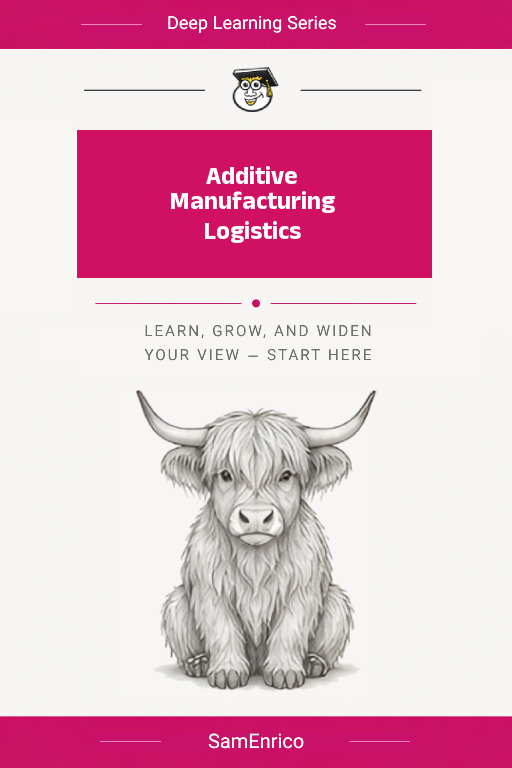 Additive Manufacturing LogisticsRichmond Carissa$12.99
 The Ghost in the Pill: The Rise and Fall of 'Flakka'Richmond Carissa$11.99
 Boardroom Bloodlines: The Cutthroat Rise of the Medici Banking EmpireRichmond Carissa$11.99
 Window Cleaning (High-rise Awareness)Richmond Carissa$11.99
 Understanding Hypogonadism Primary Partial AlopeciaRichmond Carissa$17.99
 AI Cyber Threat Assessment HandbookRichmond Carissa$12.99
 How to Become a ChoreographerRichmond Carissa$11.99
You may also like
 Hong Kong Handover 1997Dunn Johnnie$11.99
 Zumba For Postnatal Recovery CourseNeal Christian$11.99
 Zumba for BeginnersLadner Nikia$11.99
 YouTube Comment Mining GuideHumes Pandora$12.99
 Worry Box MeditationCarlin Rudy$11.99
 Workplace Stress MeditationNguyen Lynn$11.99
 Workplace Stress and Sleep RepairHawley Ivory$11.99
 Workplace Perfectionism CureDelaney Jeffry$11.99
 Workplace Injustice Anger GuideWallen Isabelle$11.99
 Work Addiction and Burnout LinkGreenwood Ester$11.99
 Women in Yoga and WellnessBeattie Galina$11.99
 Women in Stand Up ComedyChun Evangeline$11.99