
Non-FictionSelf-Help / Addiction
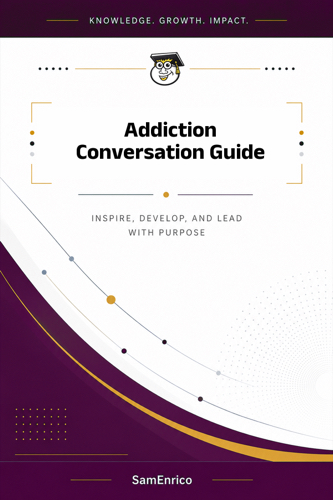
Addiction Conversation Guide eBook
undefined
by Mathias Mel
undefined
Formats
Free sample
Chapter 1: The Rat Park Revelation...--–- The first time Maria found her son’s needle, she threw it in the garbage and screamed at him for three hours. The second time, she locked him out of the house in February. The third time, she sat on the bathroom floor next to him while he wept, and she said nothing at all. That third conversation—if you could even call it a conversation—was the one that changed everything. Not because she found the right words, but because she finally stopped using the wrong ones.This is a book about words.
Specifically, it is a book about the twelve words that will likely determine whether someone you love lives or dies. That sounds dramatic. It is not. If you are reading this, you are likely the parent, spouse, sibling, child, or best friend of someone struggling with addiction. You have already said hundreds of words that did not work.
You have tried logic (“Can’t you see what this is doing to you?”). You have tried anger (“You are killing this family!”). You have tried tears, silence, ultimatums, bargains, prayers, and threats. None of it worked. Not because you are not loving enough or strong enough, but because your brain and their brain have been speaking different languages.
This chapter will teach you why the most common approaches to addiction conversations fail—and introduce you to the single most important scientific discovery about human bonding that will change everything you thought you knew.The Myth of the Moral Failure Before we can talk about conversation, we have to talk about the story you have been told about addiction. Most of us grew up with a simple, intuitive model: a person chooses to take a drug. They like it. They take it again. Eventually, they choose it over everything else—their job, their children, their own health.
At that point, we call them an addict. We say they have weak character, poor impulse control, or a moral failing. The solution, therefore, is to make the consequences of using so painful that they choose differently. We shame them. We exile them.
We wait for them to hit “rock bottom.” This is not just wrong. It is deadly.The moral failure model of addiction is to neuroscience what bloodletting is to medicine—a once-popular idea that has been proven to kill people. Over the past fifty years, researchers across multiple disciplines have arrived at a radically different conclusion: addiction is primarily a disorder of bonding and attachment. When human beings (and, as we will see, other mammals) lack meaningful relationships, they will bond compulsively to anything that provides relief—drugs, alcohol, gambling, food, or screens. The problem is not that the addict loves drugs too much.
The problem is that they love connection and cannot find it.Rat Park: The Experiment That Changed Everything In the 1970s, a psychologist named Bruce Alexander conducted a series of experiments that should have ended the moral failure model forever. Before Alexander, the standard addiction research was simple and grim: put a rat alone in a cage with two water bottles—one filled with plain water, one filled with morphine-laced water. The rat would almost always choose the morphine water, drink it obsessively, and eventually die. This was taken as proof that drugs are so powerfully addictive that any creature exposed to them will succumb. The problem, Alexander noticed, was the cage.So he built a different cage.
He called it Rat Park. It was a sprawling, luxurious habitat—sixteen times the size of a standard lab cage, filled with wheels, tunnels, toys, and most importantly, other rats. Male and female, young and old. A community. Then he repeated the experiment.
In Rat Park, the rats were offered the same two water bottles. They tried the morphine water out of curiosity—rats are naturally exploratory—but they did not prefer it. They barely touched it. Even rats who had been previously isolated and addicted, when moved to Rat Park, voluntarily stopped using morphine. They went through withdrawal, yes.
They shook and trembled and showed signs of distress. But they did not return to the drug. They chose connection over intoxication.This finding has been replicated across species and contexts. Isolated hamsters drink more alcohol. Isolated monkeys self-administer more cocaine.
Isolated human beings have higher rates of every addictive disorder. The mechanism is not mysterious. Mammalian brains are wired to bond. The same neurotransmitter systems that attach us to our parents as infants, our romantic partners as adults, and our children as parents—primarily oxytocin and dopamine—are the same systems hijacked by drugs. When a person lacks healthy bonds, the brain still craves the feeling of connection.
If no person is available, a substance will do.Shame Activates the Same Brain Circuits as Physical Pain Here is where the conversation becomes life-or-death. When you shame an addicted person—when you call them a disappointment, a liar, a failure, an embarrassment—you are not delivering a moral lesson. You are inflicting physical pain. Neuroscience research using functional MRI scans has shown that social rejection, exclusion, and shame activate the same brain regions (specifically the anterior cingulate cortex and anterior insula) as a physical burn or a punch to the gut. The brain cannot distinguish between being called a worthless addict and being hit with a baseball bat.This has devastating consequences for conversation.
When you confront an addicted person with anger or disgust, their brain goes into threat response. Cortisol spikes. The amygdala hijacks rational processing. They do not hear your words as information to consider; they hear them as an attack to survive. And what is the most reliable way to survive an attack?
Escape. For an addicted person, escape is easy: use the substance. You yell at them, they feel shame, their brain screams for relief, and the only reliable relief they know is the drug. Your attempt to stop their use has just triggered their use. This is not a failure of will on their part.
It is a failure of strategy on yours.The implications are uncomfortable but undeniable. If your current approach to talking about addiction involves raised voices, accusations, ultimatums, or any form of public or private humiliation, you are not helping. You are driving them deeper into the substance. The research is not ambiguous. A 2016 study in the journal Addiction followed 500 families over two years and found that family members who used shame-based communication strategies had loved ones with significantly higher relapse rates and lower treatment engagement.
The families who reported the best outcomes were not the ones who were “toughest.” They were the ones who learned to separate the disease from the person.The Difference Between Healthy Guilt and Toxic Shame Before we go further, we need to make a distinction that will appear throughout this book. Many readers will object at this point: “Are you saying I should never hold my loved one accountable? That they can steal from me, lie to me, endanger my children, and I should just smile and talk about feelings?” Absolutely not. Accountability matters. Consequences matter.
But there is a profound difference between toxic shame—which attacks the person’s identity—and healthy guilt—which addresses a specific behavior.Toxic shame…
This is the end of the free sample. Get the eBook to keep going. Buy now
About this book
Details
- Author
- Mathias Mel
- Publisher
- SamEnrico
- Language
- English
- Genre
- Non-Fiction, Self-Help / Addiction
- Released
- 2026-06-07
- Pages (approx.)
- 130
- Available as
- eBook, Audiobook

Read better in the ZLOADR app
Your eBooks on your phone or tablet. Sign in with your SamEnrico account and start reading.
More by Mathias Mel
 The Hydration and Focus GuideMathias Mel$11.99
 Dream Health Indicator LogMathias Mel$11.99
 Bay Village Bludgeoning MysteryMathias Mel$11.99
 Pet Loss and HoardingMathias Mel$11.99
 Downsizing Sentimental Items GuideMathias Mel$11.99
 Goal Setting For AnxietyMathias Mel$11.99
 Cope With EmotionsMathias Mel$11.99
 The Black Death's Silent WitnessMathias Mel$11.99
 The Golden Scrolls of Timbuktu: Africa's Forgotten ScholarsMathias Mel$11.99
 Service Providers Guide to Video ProductionMathias Mel$11.99
 How to Produce VacuumsMathias Mel$11.99
 Create a Spreadsheet Product FastMathias Mel$12.99
You may also like
 Hong Kong Handover 1997Dunn Johnnie$11.99
 Zumba For Postnatal Recovery CourseNeal Christian$11.99
 Zumba for BeginnersLadner Nikia$11.99
 YouTube Comment Mining GuideHumes Pandora$12.99
 Worry Box MeditationCarlin Rudy$11.99
 Workplace Stress MeditationNguyen Lynn$11.99
 Workplace Stress and Sleep RepairHawley Ivory$11.99
 Workplace Perfectionism CureDelaney Jeffry$11.99
 Workplace Injustice Anger GuideWallen Isabelle$11.99
 Work Addiction and Burnout LinkGreenwood Ester$11.99
 Women in Yoga and WellnessBeattie Galina$11.99
 Women in Stand Up ComedyChun Evangeline$11.99