

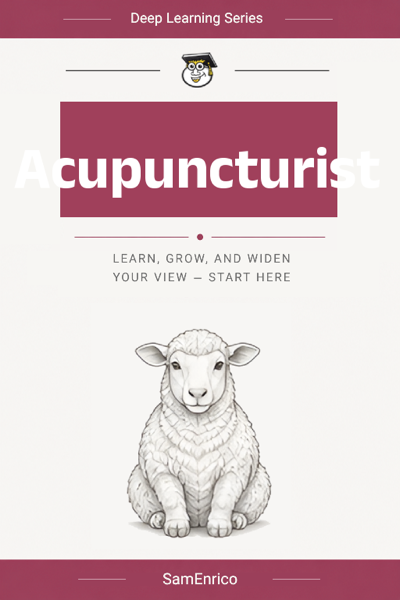
Non-FictionInformativeEducational
Acupuncturist eBook
A Coursebook on Acupuncturist
A Coursebook on Acupuncturist
Formats
Free sample
Chapter 1: The Living Thread...--–- Before the first needle was ever forged from stone, before the first bian stone drew blood from a suffering body, there was a question. The question was not "What is this disease?" nor "Which herb cures this fever?" nor even "How do I stop this pain?" The question—the one that gave birth to what we now call acupuncture—was far more ancient and far more radical: How does the universe move through me?This chapter does not begin with a list of points. It does not begin with a diagram of meridians or a table of Zang-Fu organs. It begins with a story—the story of how human beings, observing the rhythms of heaven and earth, came to see themselves as participants in a living, breathing cosmos. For without this story, acupuncture becomes mere technique: a collection of insertions without meaning, a set of locations without logic.
With this story, every needle becomes a conversation between the practitioner, the patient, and the fundamental patterns of existence.The Archaeology of Healing: From Stone to Systematic Thought The earliest evidence of what we might call acupuncture comes not from written texts but from the ground itself. In the Neolithic sites of China, archaeologists have unearthed bian stones—sharpened fragments of chipped stone, shaped with a care that suggests deliberate medical use. These were not weapons. They were not tools for hunting or butchery. They were instruments for opening the body, for letting out what should not be there, for calling the body back to balance.
The Chinese character bian (砭) combines the radical for "stone" with the radical for "to strike" or "to tap." To treat with bian stones was to strike the skin, to bleed superficial channels, to release the noxious influences that had invaded the patient's flesh.But here is the crucial insight: even at this prehistoric stage, the practice was never purely mechanical. The person wielding the bian stone was not a technician following a manual. They were a healer who understood that the body's suffering was connected to something larger—to the weather, to the seasons, to the emotions of the community, to the movements of the stars. Healing was not about fixing a broken part. Healing was about restoring a broken relationship between the person and the cosmos.The leap from stone tools to systematic medicine occurred during the Han Dynasty (206 BCE–220 CE) , a period of extraordinary intellectual flowering in Chinese history.
It was during this era that the Huangdi Neijing (Yellow Emperor's Inner Classic) was compiled—not written by a single author, but assembled from centuries of oral tradition, clinical observation, and philosophical speculation. This text, which remains the foundational scripture of acupuncture to this day, is structured as a dialogue between the Yellow Emperor (Huangdi) and his minister Qi Bo. The Emperor asks the practical questions: "Why do people get sick? How do I treat fever? What causes pain?" Qi Bo answers not with protocols but with principles: "The Dao gives birth to one.
One gives birth to two. Two gives birth to three. Three gives birth to the ten thousand things."The Neijing does not teach a technique. It teaches a way of seeing.The Two Pillars: Yin-Yang and the Five Elements Every system of thought rests on foundational assumptions. In Western biomedicine, the foundational assumptions are materialist and reductionist: the body is a machine, disease is a breakdown of that machine, and treatment is the repair or replacement of broken parts.
This model has produced miracles—antibiotics, surgery, vaccines, organ transplantation. But it has also produced blind spots. It struggles with chronic pain. It treats symptoms rather than patterns. It separates mind from body in ways that violate the lived experience of most patients.The TCM model rests on two different pillars.Yin-Yang is the first pillar.
The concept is famously simple: all phenomena can be understood as having two complementary, opposing, and mutually defining aspects. Day is Yang, night is Yin. Summer is Yang, winter is Yin. Activity is Yang, rest is Yin. The front of the body is Yin, the back is Yang.
The lower burner is Yin, the upper burner is Yang. But here is the subtlety: nothing is purely Yin or purely Yang. Every Yang contains the seed of Yin; every Yin contains the seed of Yang. The cycle of day and night is not a battle between light and darkness—it is a dance. The most Yang moment of midday contains within it the beginning of the descent toward evening.
The most Yin moment of midnight contains within it the beginning of the ascent toward dawn.In clinical terms, this means that the practitioner never asks "Is this patient Yin or Yang?" but rather "In what proportion are Yin and Yang present, and how are they interacting?" A fever is excess Yang, yes—but the Yang may be rising because of an external invasion (acute infection) or because Yin is insufficient to anchor it (adrenal exhaustion with low-grade inflammation). The treatment for these two conditions could not be more different, yet both present as "heat." The Yin-Yang lens prevents the practitioner from treating the symptom and forces them to treat the relationship.The Five Elements (Wood, Fire, Earth, Metal, Water) is the second pillar. This is not a theory of matter—the Chinese did not believe that the body was literally made of wood or fire. Rather, the Five Elements are phases of transformation, dynamic processes that describe how energy changes form. Wood is the phase of upward, outward expansion—springtime, birth, the Liver.
Fire is the phase of maximal activity—summer, ripening, the Heart. Earth is the phase of central nourishment—late summer, harvest, the Spleen. Metal is the phase of contraction and purification—autumn, falling leaves, the Lungs. Water is the phase of storage and potential—winter, seeds dormant in frozen ground, the Kidneys.The elements are not static categories. They generate and control one another in predictable cycles.
The Generating Cycle (Sheng) describes how each element nourishes the next: Wood feeds Fire (fuel), Fire creates Earth (ash), Earth bears Metal (ore), Metal collects Water (condensation), Water nourishes Wood (rain). The Controlling Cycle (Ke) describes how each element checks the next: Wood parts Earth (roots), Earth absorbs Water (banks), Water extinguishes Fire, Fire melts Metal, Metal cuts Wood. When these cycles function harmoniously, the body moves smoothly through its daily and seasonal rhythms. When they break down—excessive generation or insufficient control—disease follows.A simple example: the emotion of anger is associated with Wood (Liver). If a patient experiences chronic, suppressed anger, the Wood energy becomes congested.
According to the Controlling Cycle, Wood should be kept in check by Metal (Lungs, grief, release). But if the patient cannot grieve or release, the Wood overacts, and it will next attack the Earth (Spleen, digestion). The clinical presentation? A patient who is irritable (Liver Qi stagnation), but who also presents with bloating, loose stools, and fatigue (Spleen Qi deficiency). The Five Elements lens reveals that the digestive symptoms are not separate from the emotional symptoms—they are the same pattern expressing at different levels.Defining Qi: A Functional, Non-Mystical Framework No concept in…
This is the end of the free sample. Get the eBook to keep going. Buy now
About this book
Details
- Author
- Reeves Christine
- Publisher
- SamEnrico
- Language
- English
- Genre
- Non-Fiction, Informative, Educational
- Released
- 2026-06-02
- Pages (approx.)
- 154
- Available as
- eBook, Audiobook

Read better in the ZLOADR app
Your eBooks on your phone or tablet. Sign in with your SamEnrico account and start reading.
More by Reeves Christine
 MBSR For Caregiver BurnoutReeves Christine$11.99
 Burnout Prevention for Nonprofit Workers GuideReeves Christine$11.99
 Confucius Life and TeachingsReeves Christine$11.99
 AI Whistleblower Protections GuideReeves Christine$11.99
 The Self Esteem Journaling Prompts GuideReeves Christine$11.99
 Margaret Thatcher's Iron Gamble: The Falklands War and the Making of a Political LegacyReeves Christine$11.99
 How to Start a One-Hour Photofinishing BusinessReeves Christine$11.99
 Understanding Klippel–feil Syndrome Dominant TypeReeves Christine$17.99
 Usage Based SaaS GuideReeves Christine$12.99
 Journal Entry Review ManualReeves Christine$12.99
You may also like
 Hong Kong Handover 1997Dunn Johnnie$11.99
 Zumba For Postnatal Recovery CourseNeal Christian$11.99
 Zumba for BeginnersLadner Nikia$11.99
 YouTube Comment Mining GuideHumes Pandora$12.99
 Worry Box MeditationCarlin Rudy$11.99
 Workplace Stress MeditationNguyen Lynn$11.99
 Workplace Stress and Sleep RepairHawley Ivory$11.99
 Workplace Perfectionism CureDelaney Jeffry$11.99
 Workplace Injustice Anger GuideWallen Isabelle$11.99
 Work Addiction and Burnout LinkGreenwood Ester$11.99
 Women in Yoga and WellnessBeattie Galina$11.99
 Women in Stand Up ComedyChun Evangeline$11.99