
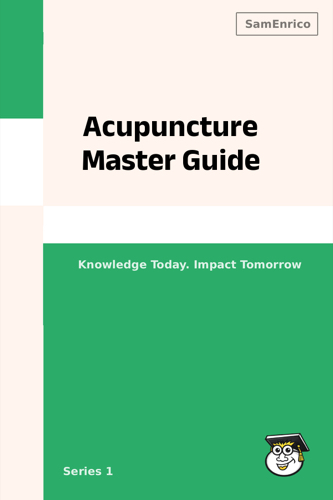
Acupuncture Master Guide eBook
Complete reference for acupuncture health applicat
by Lackey Debi
Complete reference for acupuncture health applications.
Formats
Free sample
Chapter 1: The Silk Road Within--–- The needle slipped into the patient’s hand with barely a whisper. No blood. No pain. Just a subtle, spreading warmth that seemed to travel up her arm, across her shoulder, and settle somewhere deep behind her eyes. Ten minutes later, the migraine that had tormented her for three straight days simply...
dissolved. She wept, not from pain, but from relief. She had tried everything—opioids, triptans, nerve blocks, even a week of inpatient neurology. Nothing worked. Yet four tiny filaments of stainless steel, placed by a practitioner trained in a 2,000-year-old medical tradition, had done what modern pharmacology could not.This scene, repeated millions of times daily across every continent, represents one of the most profound and yet poorly understood transformations in contemporary medicine.
Acupuncture, once dismissed as primitive superstition or placebo theater, has emerged as the single most researched and widely integrated non-pharmacological intervention in global healthcare. The World Health Organization recognizes over 100 conditions for which acupuncture has demonstrated therapeutic benefit. The U.S. National Institutes of Health has invested hundreds of millions of dollars in acupuncture research. Major medical centers—from Johns Hopkins to the Mayo Clinic to MD Anderson—now offer acupuncture alongside chemotherapy, surgery, and physical therapy.
And yet, for all this institutional acceptance, a chasm remains between what acupuncture is and what most people—including many physicians—believe it to be.This book is not another collection of mystical claims or diluted self-help platitudes. It is a comprehensive clinical reference designed for practitioners, students, and informed patients who demand evidence, precision, and practical application. We will dissect the anatomy beneath each point, the physiology behind each needle, and the data supporting each protocol. We will honor the classical traditions that gave birth to this medicine while ruthlessly testing them against the standards of modern science. By the end of these twelve chapters, you will not simply know about acupuncture.
You will understand how to apply it, why it works, and where it fits within the broader landscape of twenty-first-century healthcare.The Prehistory of Precision: Acupuncture Before Writing Long before the Huangdi Neijing (Yellow Emperor’s Inner Classic) was committed to silk or bamboo, there were stones. Archaeological excavations across Neolithic China have uncovered bian stones—sharpened implements of carved jade or bone, dating to 6000 BCE—that show wear patterns consistent with lancing abscesses, draining blood, and stimulating what we would now call acupuncture points. These were not mystical artifacts. They were tools, born of empirical observation: press here, and pain there diminishes. Cut here, and fever breaks.
These early healers had no theory of Qi or meridians. They had only cause and effect, trial and error, and a desperate need to relieve suffering.The shift from stone to metal needles occurred during the Shang Dynasty (1600–1046 BCE), contemporaneous with the Bronze Age civilizations of the Mediterranean. But it was during the Warring States period (475–221 BCE) that acupuncture underwent its first intellectual revolution. Philosophers and physicians, influenced by the naturalist traditions of Taoism and the emerging school of Yin-Yang thought, began to systematize scattered clinical observations into a coherent medical framework. The Huangdi Neijing, compiled over several centuries beginning around 300 BCE, represents the first complete articulation of this system.The Neijing is not a textbook in the modern sense.
It is a series of dialogues between the mythical Yellow Emperor and his ministers, covering anatomy, physiology, pathology, diagnosis, and treatment. In its pages, we encounter the first clear descriptions of:The Meridian System (Jing-Luo): A network of 12 primary channels and 8 extraordinary vessels through which Qi (vital energy) and blood circulate.Acupuncture Points (Xue): Specific locations along these channels where needle insertion can influence internal organ function.The Five Elements (Wu Xing): Wood, Fire, Earth, Metal, and Water as organizing principles for physiology and pathology.Yin-Yang Theory: The dynamic balance of opposing forces as the foundation of health and disease.What is remarkable about the Neijing is not its metaphysical speculation—every pre-modern medical system had its own cosmology—but its clinical sophistication. The text describes pulse palpation in terms that would be recognizable to any modern cardiologist. It distinguishes between acute and chronic illness. It warns against needling pregnant women in certain locations.
It even discusses what we would now call informed consent. For its time, the Neijing was as advanced relative to its contemporaries as Harrison‘s Principles of Internal Medicine is today.The Long Millenium: Acupuncture from the Han to the Qing The centuries following the Neijing saw acupuncture evolve from a regional practice into the dominant medical system of East Asia. The Han Dynasty (206 BCE–220 CE) produced the Zhen Jiu Jia Yi Jing (Systematic Classic of Acupuncture and Moxibustion) by Huangfu Mi, which standardized point locations and established the first comprehensive reference guide. The Tang Dynasty (618–907 CE) established the Imperial Medical Bureau, which made acupuncture a formal specialty requiring examination and licensure—the first professional regulation of acupuncture in history.Perhaps the most significant innovation occurred during the Song Dynasty (960–1279 CE), when the physician Wang Weiyi cast two life-sized bronze statues depicting the 354 classical acupuncture points. These statues, hollow and filled with water or mercury, were used for examination: students had to insert needles into the correct points to release the fluid.
Miss by a fraction of an inch, and the statue remained sealed. This demand for anatomical precision, centuries before Vesalius, challenges the stereotype of acupuncture as vague or imprecise.The Ming Dynasty (1368–1644 CE) saw the publication of the Zhen Jiu Da Cheng (Great Compendium of Acupuncture and Moxibustion), which remains the most complete classical reference. It was during this period that acupuncture spread beyond China to Korea, Japan, and Vietnam, each culture adapting the practice to its own diagnostic preferences. Japanese acupuncture, for example, developed a reputation for thinner needles and more superficial insertion. Korean hand acupuncture (Koryo Sooji Chim) mapped the entire body onto the hand.
These variations, far from diluting the tradition, enriched it with clinical innovations.The Qing Dynasty (1644–1912) marked a period of relative decline. The imperial court favored herbal medicine and moxibustion over acupuncture, and many classical texts were lost or suppressed. By the time the last emperor fell in 1911, acupuncture had become a folk practice, marginalized in favor of Western medicine introduced by missionaries and colonial powers. In 1929, the Chinese government attempted to ban acupuncture entirely. It survived only because rural peasants, with no access to Western drugs or doctors, continued to demand it.The Western Awakening: From James Reston to the NIHEvery acupuncture student knows the story, and it bears repeating because it illuminates how cultural transmission often occurs through accident and celebrity.
In July 1971, James Reston, a columnist for the New York Times, accompanied Henry Kissinger on a secret diplomatic mission to China. Reston developed acute appendicitis and underwent emergency surgery at the Anti-Imperialist Hospital in Beijing. Postoperatively, he suffered significant abdominal pain. The Chinese surgeons, rather than administering morphine, inserted three long needles around his elbows and knees, then twisted them for twenty minutes. Reston‘s pain subsided completely.He wrote about the experience.
The Times published his account on July 26, 1971, under the headline: “Now, About My Operation in Peking.” The piece was not about…
This is the end of the free sample. Get the eBook to keep going. Buy now
About this book
Details
- Author
- Lackey Debi
- Publisher
- SamEnrico
- Language
- English
- Genre
- Non-Fiction, Health & Wellness, Complete
- Released
- 2026-06-05
- Pages (approx.)
- 160
- Available as
- eBook, Audiobook

Read better in the ZLOADR app
Your eBooks on your phone or tablet. Sign in with your SamEnrico account and start reading.
More by Lackey Debi
 Validation for LeadersLackey Debi$11.99
 Vocabulary Palace MethodLackey Debi$11.99
 Falling Nightmare RescriptingLackey Debi$11.99
 The Alcohol and ED LinkLackey Debi$11.99
 Family Assertiveness GuideLackey Debi$11.99
 Wholesaling Ethical PracticesLackey Debi$11.99
 Commute Time FreelancingLackey Debi$11.99
 The Day the Sun Stood Still: The Great Solar Storm of 1859Lackey Debi$11.99
 The Cyber Siege: When a Ransomware Attack Turned Deadly in SeoulLackey Debi$11.99
 Antitrust Law: Monopolies, Cartels & CompetitionLackey Debi$11.99
 How to Produce Rhinestones and FlatbacksLackey Debi$11.99
 How to Produce Facial Tissue HoldersLackey Debi$11.99
You may also like
 Men's Master GuideGass Viviana$11.99
 Injury Master GuideStuckey Berenice$11.99
 Macronutrient Master GuideTillery Carlita$11.99
 Sleep Master GuideDesantis Dominique$11.99
 PCOS Master GuideOtoole Sierra$11.99
 Flexibility Master GuideSamples Lawrence$11.99
 IBS Master ReferenceBolin Meryl$11.99
 Hormonal Master GuideOswald Elda$11.99
 Food Intolerances Complete GuideTitus Earleen$11.99
 Beginner Fitness MasterSharkey Vinita$11.99
 Napping Complete Health GuideEnnis Laronda$11.99
 Group Fitness MasterHolly Lashawnda$11.99