
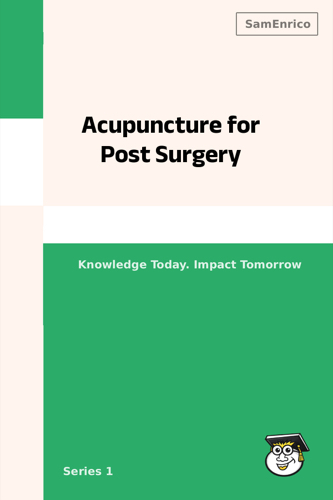
Non-FictionHealth & Wellness / Surgery
Acupuncture for Post Surgery eBook
Accelerates healing and reduces pain after operati
Accelerates healing and reduces pain after operations.
Formats
Free sample
Chapter 1: The Zero-Dollar Drug...--I wrote this chapter in bed. Not a comfortable bed in a well-appointed bedroom, but a hospital bed that had been moved into my living room because I could not climb the stairs. Three days after a surgery that my surgeon had called "minimally invasive," I was lying in my own sweat, constipated from the painkillers, too afraid to move, and crying because I could not lift my own water glass. The water glass was four inches from my hand. My hand would not obey.
My surgeon said I was healing "fine." But fine was not sleeping. Fine was not walking. And fine was definitely not living.That night, at two in the morning, I did something desperate. I had read a single sentence in an obscure pain management journal months earlier—something about a point on the ear called Shen Men, the "Gate of the Spirit." I had no needles. I had no training.
But I had a bag of vaccaria seeds left over from a long-ago acupuncture visit, and I had nothing left to lose. I taped a single seed to the triangular depression in my left ear. I pressed it for sixty seconds. And then I waited.Twelve minutes later, my pain dropped from an eight to a four.I did not believe it. I am not the kind of person who believes in magic.
I am the kind of person who reads meta-analyses for fun, who demands citations, who rolls her eyes at wellness influencers selling crystals and intention. But the pain did not care about my skepticism. It was gone. Not entirely, not miraculously—but enough. Enough to sleep.
Enough to reach for the water glass. Enough to start asking a different question: not does acupuncture work, but how, and why, and why is no one telling us this before we go under the knife?This book is the answer to that question. It is what I wish someone had handed me before the incision.The Hidden Epidemic No Surgeon Will Discuss Let us begin with a number that should terrify you: thirty percent.Thirty percent of patients who undergo major surgery will develop persistent post-surgical pain—pain that outlasts the expected healing window by months or years. Thirty percent. That is not a rare complication.
That is a public health crisis hiding in plain sight.The standard post-operative pain protocol has not changed meaningfully in forty years. You receive a prescription for opioids—oxycodone, hydrocodone, tramadol, or morphine. You are told to take them as needed. You are sent home with a bottle of pills and a wave. What you are not told is the full ledger of costs that come with those pills.The Opioid Ledger Side Effect Incidence Rate Impact on Recovery Nausea40%Delays oral intake, prolongs hospital stay Constipation60%Prevents mobility, causes abdominal pain Dizziness25%Increases fall risk, prevents walking Sedation35%Prevents deep sleep, impairs rehab participation Urinary retention20%Requires catheterization, increases infection risk Opioid-induced hyperalgesia15%Increases pain sensitivity over time The last one is the cruelest trick.
Opioid-induced hyperalgesia is a well-documented phenomenon where chronic opioid use actually lowers your pain threshold, making you more sensitive to pain than you would be without the medication. The cure becomes the cause.And then there is the risk that no one wants to talk about. Of the nearly eighty million surgeries performed annually in the United States, between six and ten percent of patients will still be taking opioids three months after discharge. For some procedures—back surgery, joint replacement, thoracic surgery—that number rises to fifteen percent. Fifteen percent of patients walk into surgery with no history of dependency and walk out with a new one.This is not a moral failure.
This is a pharmacological reality. Opioids are exquisitely effective at short-term pain relief and exquisitely dangerous at long-term use. The problem is that "short-term" for a hip replacement is measured in days, but the prescription bottle contains thirty pills. The problem is that the ninth pill works as well as the first, but the ninetieth does not. The problem is that no one has offered you an alternative.Until now.The Healing Gap: Why Managing Pain Is Not the Same as Accelerating Healing Here is a distinction that changed everything for me, and it will change everything for you: pain management is not healing acceleration.Pain management is the act of making you comfortable.
It is important. It is humane. It is not sufficient. When you take an opioid, the drug binds to mu-opioid receptors in your brain and spinal cord. It blocks the transmission of pain signals.
It does nothing—literally nothing—to address the underlying biology of recovery. Your wound does not close faster. Your inflammation does not resolve more completely. Your nerves do not regenerate more robustly. You are simply sedated enough to not mind the process.Healing acceleration is something else entirely.
It is the active promotion of the biological processes that restore tissue integrity: angiogenesis (the growth of new blood vessels), fibroblast proliferation (the production of collagen for wound closure), macrophage activity (the cleanup of cellular debris), and neuroplasticity (the rewiring of damaged nerve pathways). These processes are not passive. They require specific molecular signals: growth factors, cytokines, neurotransmitters, and hormones.This book is about a single intervention that influences all of these processes simultaneously. That intervention is acupuncture.I want to be precise here, because precision is the enemy of skepticism. Acupuncture is not a cure-all.
It will not regrow a severed nerve or mend a broken bone that requires surgical fixation. It is not a replacement for antibiotics, blood transfusions, or emergency surgery. But for the vast middle ground of surgical recovery—the weeks and months after the incision has closed—acupuncture is one of the most powerful, safest, and most underutilized tools in modern medicine.The Evidence: What the 2024 Meta-Analysis Actually Says Let me give you the single most important statistic in this book.In 2024, the journal Pain Management Nursing published a meta-analysis of twenty-seven randomized controlled trials examining acupuncture for post-operative pain. The analysis included 2,439 patients across a range of surgeries: orthopedic (knee, hip, spine), abdominal (hysterectomy, cholecystectomy, colorectal), thoracic (lung resection), and gynecological. The primary outcome was pain intensity measured on a standardized visual analog scale (VAS) at twenty-four hours post-surgery.The result: Acupuncture reduced post-operative pain scores by an average of 38% compared to standard care alone.Let that number land.
Thirty-eight percent. No drug has ever achieved that level of pain reduction without significant side effects. The closest comparator is intravenous morphine, which reduces pain by 40-50% in the immediate post-operative period—but at the cost of nausea in forty percent of patients, sedation in thirty-five percent, and respiratory depression in one to ten percent. Acupuncture has none of those side effects. The most common adverse event is a small bruise at the needle site, occurring in less than two percent of treatments.The meta-analysis also reported secondary outcomes that are arguably more important than pain scores:Opioid consumption was reduced by an average of 32% in the acupuncture groups Nausea and vomiting were reduced by 44% (independent of opioid reduction, suggesting a direct antiemetic effect)Time to…
This is the end of the free sample. Get the eBook to keep going. Buy now
About this book
Details
- Author
- Stamm Tawanna
- Publisher
- SamEnrico
- Language
- English
- Genre
- Non-Fiction, Health & Wellness / Surgery
- Released
- 2026-06-09
- Pages (approx.)
- 131
- Available as
- eBook, Audiobook

Read better in the ZLOADR app
Your eBooks on your phone or tablet. Sign in with your SamEnrico account and start reading.
More by Stamm Tawanna
 Yoga Asana Self HypnosisStamm Tawanna$11.99
 OKR For Digital DetoxStamm Tawanna$11.99
 Collaborative Forced Connections GuideStamm Tawanna$11.99
 Student Friendship BuildingStamm Tawanna$11.99
 Self Hypnosis for Rejection SensitivityStamm Tawanna$11.99
 Posture Check HabitStamm Tawanna$11.99
 Massage For Palliative CareStamm Tawanna$11.99
 Charlemagne's Crown: The Forge of a New EuropeStamm Tawanna$11.99
 The Golden Throne of Sheba: Queen Makeda's Wisdom and WealthStamm Tawanna$11.99
 How to Start a Coursing Business (Beginners Guide)Stamm Tawanna$11.99
 How to Produce Pie and Pastry FillingsStamm Tawanna$11.99
 How to Produce Dental Hygiene ProductsStamm Tawanna$11.99
You may also like
 Hong Kong Handover 1997Dunn Johnnie$11.99
 Zumba For Postnatal Recovery CourseNeal Christian$11.99
 Zumba for BeginnersLadner Nikia$11.99
 YouTube Comment Mining GuideHumes Pandora$12.99
 Worry Box MeditationCarlin Rudy$11.99
 Workplace Stress MeditationNguyen Lynn$11.99
 Workplace Stress and Sleep RepairHawley Ivory$11.99
 Workplace Perfectionism CureDelaney Jeffry$11.99
 Workplace Injustice Anger GuideWallen Isabelle$11.99
 Work Addiction and Burnout LinkGreenwood Ester$11.99
 Women in Yoga and WellnessBeattie Galina$11.99
 Women in Stand Up ComedyChun Evangeline$11.99