
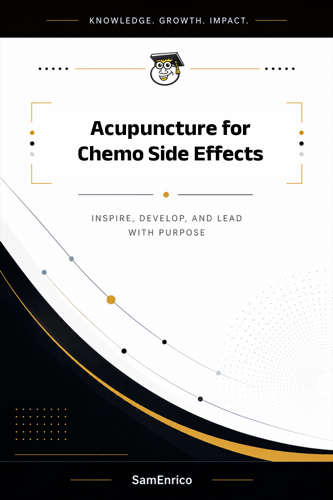
Non-FictionHealth & Wellness / Oncology
Acupuncture for Chemo Side Effects eBook
undefined
undefined
Formats
Free sample
Chapter 1: The Metabolic Storm...--–- The IV bag hangs above the hospital bed, dripping a clear liquid into the port under your collarbone. The nurse calls it a "cycle." Your oncologist calls it "standard of care." Your family calls it "the fight." But inside your body, far from these comforting words, something else is happening. Inside your body, a storm is raging.Every cell in your body is about to be tested. The drugs entering your veins right now—whether it's doxorubicin, cisplatin, paclitaxel, or any of the dozens of chemotherapy agents—cannot read the word "cancer." They cannot distinguish between the mutated, rapidly dividing cells in your breast, lung, or colon and the healthy, rapidly dividing cells in your bone marrow, your digestive tract, your hair follicles, and your nervous system. They are, to put it bluntly, biological carpet bombers.
And while they are remarkably effective at shrinking tumors, they are equally ruthless in their collateral damage.This chapter is not about Traditional Chinese Medicine. That comes in Chapter 2. This chapter is about honoring what you are experiencing right now—the nausea that arrives like a wave, the fatigue that no amount of sleep can touch, the tingling in your fingertips that feels like ants crawling under your skin, the bone pain that makes you wonder if your skeleton is splitting from the inside. This chapter is the biomedical foundation upon which every acupuncture protocol in this book is built. You cannot understand why a needle in your wrist stops nausea unless you understand why chemotherapy causes nausea in the first place.
You cannot appreciate why moxa on your lower leg restores energy unless you grasp why chemotherapy drains your bone marrow.And before we go any further, a critical warning—one that most books bury in an appendix or skip entirely.Safety First: When Acupuncture Is Not Safe for You Acupuncture is remarkably safe when performed by a qualified practitioner. But "remarkably safe" is not the same as "always safe for everyone." Your body during chemotherapy is not a normal body. Your blood counts are not normal. Your immune system is not normal. And certain conditions make acupuncture potentially dangerous.Absolute contraindications (do not receive acupuncture under any circumstances without explicit oncology approval):Platelet count below 20,000/μL.
Normal platelet counts range from 150,000 to 450,000. Chemotherapy frequently drops platelets into the 20,000–50,000 range (moderate risk). Below 20,000, spontaneous bleeding can occur. Needles create tiny punctures. Those punctures may not stop bleeding.
This is not a theoretical risk—it is a documented cause of intramuscular hematomas requiring transfusion. If your most recent blood work shows platelets under 20,000, use acupressure instead (Chapter 4) or ear seeds (Chapter 12). Do not let anyone put a needle in your body.Absolute neutrophil count (ANC) below 500/μL. Neutrophils are your first responders against bacterial infection. Below 500, you are in severe neutropenia.
A needle creates a micro-channel from the skin surface into your tissue. If bacteria are present on your skin—and they always are—that needle can carry them inside. In a patient with normal immunity, this is harmless. In a patient with ANC below 500, it can trigger cellulitis, abscess, or sepsis. Wait until your counts recover.Needle phobia with syncope (fainting).
This is not about fear. It is about vasovagal response. Some patients faint at the sight of needles, and the faint can cause falls, head injuries, or fractures in already weakened bones. Acupressure and ear seeds are excellent alternatives.Certain blood cancers. Patients with acute leukemias, particularly acute promyelocytic leukemia, have coagulation disorders beyond simple low platelets.
Needling may trigger bleeding even with normal counts. Your oncologist must sign off.Relative contraindications (proceed with caution, only with an experienced oncology acupuncturist):Lymphedema risk (discussed in detail in Chapter 11). Never needle the affected arm in breast cancer survivors who have had axillary node dissection.Bone metastases. Needling directly into a metastatic lesion is contraindicated. Needling near a lesion is acceptable if the practitioner uses shallow insertion and avoids periosteal contact.Presence of a port-a-cath.
Needling around a port is safe. Needling directly into it is not. Your acupuncturist should know where your port is located.If you are reading this book and you have not yet discussed acupuncture with your oncologist, stop here. Go get permission. Bring Chapter 3 with you—it contains the evidence you need to make your case.
Now, with that understood, let us return to the storm.The Biological Logic of Chemotherapy: Why It Works and Why It Hurts Cancer is defined by uncontrolled cell division. A normal cell divides only when it receives specific signals—a cut needs healing, a worn-out intestinal lining needs replacement, an immune cell needs to multiply to fight an infection. Cancer cells have broken those signaling pathways. They divide constantly, regardless of the body's needs.Chemotherapy drugs exploit one fundamental vulnerability: rapidly dividing cells require specific biochemical conditions to replicate their DNA. Each class of chemotherapy attacks a different step in that replication process.Alkylating agents (cyclophosphamide, cisplatin, carboplatin) damage DNA directly by adding alkyl groups to the DNA molecule, causing cross-linking that prevents strands from separating for replication.
These drugs are cell-cycle nonspecific—they kill cells whether they are dividing or not, which makes them potent but also profoundly toxic to slow-dividing cells like neurons.Antimetabolites (5-fluorouracil, methotrexate, gemcitabine) mimic the building blocks of DNA. When a cell tries to use these fake nucleotides, DNA synthesis stops. These drugs primarily affect cells in the S-phase (DNA synthesis phase) of the cell cycle.Anti-tumor antibiotics (doxorubicin, daunorubicin) intercalate between DNA base pairs, blocking transcription and replication. They also generate free radicals that damage cell membranes. This class is particularly cardiotoxic.Plant alkaloids (paclitaxel, docetaxel, vincristine) disrupt microtubules—the cellular scaffolding required for chromosome separation during mitosis.
Paclitaxel stabilizes microtubules so they cannot break down; vincristine prevents them from forming. Both stop cell division, but both also damage neurons, which rely on microtubules for axonal transport.Topoisomerase inhibitors (etoposide, irinotecan) block the enzymes that untangle DNA during replication. Without these enzymes, DNA strands break and the cell dies.Your oncologist chooses a specific combination based on your cancer type, stage, and genetic markers. But here is the critical insight for this book: no matter which drugs you receive, the pattern of side effects follows a predictable logic based on which healthy tissues divide most rapidly.The Three Most Vulnerable Tissues The body maintains several populations of cells that divide constantly throughout adult life. These are the collateral damage zones.Zone 1: The Bone Marrow (The Source)Your bone marrow produces approximately 200 billion new red blood cells, 100 billion new white blood cells, and 100 billion new platelets every single day.
This relentless production requires constant DNA replication. Chemotherapy cannot distinguish between leukemic blasts and healthy hematopoietic stem cells.The result is myelosuppression—the reduction of bone marrow output. The timeline is predictable:Day 3-5 after chemo: Platelet production drops first, as megakaryocytes (the cells that produce platelets) are extremely sensitive to DNA damage. Platelet counts fall.Day 7-14: White blood cell counts reach their lowest point. This is the nadir.
Neutrophils (the most abundant white blood cell) have the shortest lifespan (6-8 hours), so their depletion is the most dramatic. This is…
This is the end of the free sample. Get the eBook to keep going. Buy now
About this book
Details
- Author
- Gaskin Easter
- Publisher
- SamEnrico
- Language
- English
- Genre
- Non-Fiction, Health & Wellness / Oncology
- Released
- 2026-06-06
- Pages (approx.)
- 160
- Available as
- eBook, Audiobook

Read better in the ZLOADR app
Your eBooks on your phone or tablet. Sign in with your SamEnrico account and start reading.
More by Gaskin Easter
 Flow in Learning StudyingGaskin Easter$11.99
 Virtual Meeting Etiquette HandbookGaskin Easter$11.99
 Group Creativity For Agile TeamsGaskin Easter$11.99
 The Dubai Exam ProctoringGaskin Easter$11.99
 Self Hypnosis for Neck PainGaskin Easter$11.99
 Forensic Odontology ResearchGaskin Easter$11.99
 Senior Therapy GuideGaskin Easter$11.99
 The Linguistic Architects of Timbuktu: Decoding the Multilingual Marvels of the Songhai EmpireGaskin Easter$11.99
 The Ghost of Mount Erebus: A Colonial Era Massacre in New ZealandGaskin Easter$11.99
 South China Tigers: Critically EndangeredGaskin Easter$11.99
 One Page Webinar Promotion PlanGaskin Easter$12.99
 Channel Strategy Cheat SheetGaskin Easter$12.99
You may also like
 Hong Kong Handover 1997Dunn Johnnie$11.99
 Zumba For Postnatal Recovery CourseNeal Christian$11.99
 Zumba for BeginnersLadner Nikia$11.99
 YouTube Comment Mining GuideHumes Pandora$12.99
 Worry Box MeditationCarlin Rudy$11.99
 Workplace Stress MeditationNguyen Lynn$11.99
 Workplace Stress and Sleep RepairHawley Ivory$11.99
 Workplace Perfectionism CureDelaney Jeffry$11.99
 Workplace Injustice Anger GuideWallen Isabelle$11.99
 Work Addiction and Burnout LinkGreenwood Ester$11.99
 Women in Yoga and WellnessBeattie Galina$11.99
 Women in Stand Up ComedyChun Evangeline$11.99