

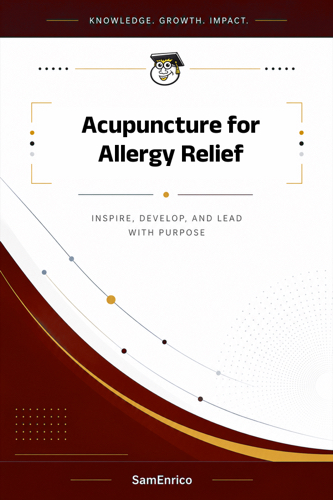
Non-FictionHealth & WellnessImmunology
Acupuncture for Allergy Relief eBook
Reduce histamine response using lung and large int
Reduce histamine response using lung and large intestine points.
Formats
Free sample
Chapter 1: The Castle Wall...--–- The first time six-year-old Maya sneezed seventeen times in a row, her mother thought it was adorable. The second time, during a field trip to a park blooming with goldenrod, it was concerning. By the third week of relentless sneezing, red-rimmed eyes, and a nose that ran like a faucet regardless of how many antihistamines she swallowed, Maya’s pediatrician delivered a diagnosis that would change the family’s routine for the next decade: seasonal allergies. Maya’s mother left the office with three prescriptions and a shrug. “Some kids just have sensitive immune systems,” the doctor said.
“She’ll grow out of it. Or she won’t. Here’s a refillable prescription.”Maya is now thirty-two years old. She never grew out of it. She has tried every over-the-counter pill, every prescription nasal spray, every expensive air filter, every avoidance strategy recommended by allergists.
She has slept with hypoallergenic pillowcases and washed her hair every night before bed to remove pollen. She has spent thousands of dollars on medications that make her drowsy, or irritable, or give her dry mouth so severe she carries water bottles like a lifeline. And every spring, like clockwork, she still sneezes seventeen times in a row.Maya is not alone. In the United States alone, more than fifty million people suffer from allergic rhinitis—the medical term for what most of us call hay fever or seasonal allergies. That is one in every six Americans.
Globally, the World Allergy Organization estimates that three hundred to four hundred million people struggle with allergic rhinitis, with rates rising fastest in urban centers and among children. The economic cost is staggering: lost productivity, doctor visits, medications, and emergency room visits for severe reactions add up to more than eighteen billion dollars annually in the United States alone. And yet, despite all this suffering and all this spending, the standard medical approach has changed very little in the past thirty years. Identify the allergen. Avoid the allergen.
Suppress the histamine. Repeat.This book offers a fundamentally different approach, rooted in a medical tradition that has understood the nature of allergic reactions for more than two thousand years. That tradition is Traditional Chinese Medicine, or TCM. And the specific tool we will explore is acupuncture—but not acupuncture as it is often misunderstood in the West, as a vague “energy balancing” technique suitable only for stress reduction or vague complaints. No.
We will explore acupuncture as a precision intervention targeting specific points on the Lung and Large Intestine meridians, points with demonstrable effects on histamine release, immune modulation, and the body’s own defensive systems. This is not alternative medicine. This is sophisticated, mechanism-based medicine dressed in the language of Qi.Before we can understand how acupuncture stops a sneeze, we must first understand what a sneeze actually is. We must strip away the mystery and look at the biology. Then we must add back the wisdom of TCM, which explains not just the mechanism but the deeper reason why one person sneezes at pollen while another breathes it in without a care.
That deeper reason is what the Chinese call Wei Qi—the Defensive Qi—and it is the single most important concept in this entire book.The Biology of Misrecognition: How Histamine Turns Pollen Into Poison Every allergic reaction begins with a case of mistaken identity. Your immune system is a remarkably sophisticated surveillance network, capable of distinguishing between your own cells (which it leaves alone) and foreign invaders (which it attacks). This distinction is made possible by proteins called antibodies, which act like wanted posters. Each antibody is shaped to recognize a specific molecular pattern—a piece of a virus, a fragment of a bacterium, a protein from a parasite.In most people, pollen is recognized as harmless. The immune system looks at a ragweed or birch pollen grain, runs it through its database, and files it under “benign environmental particle.” Nothing happens.
The pollen is inhaled, trapped in mucus, and expelled or swallowed without incident.But in people with allergies, something goes wrong. The immune system misclassifies pollen as a dangerous pathogen—a virus or a parasite. It produces a specific type of antibody called Immunoglobulin E, or Ig E, designed to recognize that exact pollen protein. These Ig E antibodies attach themselves to mast cells, which are immune cells stationed in high-alert areas: the nose, the lungs, the eyes, the skin, the digestive tract. Mast cells are the sentinels.
They stand guard at every border between your body and the outside world.The first time Maya encountered goldenrod pollen, her immune system performed this misclassification silently. Her body created Ig E antibodies specific to goldenrod. Those antibodies docked onto her nasal mast cells. No symptoms yet. This is called sensitization.
It is the loading of the gun.The second time Maya encountered goldenrod pollen—during that field trip—the pollen grains bound to the Ig E antibodies already waiting on her mast cells. This cross-linking triggered an explosive cellular response. The mast cells degranulated, meaning they released packets of chemicals stored inside them. The most famous of these chemicals is histamine.Histamine is a remarkable molecule, but not in a good way during an allergic reaction. When histamine is released from mast cells in the nasal passages, it binds to H1 receptors on nearby blood vessels, causing them to dilate (widen) and become leaky.
This is vasodilation and increased capillary permeability. The result? Redness and swelling. The nasal passages become inflamed, narrow, and stuffy.Histamine also binds to nerve endings, specifically sensory C-fibers, which send signals to the brain that something is irritating the nasal lining. The brain interprets these signals as itching.
To relieve the itch, you rub your nose—the classic “allergic salute”—or you sneeze, which is a forced exhalation designed to expel the offending particle. Sneezing is not a malfunction. It is a brilliantly designed reflex to clear the airways. The problem is that in allergies, the reflex is triggered by something harmless, and it happens over and over and over again.Meanwhile, histamine triggers the production of more mucus. The nasal glands go into overdrive, producing a thin, watery discharge at first (that clear runny nose) and later, thicker mucus as the immune response continues.
Post-nasal drip—mucus that runs down the back of the throat—causes coughing and throat clearing. If the inflammation spreads to the sinuses, you get sinus pressure and headaches. If it spreads to the eyes, you get allergic conjunctivitis: red, itchy, watery eyes.This entire cascade—sensitization, re-exposure, histamine release, inflammation, itching, sneezing, mucus production—takes place in minutes. It is fast, furious, and miserable. And standard antihistamines work by blocking histamine from binding to those H1 receptors.
They do not stop histamine from being released. They do not fix the immune system’s misclassification. They simply prevent histamine from delivering its message. It is like silencing a fire alarm without putting out the fire. The fire—the underlying immune dysfunction—continues to burn.This is why antihistamines stop working the moment you stop taking them.
This is why you can take a pill every day for thirty years and still sneeze the moment you miss…
This is the end of the free sample. Get the eBook to keep going. Buy now
About this book
Details
- Author
- Nettles Tanja
- Publisher
- SamEnrico
- Language
- English
- Genre
- Non-Fiction, Health & Wellness, Immunology
- Released
- 2026-06-08
- Pages (approx.)
- 159
- Available as
- eBook, Audiobook

Read better in the ZLOADR app
Your eBooks on your phone or tablet. Sign in with your SamEnrico account and start reading.
More by Nettles Tanja
 Resilience for Carers GuideNettles Tanja$11.99
 The Abdominal Breath FocusNettles Tanja$11.99
 Trance Without Relaxation GuideNettles Tanja$11.99
 Instagram Travel Envy CycleNettles Tanja$11.99
 The Lost City of Atlantis: A Deep-Sea Vent RevelationNettles Tanja$11.99
 Walking the Wall: The Berlin Blockade and the Air Bridge of HopeNettles Tanja$11.99
 Understanding Dysencephalia Splachnocystica Or Meckel–gruberNettles Tanja$17.99
 Smartphone Stock PhotographyNettles Tanja$12.99
 Red Flags When Hiring Co FounderNettles Tanja$12.99
 Commercial Kitchen Cleaning SpecialistNettles Tanja$11.99
You may also like
 Hong Kong Handover 1997Dunn Johnnie$11.99
 Zumba For Postnatal Recovery CourseNeal Christian$11.99
 Zumba for BeginnersLadner Nikia$11.99
 YouTube Comment Mining GuideHumes Pandora$12.99
 Worry Box MeditationCarlin Rudy$11.99
 Workplace Stress MeditationNguyen Lynn$11.99
 Workplace Stress and Sleep RepairHawley Ivory$11.99
 Workplace Perfectionism CureDelaney Jeffry$11.99
 Workplace Injustice Anger GuideWallen Isabelle$11.99
 Work Addiction and Burnout LinkGreenwood Ester$11.99
 Women in Yoga and WellnessBeattie Galina$11.99
 Women in Stand Up ComedyChun Evangeline$11.99