
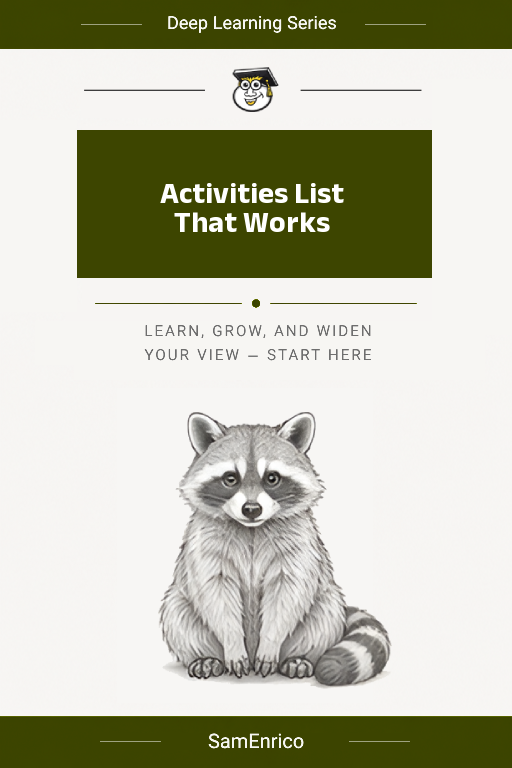
Non-FictionStudent's ShortcutActivities
Activities List That Works
Write strong activity descriptions that complement
Write strong activity descriptions that complement your essays and show depth of commitment.
Formats
About this book
Free sample
Chapter 1: The Architecture of Impact--–- Most students begin drafting their activities list exactly backward. They open the Common App, see ten blank slots, and immediately start filling them with whatever comes to mind: “Math Club member,” “Varsity soccer,” “Volunteer at hospital.” They treat the list like a form to complete rather than a strategic document to craft. This is like trying to build a house by throwing bricks at a plot of land and hoping a wall appears.Before you write a single word of your activities list, you need to understand the fundamental architecture that separates forgettable descriptions from unforgettable ones. This chapter dismantles the technical constraints, introduces the four components that every strong entry must contain, and gives you a repeatable framework for turning raw activities into compelling evidence of your impact. By the time you finish reading, you will never look at a 150-character limit the same way again.The Most Misunderstood Space on Your Application Let us start with a simple fact that most students and even many counselors get wrong: the Common App activities list is not measured in words.
It is measured in characters. That means every space, every comma, every period counts against your limit. For the Common App, you have exactly 150 characters per activity, including spaces. For the University of California system, you have 350 characters. For the Coalition App, also 150.Why does this distinction matter?
Because a student who thinks in words will write “I was the president of the debate club” and use 36 characters without realizing they could have written “Debate president” and used only 14 characters, saving precious space for impact. A student who thinks in characters understands that every unnecessary word is a lost opportunity to add another number, another result, another piece of evidence.Consider this real example from a student’s first draft: “I helped organize a fundraiser for the local animal shelter.” That sentence uses 51 characters. It tells you almost nothing. The revised version after character-aware editing: “Organized fundraiser for animal shelter → raised $3,200.” That uses 49 characters and tells you scale, action, and…
This is the end of the free sample. Get the eBook to keep going. Buy now
Contents
- Chapter 1
- Chapter 2
- Chapter 3
- Chapter 4
- Chapter 5
- Chapter 6
- Chapter 7
- Chapter 8
- Chapter 9
- Chapter 10
- Chapter 11
- Chapter 12
Details
- Author
- Hoang Grazyna
- Publisher
- SamEnrico
- Language
- English
- Genre
- Non-Fiction, Student's Shortcut, Activities
- Released
- 2026-05-29
- Pages (approx.)
- 145
- Available as
- eBook, Audiobook

Read better in the ZLOADR app
Your eBooks on your phone or tablet. Sign in with your SamEnrico account and start reading.
More by Hoang Grazyna
 Imposter Award ReceivingHoang Grazyna$11.99
 Widow Anger ProcessingHoang Grazyna$11.99
 Disability Prison Rights AdvocateHoang Grazyna$11.99
 Reconstruction of Contract KillingsHoang Grazyna$11.99
 Memory Palace For GeographyHoang Grazyna$11.99
 Jodie Foster Child GeniusHoang Grazyna$11.99
 Stretching Before Hypnosis ListeningHoang Grazyna$11.99
 Pomodoro for SalespeopleHoang Grazyna$11.99
 The Harmonic Alchemist: Pythagoras and the Music of the CosmosHoang Grazyna$11.99
 Tangaroa’s Tide: The Navigators’ Skyward SpireHoang Grazyna$11.99
 Mastering The Lateral DeltoidHoang Grazyna$11.99
 How to Produce Portable Showers and Privacy EnclosuresHoang Grazyna$11.99
You may also like
 Hong Kong Handover 1997Dunn Johnnie$11.99
 Zumba For Postnatal Recovery CourseNeal Christian$11.99
 Zumba for BeginnersLadner Nikia$11.99
 YouTube Comment Mining GuideHumes Pandora$12.99
 Worry Box MeditationCarlin Rudy$11.99
 Workplace Stress MeditationNguyen Lynn$11.99
 Workplace Stress and Sleep RepairHawley Ivory$11.99
 Workplace Perfectionism CureDelaney Jeffry$11.99
 Workplace Injustice Anger GuideWallen Isabelle$11.99
 Work Addiction and Burnout LinkGreenwood Ester$11.99
 Women in Yoga and WellnessBeattie Galina$11.99
 Women in Stand Up ComedyChun Evangeline$11.99