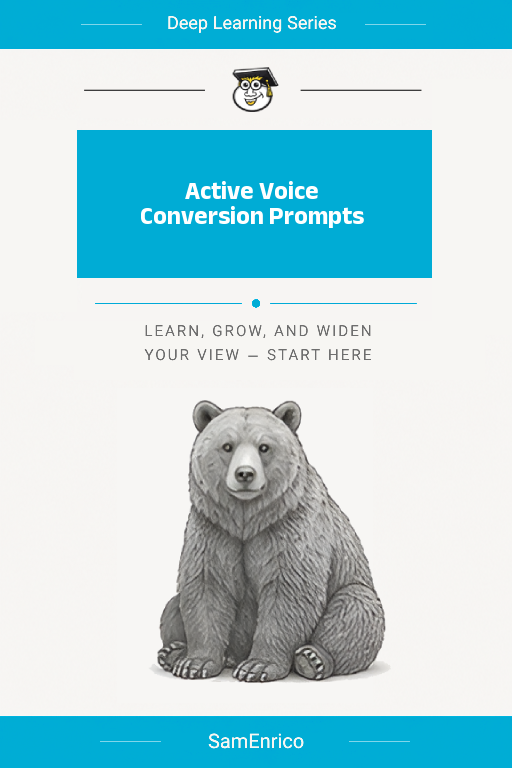
Active Voice Conversion Prompts eBook
Transform passive constructions into active voice
by Hsu Marissa
Transform passive constructions into active voice using GPT prompts for stronger, clearer sentences.
Formats
Free sample
Chapter 1: The Passive Tax...--You are about to discover something that most writers never realize until it has already cost them thousands of dollars, a promotion, a client, or a relationship.Here it is: passive voice is not a grammar problem.It never was.The textbooks have misled you. The grammar checkers have lied to you by omission. Your high school English teacher, well-intentioned as she may have been, reduced this to a rule about sentence structure when in fact it is a rule about power.Every time you write “Mistakes were made” instead of “I made a mistake,” you are not just being grammatically passive. You are being psychologically passive. You are hiding.
You are diffusing responsibility. You are signaling—loudly and clearly to anyone with advanced reading comprehension—that you are either afraid, uncertain, or unwilling to own your actions.And here is the brutal truth that no grammar book will tell you: people notice.They may not be able to name what they notice. They may not say, “Ah, I see you have employed a passive construction in the past perfect tense.” But they feel something. They feel a lack of conviction. They feel evasion.
They feel uncertainty. And in business, in leadership, in persuasive writing of any kind, those feelings translate into one thing: lost trust.This book exists because the rise of large language models like GPT has created an unprecedented opportunity. For the first time in human history, you have access to a tool that can instantly detect, diagnose, and convert passive voice into active, powerful, clear prose. But here is the paradox that most people miss: the tool is useless without the mindset shift first.You can learn every prompt in this book. You can memorize the 4-Factor Framework.
You can run the Zombie Test until you dream about the undead. But if you do not first understand why you use passive voice—what psychological need it serves, what fear it masks, what avoidance it enables—then you will simply use GPT to generate active sentences that still feel hollow. You will have correct grammar and zero impact.This chapter is not about prompts. It is about the mirror.And what that mirror will show you might be uncomfortable. Good.The Psychological Cost of Passivity Let me tell you about a study that changed how I think about writing.Researchers at Stanford University analyzed over 400,000 corporate emails.
They were looking for linguistic patterns that correlated with career advancement. The results were stark: employees who used passive voice more than 15% of the time were promoted at half the rate of those who used passive voice less than 5% of the time.Half the rate.Think about that for a moment. Two employees with identical qualifications, identical performance, identical everything—except one writes passively and one writes actively. The active writer moves up. The passive writer stays put.The researchers called this the “Clarity Penalty,” but I have a different name for it.
I call it the Passive Tax.Every passive sentence you write is a small tax on your credibility. Alone, each tax is tiny—a few cents, barely noticeable. But over the course of a career, thousands of passive sentences compound into a massive drag on your professional trajectory. You are paying this tax right now, silently, without even knowing it.Here is another study, this one from the Journal of Business Communication. Researchers asked 500 managers to evaluate two versions of the same memo.
The memos were identical in content, identical in length, identical in facts. The only difference was that one used active voice throughout and the other used passive voice throughout.The active memo was rated as 34% more persuasive, 41% more confident, and 27% more trustworthy.Same words. Same facts. Different voice.The managers could not articulate exactly what was different. They just knew, in their gut, that one writer sounded like a leader and the other sounded like a bureaucrat.That is the power of voice.
Not grammar rules on a test. Not stylistic preferences for pedants. But the fundamental, visceral, instinctive signal that you send about who you are and whether you can be trusted.If you are still reading, you have probably felt this yourself. You have read an email or a proposal and thought, “Something is off here. I don’t quite trust this person.” You could not point to a single error.
You just felt it. That feeling is often passive voice doing its quiet, corrosive work.So here is the first major claim of this book, and I want you to write it down somewhere you will see it every day:Active voice is not about grammar. It is about courage.Every time you choose active voice, you are choosing to stand behind your words. You are choosing to say, “I did this,” or “We decided this,” or “You need to know this.” You are stepping out from behind the veil of passive constructions and showing your face.That takes courage. Especially in a corporate culture that has taught us that passivity is professionalism.But here is the secret that the most successful writers in the world know: courage is charismatic.
People are drawn to clarity. They trust confidence. And they reward—with their attention, their money, their loyalty—the writer who dares to be active.Why We Hide: The Psychology of the Passive If active voice is so powerful, why do we avoid it?The answer is uncomfortable, and it requires us to look at ourselves with honesty. Most people do not use passive voice because they think it sounds more formal or objective. That is the excuse.
The real reason is simpler and more human: fear.Let me walk you through the five psychological drivers of passive voice. As you read each one, I want you to think about your own writing. Where do you see yourself?Driver One: Fear of Accountability This is the most common driver. You know you made a mistake, but you do not want to say, “I made a mistake.” So you write, “An error occurred.” You have removed yourself from the sentence entirely. You are gone.
Evaporated.The problem is that everyone knows what you did. They know an error did not just “occur.” Errors do not occur like weather. Errors are made by people. And when you refuse to name yourself as that person, you are not protecting yourself. You are revealing that you are the kind of person who does not take responsibility.In my coaching practice, I once worked with a mid-level manager named Sarah.
She was brilliant, hardworking, and consistently overlooked for promotion. When I looked at her emails, I saw the problem immediately. Every status update was written in passive voice: “The report was delayed,” “A conflict arose with the vendor,” “Additional resources have been requested.”I asked Sarah, “Who delayed the report?”She said, “Well, I did. But I didn’t want to sound defensive.”I explained that by removing herself from the sentence, she sounded not defensive but evasive. Defensive would have been “I delayed the report because of X.” That shows reasoning.
Evasive is “The report was delayed,” which shows nothing except unwillingness to engage.We rewrote her status updates in active voice…
This is the end of the free sample. Get the eBook to keep going. Buy now
About this book
Details
- Author
- Hsu Marissa
- Publisher
- SamEnrico
- Language
- English
- Genre
- Non-Fiction, Student's Shortcut, Grammar
- Released
- 2026-05-30
- Pages (approx.)
- 144
- Available as
- eBook, Audiobook

Read better in the ZLOADR app
Your eBooks on your phone or tablet. Sign in with your SamEnrico account and start reading.
More by Hsu Marissa
 Cost Structure SummaryHsu Marissa$11.99
 Thunberg Mining ConfrontationHsu Marissa$11.99
 Divorce After NarcissistHsu Marissa$11.99
 Loving Kindness for Self JudgmentHsu Marissa$11.99
 Parental Anger At Adult ChildrenHsu Marissa$11.99
 Chunking for Medical StudentsHsu Marissa$11.99
 Boundary Setting for Divorced ParentsHsu Marissa$11.99
 Constraints for EntrepreneursHsu Marissa$11.99
 The Book Thief of London: The 18th-Century Literary Con Artist Who Fooled the EliteHsu Marissa$11.99
 The Golden Quill of Olaudah Equiano: A Poet’s Fight for FreedomHsu Marissa$11.99
 Caracals: Caracal CaracalHsu Marissa$11.99
 How to Become a Cooler Room WorkerHsu Marissa$11.99