
Non-FictionCrisis ManagementPediatric
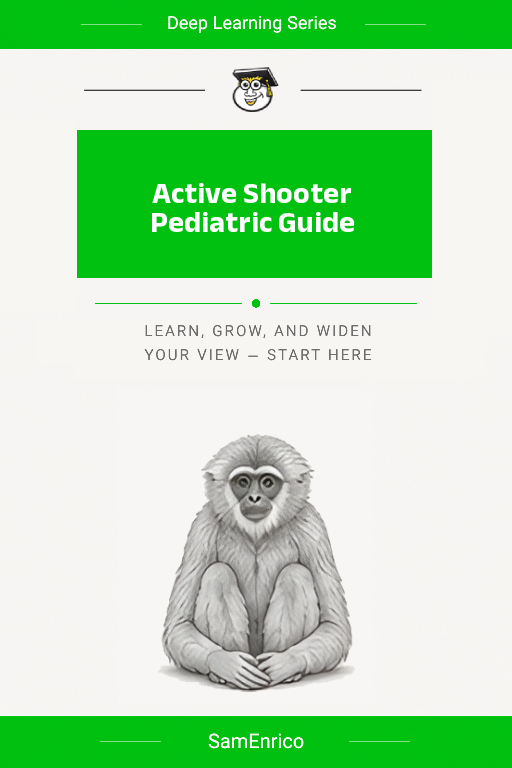
Active Shooter Pediatric Guide eBook
Protect child employees or visitors during terrori
by Dubois Ciera
Protect child employees or visitors during terrorist attacks at child-serving facilities. Use specialized lockdown techniques and age-appropriate communication.
Formats
Free sample
Chapter 1: The Guardian Mindset...--The first time I held a lockdown drill in a room of twenty-three preschoolers, I made every mistake in the book. I announced the drill with a serious face, told the children there was a "dangerous person" outside, and instructed them to hide in the corner while I turned off the lights. Three children started crying immediately. Two more refused to let go of each other. One boy, barely four years old, asked me in a trembling voice if the bad man was going to kill his mommy.
I had no good answer. The drill lasted four minutes. The aftermath lasted two weeks—nightmares, refusals to come to school, and one parent who accused me of traumatizing her child. I learned that day that preparing children for the worst-case scenario is not the same as frightening them into compliance. There is a science to this, a psychology, and most importantly, a mindset.
That mindset is what this chapter is about.The modern threat landscape has changed dramatically over the past decade, and nowhere is this more evident than in child-serving facilities. Daycare centers, preschools, pediatric clinics, summer camps, after-school programs, and religious nurseries have become what security professionals call "soft targets"—places with high concentrations of vulnerable people and relatively low levels of physical security. Unlike government buildings, corporate headquarters, or airports, these facilities rarely have armed guards, metal detectors, or controlled access points. They are designed to be welcoming, open, and nurturing. And that very design, that philosophy of openness, has made them attractive to a new generation of perpetrators seeking maximum psychological impact with minimum resistance.Consider the data.
According to the Federal Bureau of Investigation's active shooter reports, the number of active shooter incidents in the United States increased by more than fifty percent between 2015 and 2020. While the majority of these incidents occurred in commercial or educational settings, a significant and growing subset targeted locations where children gather. Schools remain the most obvious example, but the FBI notes that "soft targets" of all types—including daycare centers, pediatric medical offices, and community centers—have seen a disproportionate increase in threats. The perpetrators are not always motivated by the same ideologies. Some are driven by grievance, others by terrorism, and still others by untreated mental illness.
But they share one tactical preference: they choose places where resistance is minimal and the psychological impact of their violence will be magnified by the presence of children.This chapter is not designed to scare you. Fear is a poor motivator and an even poorer foundation for effective planning. What this chapter is designed to do is replace fear with something far more useful: informed, proactive, and psychologically sound preparedness. I call this the Guardian Mindset.The Guardian Mindset is a deliberate cognitive shift that every adult who works with children must internalize. It moves the caregiver from a reactive posture—"What if something happens?"—to a proactive one: "When something happens, here is what we will do." Notice the subtle but critical change in language.
"What if" implies uncertainty and opens the door to paralyzing anxiety. "When" implies inevitability and demands action. The Guardian Mindset does not assume that every facility will be attacked. It assumes that attacks happen in the world, that child-serving facilities are not immune, and that being prepared is a moral obligation, not a paranoid indulgence.This mindset has three pillars. First, scenario-based planning.
You cannot prepare for an abstract threat. You must prepare for specific, plausible scenarios. What if an attacker enters through the main entrance? What if an attacker attempts to breach a side door? What if an attacker is already inside the building when the threat is identified?
What if the attack occurs during nap time, when infants are asleep and staff are tired? What if the attack occurs during outdoor play, when children are spread across a playground? Each scenario demands a different response, and the Guardian Mindset requires that you think through each one before it happens. You do not invent the plan in the moment. You execute the plan you have already built.The second pillar is regular, trauma-informed drills.
Drills save lives. This is not speculation; it is demonstrated fact. Schools that conduct regular lockdown drills have significantly faster response times and lower rates of injury during real events. But drills can also cause harm if they are done poorly. Simulated gunfire, adults role-playing shooters, surprise drills for young children, and drills that last too long all create psychological damage that can outweigh the safety benefits.
The Guardian Mindset demands drills that are announced, scripted, short, and developmentally appropriate. A three-minute drill with a clear beginning and end, announced to parents in advance, and framed as a game for young children can build muscle memory without building trauma. The difference is not in the mechanics of the drill but in the mindset of the adults leading it.The third pillar is a culture of shared responsibility. In too many child-serving facilities, safety is seen as the director's job or the designated safety officer's job. Everyone else focuses on teaching, feeding, diapering, or playing.
The Guardian Mindset rejects this division. Every staff member, regardless of their primary role, must see safety as part of their job description. The teacher who hears an unusual sound does not wait for the director to investigate. The aide who notices a door propped open does not assume someone else will close it. The cook who sees a stranger in the parking lot does not dismiss it as a delivery driver without checking.
This is not paranoia. It is shared vigilance, and it is the only way to ensure that threats are identified early, before they become crises.The psychological impact of adopting the Guardian Mindset cannot be overstated. For staff, it replaces helplessness with agency. There is a well-documented phenomenon in trauma psychology called "learned helplessness"—the belief, born of repeated exposure to uncontrollable events, that nothing you do will make a difference. Learned helplessness is deadly in an active shooter situation because it leads to freezing, the most common and most dangerous response in a crisis.
The Guardian Mindset is the antidote. When staff have practiced scenarios, when they have drilled their responses, when they know that their actions have been proven to save lives, they are far less likely to freeze and far more likely to act.For children, the Guardian Mindset operates through what developmental psychologists call "co-regulation." Children look to the adults around them for cues about how to feel and how to behave. If a caregiver is panicked—wide eyes, fast breathing, high-pitched voice—the child's amygdala (the brain's fear center) will activate immediately, often leading to screaming, crying, or running. But if a caregiver is calm—slow breathing, relaxed facial muscles, low voice—the child's panic will dampen. The child's nervous system literally synchronizes with the caregiver's through mirror neurons.
This is not a metaphor. It is neurobiology. The Guardian Mindset, therefore, requires that adults regulate themselves first. You cannot pour from an empty cup, and you cannot calm a panicked child if you are panicked yourself. Self-regulation drills—tactical breathing, grounding through physical sensation, cognitive…
This is the end of the free sample. Get the eBook to keep going. Buy now
About this book
Details
- Author
- Dubois Ciera
- Publisher
- SamEnrico
- Language
- English
- Genre
- Non-Fiction, Crisis Management, Pediatric
- Released
- 2026-06-01
- Pages (approx.)
- 150
- Available as
- eBook, Audiobook

Read better in the ZLOADR app
Your eBooks on your phone or tablet. Sign in with your SamEnrico account and start reading.
More by Dubois Ciera
 Three Generations Lost And FoundDubois Ciera$11.99
 Finger Spiral InductionDubois Ciera$11.99
 LST Crew Veterans MemoirDubois Ciera$11.99
 The Roving AmbassadorDubois Ciera$11.99
 The Frozen Angels of Poltava: Surgeons in the SnowDubois Ciera$11.99
 How to Produce Bicycle Wheel Axles and SkewersDubois Ciera$11.99
 Talent Acquisition AssociateDubois Ciera$11.99
 How to Become a Glass-furnace TenderDubois Ciera$11.99
You may also like
 Hong Kong Handover 1997Dunn Johnnie$11.99
 Zumba For Postnatal Recovery CourseNeal Christian$11.99
 Zumba for BeginnersLadner Nikia$11.99
 YouTube Comment Mining GuideHumes Pandora$12.99
 Worry Box MeditationCarlin Rudy$11.99
 Workplace Stress MeditationNguyen Lynn$11.99
 Workplace Stress and Sleep RepairHawley Ivory$11.99
 Workplace Perfectionism CureDelaney Jeffry$11.99
 Workplace Injustice Anger GuideWallen Isabelle$11.99
 Work Addiction and Burnout LinkGreenwood Ester$11.99
 Women in Yoga and WellnessBeattie Galina$11.99
 Women in Stand Up ComedyChun Evangeline$11.99