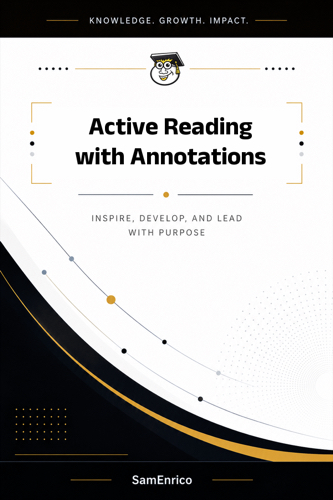
Active Reading with Annotations eBook
Teaches highlighting, margin notes, and questionin
Teaches highlighting, margin notes, and questioning while reading.
Formats
Free sample
Chapter 1: The Marginal Mindset--–- Before you underline a single word or pick up a sticky note, you need to understand something that most reading guides get backwards. Active reading is not a collection of tricks. It is not a faster way to scan text or a clever system for remembering more facts. Active reading is an identity. It is a way of showing up to a page that fundamentally changes who you are as a thinker.
And that identity begins with a single, uncomfortable realization: you have been taught to be a passive consumer of words, and that training is actively hurting your ability to think.Most people read the way they watch television. They sit back, let the words wash over them, and hope something sticks. They treat the author as a performer and themselves as an audience. The book is there to entertain, inform, or persuade them, but they have no role in the transaction except to receive. This is what Mortimer Adler, in his classic How to Read a Book, called the tragedy of the passive reader.
You can finish a book, nod along with every page, and then realize an hour later that you couldn't explain the main argument to a friend. That is not a failure of memory. It is a failure of engagement.This chapter is about rewiring your relationship with text. Before you learn the symbols for margin notes, before you master the hierarchy of underlines, before you ever touch a pen to paper, you must adopt what I call the Marginal Mindset. It is the belief that reading is a conversation, that you are an equal participant in that conversation, and that your job is not to absorb but to respond.
By the end of this chapter, you will see every book as a tennis court where ideas bounce back and forth between you and the author. You will have permission to argue, to question, to laugh, to disagree, and to write your own thoughts directly into the margins. And you will understand why keeping a book pristine is not a sign of respect but a confession of intellectual passivity.Let us begin with a story.The Curse of the Clean Book I once had a student named Sarah. She was a meticulous reader. Her textbooks looked brand new at the end of every semester.
No underlines, no dog-eared pages, no margin notes. She was proud of this. She said it showed respect for the material and for the authors who wrote it. When I asked her what she remembered from the books she had read, she struggled. She could recall vague impressions—the book was about psychology, or maybe sociology, something about memory.
But specific arguments? Evidence? Counterpoints? Nothing.Sarah was not lazy. She was not unintelligent.
She was doing exactly what she had been taught. From elementary school through college, most students are told to keep books clean. Librarians threaten fines for markings. Teachers hand out pristine textbooks year after year. Parents admire children who return borrowed books without a single crease.
The message is clear: books are sacred objects, and marking them is vandalism.This is a lie. And it is one of the most destructive lies in education.Adler put it bluntly: "Full ownership of a book only comes when you have made it a part of yourself, and the best way to make yourself a part of it is by writing in it." A clean book is not evidence of a disciplined mind. It is evidence of a mind that never engaged. The only way to truly own a book is to mark it up, to argue with it, to leave the traces of your thinking on every page. When you write in a book, you are not defacing it.
You are transforming it from a static object into a dynamic record of a conversation.Consider how we treat other forms of conversation. If you had a long discussion with a friend about politics or art or love, you would not expect to remember every word weeks later. You might jot down notes afterward. You might revisit the most interesting points. You might even write a letter summarizing your side of the argument.
That is exactly what annotation does. It externalizes your thinking so you can return to it later. It makes the invisible work of reading visible. And it gives you something to review, to challenge, and to build upon.The Marginal Mindset begins with a simple permission slip. You are allowed to write in your own books.
You are allowed to underline, to circle, to draw arrows, to write entire sentences in the margins. You are allowed to disagree with authors who have won Pulitzer Prizes. You are allowed to write "nonsense" next to a passage that strikes you as wrong. You are even allowed to draw small cartoons if that helps you remember. The book belongs to you.
The ideas belong to you. Your thoughts are not less important than the author's.For library books or borrowed books, the permission slip looks different. You cannot write directly on the pages. But you can use the sticky note system described in Chapter 2. You can keep a separate reading notebook.
You can take photos of pages and annotate those. The principle remains: you must engage actively. The medium changes; the mindset does not.Dialogue Over Monologue The core metaphor of the Marginal Mindset is the tennis court. Imagine reading as a game of tennis. The author serves the ball—a claim, a story, an argument.
You, the reader, must hit it back. If you simply let the ball bounce past you, you are not playing the game. You are watching. Active reading means returning every serve. Sometimes you return with agreement: "Yes, that makes sense because..." Sometimes you return with a question: "But what about X?" Sometimes you return with a counterargument: "I think you are wrong because..." And sometimes you return with a connection: "This reminds me of what Smith said on page 47."The tennis court metaphor reveals something crucial.
In a real conversation, you would never sit silently while someone talked for three hundred pages. You would interrupt. You would ask for clarification. You would offer your own examples. You would push back when something sounded wrong.
The only difference with a book is that the author cannot hear you. But that does not mean you should stop talking. It means you must write your side of the conversation in the margins.This is what philosopher Jacques Derrida called "the trace." Every reading leaves a trace of the reader's encounter with the text. That trace is not a corruption of the original. It is a new creation, a hybrid of author and reader, a third thing that neither could have produced alone.
When you annotate, you are not vandalizing the author's work. You are completing it.Let me give you a concrete example. Here is a passage from a popular self-help book: "Success comes from consistent daily habits, not from massive once-a-year efforts." A passive reader reads this, nods, and turns the page. An active reader writes in the margin: "What counts as 'consistent'?…
This is the end of the free sample. Get the eBook to keep going. Buy now
About this book
Details
- Author
- Caswell Shela
- Publisher
- SamEnrico
- Language
- English
- Genre
- Non-Fiction, Self-Help, Active Reading
- Released
- 2026-06-10
- Pages (approx.)
- 150
- Available as
- eBook, Audiobook

Read better in the ZLOADR app
Your eBooks on your phone or tablet. Sign in with your SamEnrico account and start reading.
More by Caswell Shela
 Selma Voting Rights CampaignCaswell Shela$11.99
 Power Hour Morning MethodCaswell Shela$11.99
 F. Lee Bailey Sheppard RoleCaswell Shela$11.99
 Sexual Health ConversationsCaswell Shela$11.99
 Small Pet Loss GuideCaswell Shela$11.99
 The Memory Athlete GuideCaswell Shela$11.99
 New Year Resolution SystemCaswell Shela$11.99
 Baba Yaga's Lament: The Witch Who Sang the World into BeingCaswell Shela$11.99
 The Night of the Vigilante: Colombia's Deadly Stand Against the Narcos (1980s)Caswell Shela$11.99
 How to Start a Cooker (solid Fuel) Business (Beginners Guide)Caswell Shela$11.99
 How to Produce Varnishes and FinishesCaswell Shela$11.99
 How to Produce Kite BuggiesCaswell Shela$11.99