
Non-FictionSelf-HelpCommunication
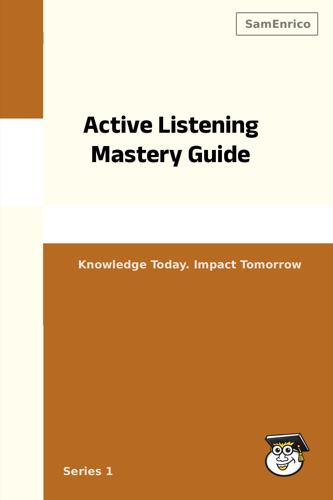
Active Listening Mastery Guide eBook
Teaches paraphrasing, reflecting, and summarizing
Teaches paraphrasing, reflecting, and summarizing to show genuine understanding.
Formats
Free sample
Chapter 1: The Hidden Epidemic--–- Sarah considered herself a good listener. She held eye contact, nodded at appropriate moments, and never interrupted. When her teenage daughter, Chloe, came home from school in tears, Sarah put down her phone, turned off the television, and sat beside her on the couch. “I’m listening,” she said warmly. Chloe explained that her best friend had spread a rumor about her in front of the entire lunch table.
She described the humiliation, the laughter, the way her face burned as she gathered her tray and walked away alone. Sarah nodded throughout. When Chloe finished, Sarah waited two seconds and said, “I understand. You know what you should do? You should talk to her tomorrow and tell her how that made you feel.
Communication is key.”Chloe looked at her mother for a long moment. Then she stood up, walked to her room, and closed the door. She did not mention the rumor again. Three years later, when Chloe was in college, Sarah learned from a therapist that her daughter had been silently struggling with social anxiety and depression for most of high school. “Why didn’t you tell me?” Sarah asked, heartbroken.
Chloe’s answer was simple: “I tried. You didn’t hear me.”This scene is not unusual. It is not the exception. It is the rule. Across thousands of conversations every day—between parents and children, spouses, managers and employees, doctors and patients, friends and lovers—people say “I’m listening” and “I understand” while missing almost everything that matters.
They confuse the mechanics of politeness with the substance of connection. They mistake the absence of interruption for the presence of empathy. And they walk away from conversations genuinely believing they have done their part, while the person who spoke feels more alone than when they began.This is the hidden epidemic of our time: the widespread, unnoticed failure of listening. It is hidden because the failure is almost never acknowledged. The listener believes they listened.
The speaker often does not know how to say “You didn’t actually hear me” without sounding accusatory. So the misunderstanding goes unmentioned, the connection erodes slowly, and years later, when the relationship has fractured or failed, no one can point to a single event. They point to everything. They point to nothing. They point to the slow accumulation of unheard words.The Invention of a Problem No One Sees Every field has its invisible problem.
In medicine, for decades, it was the failure to wash hands between patients—a practice that killed thousands until someone proved the connection. In aviation, it was the tendency of co-pilots to defer to captains even when the captain was about to crash—a pattern that went unnamed until cockpit voice recorders revealed the horror of polite silence. In communication, the invisible problem is the assumption that listening is automatic.We are not taught to listen. Think about that for a moment. From kindergarten through graduate school, we are taught to read, write, speak, and present.
We take years of English classes, literature courses, public speaking workshops. We learn to structure arguments, to use evidence, to persuade. But almost no one receives formal instruction in listening. The assumption is that listening is a passive biological function, like breathing or blinking. You have ears, therefore you listen.
This assumption is not merely wrong—it is catastrophically wrong, and its consequences shape the quality of every relationship you have.Consider the asymmetry. Speaking is an active skill that requires practice, vocabulary, grammar, and delivery. Writing requires revision, structure, and clarity. Reading requires decoding, comprehension, and inference. Listening—real listening, the kind that changes relationships—requires attention, curiosity, restraint, pattern recognition, emotional intelligence, and the ability to hold your own reactions in check while someone else speaks.
It is arguably more complex than speaking. And yet we spend zero years learning it.The result is a population of people who think they are good listeners because no one has ever told them otherwise. They have never received feedback on their listening because giving feedback on listening feels rude. “You’re not really hearing me” sounds like an accusation, so people swallow it. The poor listener goes through life thinking they are fine.
The speaker goes through life feeling vaguely unheard. Neither understands why.The Four False Gods of Listening Before we can learn what real listening is, we must unlearn the false substitutes that masquerade as listening in daily conversation. These are behaviors that look like listening on the surface—they use the right body language and the right verbal cues—but they produce no genuine understanding. We call them the Four False Gods because people worship them as virtues, and because they demand sacrifice without delivering salvation.The Nodding God. This is the most common false god.
The Nodder maintains eye contact, tilts their head at appropriate intervals, and produces a steady stream of “mm-hmm,” “uh-huh,” and “I see.” They have mastered the performance of attention. They look like they are listening. They sound like they are listening. They are often not listening at all. Their mind is elsewhere—planning dinner, replaying an argument, composing an email—while their body performs the ritual of attentiveness.
The Nodding God demands that you produce the appearance of listening, and in exchange, it promises that no one will ever accuse you of being rude. What it does not deliver is understanding.The Parroting God. The Parroter goes one step beyond nodding. They repeat back the speaker’s exact words, often in the form of a question. Speaker: “I’m really stressed about the deadline.” Parroter: “You’re really stressed about the deadline?” This feels like listening because there is a verbal response that references what the speaker said.
But parroting requires no comprehension. A parrot can repeat words. A recording can repeat words. Real listening requires restating the content in your own words—a process that forces your brain to process meaning. The Parroting God promises that you will sound engaged.
It delivers the hollow echo of engagement without the substance.The Advising God. The Advisor listens just long enough to identify a problem, then immediately shifts into solution mode. Before the speaker has finished describing their situation, the Advisor is already mentally constructing recommendations. The Advisor’s internal monologue: “If they just tried X… have they considered Y… what about Z?” When the speaker finishes—or sometimes before—the Advisor delivers their wisdom. The Advisor believes they are being helpful.
They are solving problems. They are adding value. What they are actually doing is telling the speaker that their experience is not worth hearing unless it can be fixed. The Advising God promises usefulness. It delivers dismissal disguised as help.The One-Upping God.
The One-Upper listens for an opportunity to share a related story. Speaker: “I had the worst day at work.” One-Upper: “Oh yeah? Let me tell you about my day.” The One-Upper is not trying to be rude. They are trying to connect. They believe that sharing a similar experience is a form of empathy.
But what the speaker hears is “My experience is more interesting than yours” or “I’m going to make this about…
This is the end of the free sample. Get the eBook to keep going. Buy now
About this book
Details
- Author
- Wilkerson Julian
- Publisher
- SamEnrico
- Language
- English
- Genre
- Non-Fiction, Self-Help, Communication
- Released
- 2026-06-10
- Pages (approx.)
- 140
- Available as
- eBook, Audiobook

Read better in the ZLOADR app
Your eBooks on your phone or tablet. Sign in with your SamEnrico account and start reading.
More by Wilkerson Julian
 Creative Block Breakthrough GuideWilkerson Julian$11.99
 Overtraining Syndrome RecoveryWilkerson Julian$11.99
 Mindful Stress Reduction for First RespondersWilkerson Julian$11.99
 Wholesaling Transaction CoordinationWilkerson Julian$11.99
 Assertiveness For ChaplainsWilkerson Julian$11.99
 Gunshot Residue ParticlesWilkerson Julian$11.99
 Coppola DynastyWilkerson Julian$11.99
 The Belt KeepsakeWilkerson Julian$11.99
 The Max Planck Revolution: How a German Academy Redefined Modern PhysicsWilkerson Julian$11.99
 The Luminary Minds: Black Laureates Who Illuminated the SciencesWilkerson Julian$11.99
 The Art of the Steal: How a Small-Town Con Artist Duped the Biggest Names in HollywoodWilkerson Julian$11.99
 Research Collaboration with AI PromptsWilkerson Julian$11.99
You may also like
 Hong Kong Handover 1997Dunn Johnnie$11.99
 Zumba For Postnatal Recovery CourseNeal Christian$11.99
 Zumba for BeginnersLadner Nikia$11.99
 YouTube Comment Mining GuideHumes Pandora$12.99
 Worry Box MeditationCarlin Rudy$11.99
 Workplace Stress MeditationNguyen Lynn$11.99
 Workplace Stress and Sleep RepairHawley Ivory$11.99
 Workplace Perfectionism CureDelaney Jeffry$11.99
 Workplace Injustice Anger GuideWallen Isabelle$11.99
 Work Addiction and Burnout LinkGreenwood Ester$11.99
 Women in Yoga and WellnessBeattie Galina$11.99
 Women in Stand Up ComedyChun Evangeline$11.99