
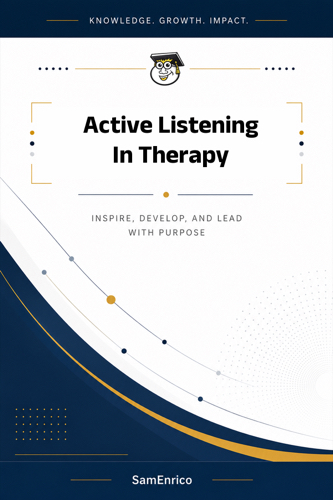
Non-FictionSelf-HelpTherapyEmpathy
Active Listening In Therapy
Build therapeutic alliance through empathic listen
by Wray Keitha
Build therapeutic alliance through empathic listening and validation techniques.
Formats
About this book
Free sample
Chapter 1: Beyond the Nod...--–- The first thing every therapist learns is how to nod. The second thing is how disastrous a nod can be.Sarah, a third-year social work intern, sat across from Marcus, a 34-year-old veteran who had been referred for anger management after an incident at work. Marcus spoke in a low, flat voice about his morning: the traffic, the coffee that spilled on his shirt, the way his supervisor had looked at him sideways. Sarah nodded. She had been taught to nod—to show she was listening, to encourage the client to keep talking.
She nodded at the traffic. She nodded at the coffee. She nodded at the supervisor’s sideways glance. Marcus stopped talking. He looked at the clock.
He said, “I guess that’s it,” and stood up to leave. Sarah had fourteen minutes left in the session. She did not know what had just happened. She thought she had been listening.She had been hearing. She had not been listening.This chapter draws a sharp, evidence-based line between these two states—hearing, which is passive and automatic, and active listening, which is intentional, effortful, and clinically transformative.
It introduces the three pillars of a facilitative therapeutic relationship as defined by Carl Rogers: Unconditional Positive Regard, Accurate Empathy, and Congruence. It reviews the empirical evidence that active listening—specifically, accurate reflection of feeling and meaning—significantly reduces dropout rates across treatment modalities. And it establishes the unified definition of active listening that will govern every subsequent chapter of this book.But first, we must understand the failure of the nod.The Nodding Disease: How Good Therapists Learn to Pretend The nodding therapist is not a caricature. She is a real clinician, often well-trained, frequently well-intentioned, who has internalized a dangerous assumption: that listening is mostly about staying quiet and looking attentive. This assumption is taught implicitly in most graduate programs.
Students are told to “use minimal encouragers”—“mm-hmm,” “I see,” “go on”—to keep the client talking. They are told to maintain eye contact, to lean forward slightly, to avoid interrupting. All of this is…
This is the end of the free sample. Get the eBook to keep going. Buy now
Contents
- Chapter 1
- Chapter 2
- Chapter 3
- Chapter 4
- Chapter 5
- Chapter 6
- Chapter 7
- Chapter 8
- Chapter 9
- Chapter 10
- Chapter 11
- Chapter 12
Details
- Author
- Wray Keitha
- Publisher
- SamEnrico
- Language
- English
- Genre
- Non-Fiction, Self-Help, Therapy, Empathy
- Released
- 2026-06-09
- Pages (approx.)
- 148
- Available as
- eBook, Audiobook

Read better in the ZLOADR app
Your eBooks on your phone or tablet. Sign in with your SamEnrico account and start reading.
More by Wray Keitha
 Envy and Self EsteemWray Keitha$11.99
 The Self Talk for DeadlinesWray Keitha$11.99
 TM for Pornography RecoveryWray Keitha$11.99
 The Psychopaths in Prison GuideWray Keitha$11.99
 Samir the Lion: The Unlikely Rise of Qatar’s Football KingWray Keitha$11.99
 Software Engineering ManagerWray Keitha$11.99
 Understanding Togaviridae DiseaseWray Keitha$17.99
 How to Become a Dry-house AttendantWray Keitha$11.99
 Inkscape Replaces Illustrator GuideWray Keitha$12.99
 Factoring Fintech in Emerging MarketsWray Keitha$12.99
You may also like
 Hong Kong Handover 1997Dunn Johnnie$11.99
 Zumba For Postnatal Recovery CourseNeal Christian$11.99
 Zumba for BeginnersLadner Nikia$11.99
 YouTube Comment Mining GuideHumes Pandora$12.99
 Worry Box MeditationCarlin Rudy$11.99
 Workplace Stress MeditationNguyen Lynn$11.99
 Workplace Stress and Sleep RepairHawley Ivory$11.99
 Workplace Perfectionism CureDelaney Jeffry$11.99
 Workplace Injustice Anger GuideWallen Isabelle$11.99
 Work Addiction and Burnout LinkGreenwood Ester$11.99
 Women in Yoga and WellnessBeattie Galina$11.99
 Women in Stand Up ComedyChun Evangeline$11.99