
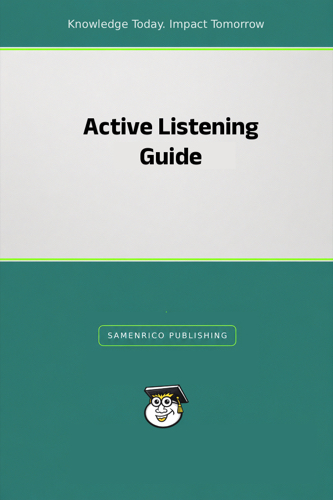
Non-FictionSelf-HelpListening Skills
Active Listening Guide eBook
Keep small talk flowing by truly hearing others us
Keep small talk flowing by truly hearing others using this practical communication workbook.
Formats
Free sample
Chapter 1: The Party That Broke Me--I spent three years dreading elevators. Not because I am claustrophobic—the doors do not trigger any primal fear of enclosed spaces. I dreaded elevators because of the six seconds between the doors closing and the first floor arrival. Six seconds of standing shoulder-to-shoulder with a coworker, a neighbor, a stranger, while the universal script for small talk sat on the tip of my tongue like a dead battery. “How’s it going?” they would say.
“Good, you?” I would reply. Then silence. Then the doors would open, and we would both exhale with relief.That was my life before I understood what listening actually meant. I thought I was a good listener. I nodded at the right moments.
I made eye contact. I waited (mostly) for people to finish their sentences before I spoke. But something was broken. Conversations that started with promise—a new colleague, a potential friend at a party, a date who seemed genuinely interesting—would fizzle after ninety seconds like a sparkler dropped in wet sand. I would walk away thinking, What just happened?
And then I would blame the other person. They were boring. They didn’t have anything to say. They weren’t trying.Until the party that broke me.It was a Saturday night in October. A friend had dragged me to a housewarming in a neighborhood I did not know, full of people I had never met.
The host had good lighting and bad wine and the kind of open floor plan that forces strangers to talk to each other because there is nowhere else to look. I grabbed a plastic cup of something red and positioned myself near a bookshelf, hoping to look thoughtful and unapproachable. It did not work.A woman about my age walked over. She had kind eyes and a chipped coffee mug that she was using as a wine glass, which I took as a sign of admirable disregard for social norms. She smiled and said, “I love that you’re judging the host’s book collection.
Which one are you silently mocking right now?”I laughed. She was funny. This was going well. I pointed to a self-help book with a cartoon brain on the cover and said something clever about how the brain on the cover looked as confused as I was. She laughed back.
Then she said, “So what do you do?”And that is where the wheels came off.I told her what I did. She told me what she did. I asked her how long she had been doing it. She said three years. I said, “Oh, cool.” Then I panicked.
My brain, which had been cruising along just fine, suddenly started screaming at me: Say something else. Ask another question. Don’t let it get quiet. She’s going to think you’re boring. She’s going to walk away.
So I asked her if she liked it. She said yes, most days. I said, “That’s great.” Then I took a sip of wine and stared at the cartoon brain on the book cover like it might rescue me.She tried again. She told me about a project she was working on, something to do with data visualization and nonprofit funding. It sounded genuinely interesting, but I was not listening anymore.
I was rehearsing. My internal monologue had become a frantic news ticker: She said data visualization. You know nothing about data visualization. She is going to think you are stupid. Quick, think of something you know.
Weather. You know weather. Ask her if she thinks it is going to rain tomorrow. No, that’s insane. Say something about your own job.
Tell her about the spreadsheet from hell. That always gets a laugh. No, that’s a shift response. She’ll think you’re self-absorbed. Just nod.
Nod and look interested.I nodded. She kept talking. I kept not listening. And then, mercifully or not, she stopped. She looked at me for a beat longer than comfortable, gave a small smile that did not reach her eyes, and said, “Well, I should go find the bathroom.” She walked away.
She did not come back.I stood there for another forty-five minutes, having the same version of that conversation with five other people. Each time, the pattern repeated: opening banter, a flicker of connection, a question or two, and then the slow, visible deflation of the other person as they realized I was not actually present. By the time I left, I had learned exactly nothing about anyone in that room. I could not tell you a single person’s name, what they cared about, what was keeping them up at night, or what had made them laugh that week. I had been there for almost two hours, surrounded by human beings, and I had never felt more alone.On the drive home, I tried to do what I always did: blame them.
They were boring. They didn’t know how to have a real conversation. Small talk is stupid anyway. But this time, the excuse did not stick. Because the woman with the chipped coffee mug had not been boring.
She had been warm and funny and interesting. She had tried, twice, to pull me into a real exchange. And I had failed her. Not because I was mean or rude or socially anxious in the clinical sense. I had failed her because I did not know how to listen.That was the night I stopped asking, Why are people so hard to talk to?
and started asking, What am I doing wrong?The answer, it turns out, was hiding in plain sight inside my own skull.The 275-Word Gap Where Conversations Go to Die Here is a fact that will change how you think about every conversation you have from this moment forward: your brain can process speech at more than 400 words per minute. The average person speaks at approximately 125 words per minute.Do the subtraction. That is a 275-word gap. Every minute of conversation, your brain has 275 words worth of idle processing power that it does not need just to understand what the other person is saying. Your brain is a Ferrari idling in neutral while the other person pedals a bicycle.
And here is what your brain does with that extra horsepower: it fills the gap with distraction.Sometimes it rehearses. When she finishes this sentence, I will say X. No, that sounds stupid. I will say Y. But what if she asks about Z?
Then I will need to say… Sometimes it judges. That was a weird way to phrase that. He seems nervous. Is he lying? I bet he is exaggerating.
Sometimes it wanders. Did I lock the car? What should I eat for dinner? I need to call my mom. Why did I say that thing in the meeting yesterday?
And sometimes, worst of all, it checks out entirely, running a background script of “mm-hmm” and “yeah” and “that’s crazy” while the real you takes a mental vacation.This is not a character flaw. This is not a sign that you are a bad person or a selfish…
This is the end of the free sample. Get the eBook to keep going. Buy now
About this book
Details
- Author
- Conover Alexia
- Publisher
- SamEnrico
- Language
- English
- Genre
- Non-Fiction, Self-Help, Listening Skills
- Released
- 2026-06-10
- Pages (approx.)
- 148
- Available as
- eBook, Audiobook

Read better in the ZLOADR app
Your eBooks on your phone or tablet. Sign in with your SamEnrico account and start reading.
More by Conover Alexia
 Blue Zone Lifelong Learning GuideConover Alexia$11.99
 Vegan Diet for Food AddictionConover Alexia$11.99
 Email Two Sentence Rule GuideConover Alexia$11.99
 The Worst Idea BrainstormConover Alexia$11.99
 The Last Pharaoh's Shadow: Hatshepsut's Secret WarConover Alexia$11.99
 Understanding Wolf–hirschhorn SyndromeConover Alexia$17.99
 Product-Led CAC ReductionConover Alexia$12.99
 Second Time Founder DepressionConover Alexia$12.99
 Barbie vs Oppenheimer: The Box Office PhenomenonConover Alexia$11.99
 How to Start a Photogrammetric Equipment (non-electronic) Business (Beginners Guide)Conover Alexia$11.99
You may also like
 Hong Kong Handover 1997Dunn Johnnie$11.99
 Zumba For Postnatal Recovery CourseNeal Christian$11.99
 Zumba for BeginnersLadner Nikia$11.99
 YouTube Comment Mining GuideHumes Pandora$12.99
 Worry Box MeditationCarlin Rudy$11.99
 Workplace Stress MeditationNguyen Lynn$11.99
 Workplace Stress and Sleep RepairHawley Ivory$11.99
 Workplace Perfectionism CureDelaney Jeffry$11.99
 Workplace Injustice Anger GuideWallen Isabelle$11.99
 Work Addiction and Burnout LinkGreenwood Ester$11.99
 Women in Yoga and WellnessBeattie Galina$11.99
 Women in Stand Up ComedyChun Evangeline$11.99