
Non-FictionSelf-HelpInterview Skills
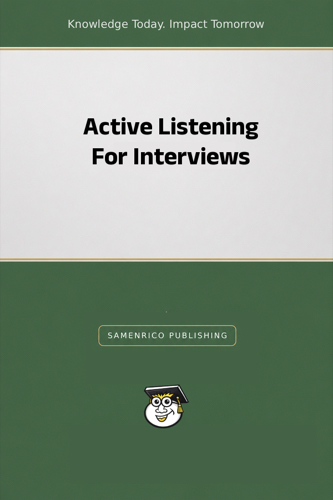
Active Listening For Interviews eBook
Build rapport and gather information through skill
Build rapport and gather information through skilled listening.
Formats
Free sample
Chapter 1: Your Mouth Is the Mute Button--You are about to discover something that will infuriate you. After years of believing you were a good listener, after countless conversations where you nodded and smiled and said “uh-huh” at the right moments, you are about to learn that you have been doing it wrong. Not a little wrong. Fundamentally, structurally, disastrously wrong. The good news is that once you see the problem, you cannot unsee it.
And once you cannot unsee it, you can fix it. This chapter is the intervention you did not know you needed.The problem is not your intentions. You want to listen. You believe you are listening. You would swear under oath that you are a better listener than most people you know.
And yet, the people you interview leave feeling vaguely unheard. They give you surface answers. They hold back the thing that would have changed everything. They do not trust you, and neither of you knows exactly why. The reason is hiding in plain sight: your mouth is the mute button on their truth.Every time you speak, you are signaling.
Sometimes you are signaling curiosity. Sometimes you are signaling intelligence. Sometimes you are signaling impatience, judgment, or the desperate need to be seen as competent. The problem is that you cannot control which signal lands. And in the high-stakes environment of an interview, the default interpretation of your voice is not what you think.
The default interpretation is: “They are waiting for their turn to talk. They are not really listening.”This chapter will dismantle your assumptions about conversation and rebuild them from the ground up. You will learn why talking less is the single highest-leverage skill you can develop. You will learn the difference between hearing and listening, and why confusing the two has cost you valuable information. You will confront the voice in your head that rehearses responses while others speak, and you will learn to silence it.
You will understand, for the first time, why silence is not awkward but powerful. And you will begin the practice of becoming someone who listens so well that people tell you things they have never told anyone.The Mathematics of Mastery: Why 80/20 Is Not a Suggestion Let us begin with numbers because numbers do not lie. Researchers have analyzed thousands of recorded interviews across journalism, law enforcement, medicine, human resources, and sales. They have measured speaking time, information retention, trust scores, and disclosure rates. The findings are so consistent they amount to a law of human interaction.In the most effective interviews, the interviewer speaks no more than twenty percent of the time.
The interviewee speaks the remaining eighty percent. This is the 80/20 Rule of Interviewing. When the interviewer exceeds twenty percent, two things happen simultaneously. First, the quantity of information from the interviewee drops by more than half. Second, the quality of that information degrades.
The interviewee stops sharing nuances, caveats, vulnerabilities, and contradictions. They give you the cleaned-up, safe version.When the interviewer drops below twenty percent, the opposite occurs. Disclosure increases. Trust increases. The interviewee remembers the conversation as more positive, regardless of the content.
They feel respected. They feel heard. And they say things they did not plan to say.Let me translate this into practical terms. In a one-hour interview, your target is twelve minutes of speaking. Everything beyond that is stealing from the other person’s contribution.
If you are currently speaking for twenty minutes, you are leaving valuable information on the table. If you are speaking for thirty minutes, you are not conducting an interview. You are hosting a monologue with occasional guest appearances.The 80/20 Rule feels wrong to most people. We are conditioned to believe that effective communicators talk a lot. We admire people who speak fluidly, who fill silence with stories and insights, who seem never to run out of words.
But admiration is not effectiveness. The person who speaks constantly may be charismatic. They may be persuasive. They are almost certainly not learning anything new. The person who speaks only twelve minutes in an hour is not passive.
They are strategic. They are creating space for the other person to reveal themselves.Here is the hardest part of the 80/20 Rule: you cannot fake it. You cannot simply set a timer and force yourself to be quiet. The silence must be genuine. The other person can feel the difference between a listener who is patiently waiting for their turn and a listener who is truly present.
The former creates pressure. The latter creates safety. The former makes people talk faster. The latter makes people talk deeper.Hearing Is Automatic. Listening Is Exhausting.There is a reason most people are terrible listeners.
It is not a character flaw. It is biology. Your brain is designed to conserve energy. Thinking burns calories. Focus burns calories.
Genuine attention is metabolically expensive. Your brain would rather run on autopilot.This is the difference between hearing and listening. Hearing is the passive, automatic process of perceiving sound. Sound waves enter your ear canal. Your eardrum vibrates.
Signals travel to your brain. You do nothing. It just happens. You can be completely distracted, entirely checked out, and still hear someone talking. You will not remember what they said.
You will not process their meaning. But you heard them.Listening is different. Listening is the active, effortful process of constructing meaning from sound. It requires attention. It requires intention.
It requires you to suppress the autopilot and engage the conscious mind. Listening burns glucose. Listening fatigues the prefrontal cortex. Listening is work. Real work.Most people confuse the two.
They hear someone talking and give themselves credit for listening. They nod. They make eye contact. They produce the occasional “mm-hmm.” And all the while, their brains are somewhere else—planning dinner, rehearsing a response, judging what they are hearing, or simply drifting. This is not listening.
This is hearing with performance.The master interviewer does not confuse the two. They know that listening requires energy, so they conserve their energy for the moments that matter. They do not waste attention on surface-level processing. They go deep. They listen for what is not being said.
They listen for the shape beneath the words. They listen in a way that leaves them genuinely tired at the end of an interview, because exhaustion is the price of presence.Rehearsal Listening: The Epidemic No One Talks About Let me name the most common form of fake listening. It has no official name in the research literature, so I have given it one. I call it rehearsal listening.Rehearsal listening is the act of formulating your next contribution while the other person is still speaking. You hear the beginning of their sentence.
Your brain recognizes a pattern. Immediately, you begin constructing your response. You are not listening to the rest of their sentence. You are preparing. You are rehearsing.
You are waiting for your turn.Here is how it feels from the inside. The interviewee starts answering your question. You listen to the first few words. Something they say triggers an association. You think: “Ah, that reminds me of a similar situation.” Or: “They are wrong about that.”…
This is the end of the free sample. Get the eBook to keep going. Buy now
About this book
Details
- Author
- Wiles Corrinne
- Publisher
- SamEnrico
- Language
- English
- Genre
- Non-Fiction, Self-Help, Interview Skills
- Released
- 2026-06-07
- Pages (approx.)
- 140
- Available as
- eBook, Audiobook

Read better in the ZLOADR app
Your eBooks on your phone or tablet. Sign in with your SamEnrico account and start reading.
More by Wiles Corrinne
 Cocaine Craving Urge SurfingWiles Corrinne$11.99
 Seconds Rule for PurchasesWiles Corrinne$11.99
 Pharmacy Naloxone AccessWiles Corrinne$11.99
 The Outback Plaguebreakers: Australia's Medical Pioneers in the 1919 Influenza PandemicWiles Corrinne$11.99
 Learn to Play the Great BassWiles Corrinne$11.99
 Demand Creation Through EducationWiles Corrinne$11.99
 Multi Language Support with AIWiles Corrinne$12.99
 How to Start a Network Interface Business (Beginners Guide)Wiles Corrinne$11.99
You may also like
 Hong Kong Handover 1997Dunn Johnnie$11.99
 Zumba For Postnatal Recovery CourseNeal Christian$11.99
 Zumba for BeginnersLadner Nikia$11.99
 YouTube Comment Mining GuideHumes Pandora$12.99
 Worry Box MeditationCarlin Rudy$11.99
 Workplace Stress MeditationNguyen Lynn$11.99
 Workplace Stress and Sleep RepairHawley Ivory$11.99
 Workplace Perfectionism CureDelaney Jeffry$11.99
 Workplace Injustice Anger GuideWallen Isabelle$11.99
 Work Addiction and Burnout LinkGreenwood Ester$11.99
 Women in Yoga and WellnessBeattie Galina$11.99
 Women in Stand Up ComedyChun Evangeline$11.99