
Non-FictionSelf-HelpDifficult Talks
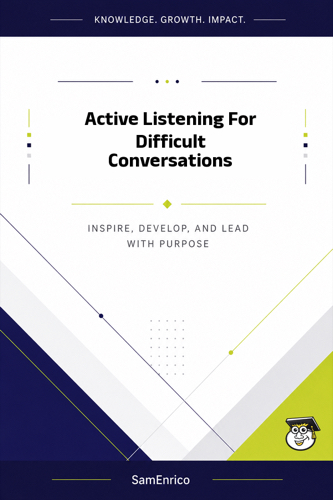
Active Listening For Difficult Conversations eBook
Navigates high stakes talks with skilled hearing.
Navigates high stakes talks with skilled hearing.
Formats
Free sample
Chapter 1: The Red Zone--–- The call came in at 2:17 on a Tuesday afternoon. You recognize the name on your phone, and your chest tightens before you even answer. This is the colleague who has been quietly undermining your work. The family member who brings up the same grievance every holiday. The manager whose feedback always feels like an indictment.
You take a breath, swipe to answer, and within thirty seconds, you have stopped listening. You are not a bad person. You are not a poor communicator. You are simply human, and your brain has just done what it evolved to do: it has entered the Red Zone.The Red Zone is the name for the neurobiological state that occurs when your brain perceives an emotional threat. In that state, your ability to process complex information, to feel genuine empathy, and to accurately hear what another person is saying drops by as much as fifty percent.
The research is clear: under conditions of interpersonal threat, the brain literally reroutes blood flow away from the prefrontal cortex—the region responsible for nuanced reasoning, perspective-taking, and impulse control—and toward the survival reflexes of the amygdala and brainstem. You do not choose to stop listening. Your biology chooses for you.This chapter is about understanding that biology, naming it, and learning to interrupt it before it sabotages your most important conversations. Most books about difficult conversations assume that listening is a matter of will or character. If you just cared more, tried harder, or practiced better manners, you would listen well.
That assumption is not only wrong; it is harmful. It turns a neurological reality into a moral failure. You cannot will your way out of a flooded amygdala any more than you can will your way out of a flooded basement. You need a pump. This chapter is the pump.The Myth of the Bad Listener Before we go any further, let us clear something up.
You have probably been told at some point in your life that you are a bad listener. Maybe a partner said it during an argument. Maybe a colleague hinted at it in performance feedback. Maybe you have said it about yourself. Here is what almost no one tells you: being a bad listener is not a character flaw.
It is a predictable, measurable, and reversible physiological response to perceived threat.Consider the evidence. In low-stakes conversations—chatting about weekend plans, debating where to order lunch, sharing a funny story from your commute—most people listen perfectly well. You ask questions. You remember details. You laugh at the right moments.
The problem is not that you lack listening skills. The problem is that those skills disappear precisely when you need them most. When the stakes rise, your brain treats the conversation like a predator and your listening ability like a luxury it cannot afford.This pattern has a name in the research literature: threat-induced cognitive narrowing. Under threat, your visual field literally constricts. Your hearing becomes selective.
Your working memory shrinks. These are not bugs in your design; they are features that kept your ancestors alive on the savanna. A twig snapping in the bushes required your full attention. A friendly voice explaining a minor misunderstanding did not. The problem is that your brain cannot reliably tell the difference between a physical threat and a social threat.
To your amygdala, being publicly corrected in a team meeting activates the same neural circuits as being charged by a wild animal. The response is the same: fight, flight, freeze, or fawn. None of those responses includes careful, curious listening.So let us retire the myth of the bad listener. You are not bad at listening. You are good at surviving.
And surviving is exactly what your brain is trying to do when it shuts down your ears in the middle of a difficult conversation. The question is not whether you are a good or bad listener. The question is whether you can learn to recognize the Red Zone quickly enough to do something about it.The Four Symptoms of Red Zone Listening How do you know you are in the Red Zone? The symptoms are specific, recognizable, and almost universal. Learn to name them, and you learn to catch yourself before the conversation spirals.Selective hearing is the first symptom.
You are no longer hearing everything the other person is saying. Instead, you are scanning for keywords that feel like threats. If they say, "I think we need to talk about the timeline," you hear only "timeline" and interpret it as an accusation about your work ethic. If they say, "I felt frustrated when that happened," you hear only "frustrated" and assume they are attacking your character. You are not listening to understand.
You are listening for weapons.Tone obsession is the second symptom. You have lost the ability to attend to content because you are entirely focused on delivery. Was that sigh disrespectful? Did that pause mean they think you are stupid? Is that volume appropriate or aggressive?
Tone obsession is a form of hypervigilance. Your brain is trying to predict danger by reading every vocal cue as a potential threat signal. The irony is that when you are tone-obsessed, you are almost certain to misinterpret tone. Fear makes you hear hostility where none exists.Interrupting is the third symptom, and it is the one most people recognize in themselves. You cannot hold your response any longer.
The words are building up in your throat. You have stopped listening because you are too busy rehearsing your defense, your counterargument, or your exit line. Interrupting is not a sign of rudeness. It is a sign of a working memory that has been overwhelmed by threat. You are not trying to be dismissive.
You are trying to survive, and survival demands that you speak before the opportunity disappears.Internal scriptwriting is the fourth symptom, and it is the most deceptive. From the outside, you look like you are listening. Your eyes are fixed on the other person. You are nodding occasionally. But inside your head, you are composing a novel.
You are rehearsing what you should have said. You are planning what you will say when they finally stop talking. You are replaying the argument from last week and imagining how you would win it this time. Internal scriptwriting is the Red Zone's stealth mode. You believe you are listening.
You are not.If you recognize any of these symptoms in yourself, you are not broken. You are normal. The question is not whether you experience them. The question is what you do when you notice them.Listening to Reply versus Listening to Learn The Red Zone is not an on-off switch. It is a dimmer, and you have more control over the dimmer than you think.
The first step in taking that control is understanding the fundamental choice that every difficult conversation presents: you can listen to reply, or you can listen to learn.Listening to reply is debate mode. Your goal is not to understand the other person. Your goal is to wait for a gap in their speech, then insert your superior argument. In this mode, you…
This is the end of the free sample. Get the eBook to keep going. Buy now
About this book
Details
- Author
- Bohannon Charita
- Publisher
- SamEnrico
- Language
- English
- Genre
- Non-Fiction, Self-Help, Difficult Talks
- Released
- 2026-06-11
- Pages (approx.)
- 136
- Available as
- eBook, Audiobook

Read better in the ZLOADR app
Your eBooks on your phone or tablet. Sign in with your SamEnrico account and start reading.
More by Bohannon Charita
 The MBSR for Tension HeadachesBohannon Charita$11.99
 Mentorship for Career ChangersBohannon Charita$11.99
 Creative Block ResearchBohannon Charita$11.99
 The Wooden Spoon LegacyBohannon Charita$11.99
 Cycling Injury Prevention GuideBohannon Charita$11.99
 Annual Penalty Summation GuideBohannon Charita$11.99
 Redgrave Dynasty - Natasha RichardsonBohannon Charita$11.99
 Assertiveness With Adult ChildrenBohannon Charita$11.99
 The Silent Siege: How a 1970s Prison Uprising Exposed America's Darkest SecretsBohannon Charita$11.99
 The Maestro of the African Diaspora: Chevalier de Saint-Georges and the Birth of Classical EleganceBohannon Charita$11.99
 The Day the Sky Blew Orange: The Great Dust Bowl UprisingBohannon Charita$11.99
 Growing MalopeBohannon Charita$11.99
You may also like
 Hong Kong Handover 1997Dunn Johnnie$11.99
 Zumba For Postnatal Recovery CourseNeal Christian$11.99
 Zumba for BeginnersLadner Nikia$11.99
 YouTube Comment Mining GuideHumes Pandora$12.99
 Worry Box MeditationCarlin Rudy$11.99
 Workplace Stress MeditationNguyen Lynn$11.99
 Workplace Stress and Sleep RepairHawley Ivory$11.99
 Workplace Perfectionism CureDelaney Jeffry$11.99
 Workplace Injustice Anger GuideWallen Isabelle$11.99
 Work Addiction and Burnout LinkGreenwood Ester$11.99
 Women in Yoga and WellnessBeattie Galina$11.99
 Women in Stand Up ComedyChun Evangeline$11.99