
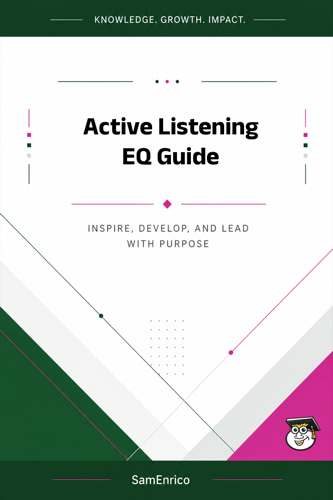
Non-FictionSelf-HelpActive ListeningCommunication
Active Listening EQ Guide eBook
Listen to understand rather than reply, using refl
by Nolan Hoyt
Listen to understand rather than reply, using reflection and clarification.
Formats
Free sample
Chapter 1: The Reply Reflex--–- The first time Maria realized she had stopped listening to her husband, she was already three sentences into her own response. He had been describing a difficult conversation with his boss—something about being passed over for a promotion, something about feeling invisible. But Maria’s brain had already categorized the problem, diagnosed the solution, and begun delivering it before he could finish his second sentence. “Have you tried scheduling a one-on-one to share your wins?” she offered. He fell silent.
Not the comfortable silence of feeling heard. The other silence. The one that means I give up.This scene repeats itself millions of times every day, in bedrooms and boardrooms, across dinner tables and video calls. Two people occupy the same space, exchange the same air, and yet neither truly listens to the other. One speaker feels dismissed.
The other listener feels helpful. Both walk away lonelier than before.The problem is not that people are selfish or unkind. The problem is a deeply wired, relentlessly reinforced cognitive habit called the reply reflex. It is the automatic, often unconscious urge to formulate a response while someone else is still speaking. It is the reason you have nodded along to a story only to realize you cannot recall the last three sentences.
It is the reason you have interrupted a colleague mid-sentence with “Actually, let me add something here” before they could finish their thought. It is the reason marriages drift apart not through fighting, but through the slow erosion of feeling heard.This chapter will not merely diagnose the reply reflex. It will help you catch it in action, understand why your brain is wired for this very behavior, and—most importantly—reframe the reflex from an enemy to be eliminated into a signal to be honored. Because the goal of this book is not to turn you into a silent, nodding robot. The goal is to help you earn the right to reply by first demonstrating that you have truly understood.The Anatomy of an Interruption Before we can fix the reply reflex, we must see it clearly.
And seeing it requires slowing down something that happens in milliseconds.Consider a typical exchange. Your partner says, “I’m really stressed about the budget this month.” In the 0.3 seconds between the final syllable of that sentence and your response, a remarkable sequence unfolds inside your brain.First, your auditory cortex processes the sound. Within 150 milliseconds, your brain has identified the words and begun matching them against stored memories—past conversations about money, your own anxiety about finances, the fight you had last month about overspending. Simultaneously, your amygdala scans for threat. Is this an attack?
A criticism? A demand? If your amygdala detects even a hint of blame (“we spent too much,” even if unspoken), it triggers a mild stress response. Your heart rate increases slightly. Your attention narrows.
You are no longer absorbing; you are preparing to defend.Meanwhile, your brain’s default mode network—the system responsible for self-referential thought—activates. This is the part of your brain that asks, What does this have to do with me? It pulls up your own recent experiences with budgeting, your own frustrations, your own solutions that worked last quarter. Within half a second, your brain has shifted from listening to understand to listening to reply.None of this is conscious. None of this is malicious.
It is simply efficient. Your brain is a prediction engine, constantly anticipating what comes next so it can respond quickly. In evolutionary terms, this speed was essential. If a rustle in the bushes might be a predator, you did not want to wait until the tiger finished explaining itself before you ran. But in modern conversations—where the stakes are rarely life or death—this same efficiency becomes a liability.The reply reflex is not a character flaw.
It is a biological legacy. And the first step to managing it is to stop blaming yourself for having it.The Three Layers of the Reflex: Biology, Ego, and Culture The reply reflex does not have a single cause. It is the product of three interacting layers: biological (how your brain is wired), psychological (how your ego protects itself), and sociological (how your environment rewards speed over depth). Understanding these layers is essential because each requires a different intervention. You cannot fix a cultural problem with a breathing technique, and you cannot fix a neurological problem with a pep talk.Layer One: The Biological Urge Neuroscience research using functional MRI scans has revealed something counterintuitive about conversation.
When we listen to someone speak, our brain’s Broca’s area—the region responsible for speech production—activates before the speaker finishes. Your brain begins rehearsing possible responses in parallel with listening. This is not a design flaw; it is a feature that allows for fluid back-and-forth exchange. But in practice, it means your brain is always slightly ahead of the conversation, always preparing its next move.This becomes problematic when the preparation overrides the reception. In a now-famous study, researchers found that listeners could recall only about 25 percent of a speaker’s message when they were simultaneously preparing a response.
When instructed to simply listen without any expectation of replying, recall jumped to nearly 80 percent. The mere anticipation of responding degrades listening.Additionally, the amygdala hijack—a term coined by Daniel Goleman—occurs when the brain perceives an emotional threat. If a speaker’s words trigger shame, anger, or fear, the amygdala overrides the prefrontal cortex (your reasoning center) and shifts the brain into fight-or-flight mode. In this state, genuine listening is neurologically impossible. You are not being stubborn or defensive; your brain has literally taken the wheel.Layer Two: The Ego’s Fear Even without a full amygdala hijack, the ego operates as a constant, low-grade filter on listening.
Your sense of self is invested in being right, being smart, being helpful, and being in control. When someone speaks, your ego asks a series of silent questions: Does this challenge my expertise? Does this imply I made a mistake? Does this require me to admit I don’t know something? Does this demand patience I don’t feel like giving?These questions are rarely conscious.
But they shape your listening in profound ways. For example, when a colleague says, “I’m not sure your approach will work,” your ego may interpret that as an attack on your competence—even if the colleague intended a genuine question. Your reply reflex kicks in not because you are a bad listener, but because your ego perceived a threat to its status.Similarly, the ego fears incompetence. In many workplaces, listening is undervalued while speaking is rewarded. The person who listens quietly for ten minutes and then offers a thoughtful reflection may be seen as passive.
The person who jumps in with an immediate opinion is seen as decisive. Over time, the ego learns that silence equals weakness and that rapid replying equals strength. This is not paranoia; it is pattern recognition.Layer Three: The Culture of Speed The third layer is the environment you inhabit. Schools reward students who raise their hands first with the…
This is the end of the free sample. Get the eBook to keep going. Buy now
About this book
Details
- Author
- Nolan Hoyt
- Publisher
- SamEnrico
- Language
- English
- Genre
- Non-Fiction, Self-Help, Active Listening, Communication
- Released
- 2026-06-08
- Pages (approx.)
- 147
- Available as
- eBook, Audiobook

Read better in the ZLOADR app
Your eBooks on your phone or tablet. Sign in with your SamEnrico account and start reading.
More by Nolan Hoyt
 Teen Athletic Self EsteemNolan Hoyt$11.99
 Canva Brand Identity for YouTubersNolan Hoyt$11.99
 Step Eleven Sleep MeditationNolan Hoyt$11.99
 Baba Yaga's Bone House: The Witch of the Forest's Dark BargainsNolan Hoyt$11.99
 AI for Slide Deck DesignNolan Hoyt$12.99
 Learn to Play the Six-stringed BanjoNolan Hoyt$11.99
 Healthcare ManagerNolan Hoyt$11.99
 How to Become a Liner AssemblerNolan Hoyt$11.99
You may also like
 Hong Kong Handover 1997Dunn Johnnie$11.99
 Zumba For Postnatal Recovery CourseNeal Christian$11.99
 Zumba for BeginnersLadner Nikia$11.99
 YouTube Comment Mining GuideHumes Pandora$12.99
 Worry Box MeditationCarlin Rudy$11.99
 Workplace Stress MeditationNguyen Lynn$11.99
 Workplace Stress and Sleep RepairHawley Ivory$11.99
 Workplace Perfectionism CureDelaney Jeffry$11.99
 Workplace Injustice Anger GuideWallen Isabelle$11.99
 Work Addiction and Burnout LinkGreenwood Ester$11.99
 Women in Yoga and WellnessBeattie Galina$11.99
 Women in Stand Up ComedyChun Evangeline$11.99