
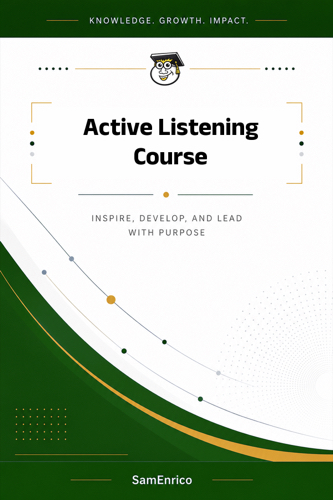
Non-FictionSelf-HelpListening Skills
Active Listening Course eBook
Teaches reflective listening, summarizing, and emo
Teaches reflective listening, summarizing, and emotional validation to deepen professional relationships.
Formats
Free sample
Chapter 1: The $10,000 Nod--–- You are about to make a very expensive mistake. It will happen sometime in the next forty-eight hours, probably during a conversation you do not remember. Someone will tell you something important—not loudly, not with a flashing warning label, but in the ordinary course of work. They will use words like “I’m fine” when they are not fine, or “That’s interesting” when they mean “That’s a disaster,” or “Let’s circle back” when they mean “I have already decided you do not listen.” You will nod. You will say “Got it” or “Makes sense” or nothing at all.
And then you will move on, having missed the signal entirely. The cost of that missed signal, averaged across a career, is approximately ten thousand dollars per nod. This is not a metaphor. This is a calculation.The Arithmetic of Not Listening Let us put numbers on something most professionals prefer to leave vague. A mid-level manager who loses one top performer because that employee felt unheard costs their organization between forty thousand and two hundred thousand dollars in recruitment, hiring, and productivity drag, according to data from the Center for American Progress and multiple workplace retention studies.
A salesperson who loses one deal per quarter because they failed to hear a client’s real objection—not the spoken objection, but the real one—loses between ten thousand and five hundred thousand dollars annually, depending on their industry. A project lead whose team misses one deadline because of miscommunication that a single summary would have caught costs their company in overtime, rework, and damaged client trust.These numbers are not extreme cases. They are the ordinary math of professional life. And yet, when we ask professionals to rate their own listening ability, ninety-six percent describe themselves as “good” or “excellent” listeners. When we ask their colleagues to rate the same people, the number drops to less than thirty percent.
This gap—the space between how well you think you listen and how well you actually listen—is the most expensive blind spot in the modern workplace. It is more expensive than poor strategy. It is more expensive than bad hires. It is more expensive than almost any single operational failure, because listening failure is a multiplier: it turns small misunderstandings into large conflicts, reasonable frustrations into quiet quitting, and solvable problems into career-limiting patterns.This book exists to close that gap. Not with vague advice about empathy or presence or “being there” for people.
Those sentiments, however well-intentioned, are useless without structure. You do not need to be a nicer person. You need to be a more accurate person. You need to know, with surgical precision, what to say when someone is angry, what to do when someone is silent, and how to move a conversation from chaos to clarity in under ninety seconds. That is what active listening actually is: a set of teachable, repeatable, measurable skills.
And the first skill is recognizing that you are probably not listening as well as you think you are.The Three Counterfeit Listening Styles Before we can build better listening habits, we have to name the fake ones. Most professionals do not actually listen poorly because they are selfish or distracted—though those are contributing factors. They listen poorly because they have learned counterfeit styles that feel like listening. These styles produce the outward signs of attention without the substance. They are the vocal fry of communication: common, socially accepted, and quietly destructive.Counterfeit One: Fake Listening Fake listening is the most common counterfeit, and it is also the most socially rewarded.
You know this one. You have done it today. Someone is speaking, and you are nodding at regular intervals, making eye contact, producing the minimal encouragers—“uh-huh,” “right,” “I see”—while your actual attention is elsewhere. Sometimes the elsewhere is obvious: you are checking your phone, glancing at your screen, or watching the clock. More often, the elsewhere is internal: you are rehearsing what you will say next, replaying a previous conversation, or solving a completely different problem in your head.Fake listening works socially because it produces the appearance of attention without the effort of actual comprehension.
In low-stakes situations—the status update that could have been an email, the colleague who tends to ramble—fake listening is a reasonable coping mechanism. The trouble is that fake listening becomes habitual. What starts as a polite shortcut in low-stakes conversations becomes your default setting in high-stakes ones. You will nod your way through a performance review, a client complaint, or a partner’s emotional disclosure, producing all the right signals while absorbing almost none of the content. And the other person will know.
They may not say anything. But they will feel it. And they will adjust their behavior accordingly—by sharing less, by trusting less, by leaving when they can.Counterfeit Two: Evaluative Listening Evaluative listening is more sophisticated than fake listening, which is what makes it more dangerous. The evaluative listener is not checked out. On the contrary, they are highly engaged.
The problem is that they are engaged in the wrong task. Instead of seeking to understand what the speaker means, the evaluative listener is busy judging whether the speaker is correct, reasonable, or aligned with their own views.You can spot evaluative listening by the internal monologue it produces. While the other person is speaking, the evaluative listener is thinking: “That’s wrong.” “That’s not how I see it.” “That’s an overreaction.” “That’s actually not what happened.” Sometimes these judgments are accurate. Sometimes the speaker is wrong, or overreacting, or misremembering. But here is the problem: accuracy of judgment is not the same as accuracy of understanding.
You can correctly identify that someone is wrong without understanding why they believe what they believe. And without that why, you cannot influence, persuade, or collaborate with them. You can only oppose them.Evaluative listening is especially common among high-achieving professionals. We have been trained to assess, critique, and decide. That training is valuable in analysis and execution.
But in conversation, it is a liability. When you listen evaluatively, you are not hearing the other person. You are hearing your own reaction to the other person. Those are not the same thing.Counterfeit Three: Solutioneering Solutioneering is the most seductive counterfeit because it feels generous. The solutioneer hears a problem and immediately jumps to solving it.
“Here’s what you should do.” “Have you tried X?” “What if you Y?” The solutioneer is not being dismissive; they are genuinely trying to help. But solutioneering sends an unintended message: I cannot tolerate your discomfort, so I will replace it with my solution before you have finished explaining.Solutioneering damages relationships in two ways. First, it assumes that the speaker wants a solution. Often, they do not. They want acknowledgment, validation, or simply the experience of being heard while they think out loud.
Second, solutioneering closes down exploration. When you offer a solution too early, you anchor the conversation on your frame. The speaker’s deeper concerns—the ones that would emerge if you simply listened for another sixty seconds—never see the light. This…
This is the end of the free sample. Get the eBook to keep going. Buy now
About this book
Details
- Author
- Ritter Vannesa
- Publisher
- SamEnrico
- Language
- English
- Genre
- Non-Fiction, Self-Help, Listening Skills
- Released
- 2026-06-10
- Pages (approx.)
- 125
- Available as
- eBook, Audiobook

Read better in the ZLOADR app
Your eBooks on your phone or tablet. Sign in with your SamEnrico account and start reading.
More by Ritter Vannesa
 The Empathy Development HandbookRitter Vannesa$11.99
 Senior Mentoring Self Esteem CourseRitter Vannesa$11.99
 Adolescent Body Image RescueRitter Vannesa$11.99
 Polish Secret State StructuresRitter Vannesa$11.99
 Orpheus and the Lyre That Conquered DeathRitter Vannesa$11.99
 Litigation LawyerRitter Vannesa$11.99
 Understanding Macular Degeneration, Age-relatedRitter Vannesa$17.99
 Data Presentation Mistakes GalleryRitter Vannesa$12.99
 A Beginners Guide to Drum and bugle corps (modern) (Volume 1)Ritter Vannesa$11.99
You may also like
 Hong Kong Handover 1997Dunn Johnnie$11.99
 Zumba For Postnatal Recovery CourseNeal Christian$11.99
 Zumba for BeginnersLadner Nikia$11.99
 YouTube Comment Mining GuideHumes Pandora$12.99
 Worry Box MeditationCarlin Rudy$11.99
 Workplace Stress MeditationNguyen Lynn$11.99
 Workplace Stress and Sleep RepairHawley Ivory$11.99
 Workplace Perfectionism CureDelaney Jeffry$11.99
 Workplace Injustice Anger GuideWallen Isabelle$11.99
 Work Addiction and Burnout LinkGreenwood Ester$11.99
 Women in Yoga and WellnessBeattie Galina$11.99
 Women in Stand Up ComedyChun Evangeline$11.99