
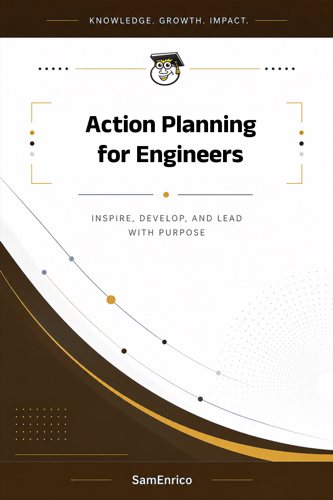
Non-FictionSelf-HelpEngineering
Action Planning for Engineers eBook
Design and project completion targets.
by Burris Ira
Design and project completion targets.
Formats
Free sample
Chapter 1: The Execution Mirage–- On a quiet Tuesday morning in Portland, Oregon, a senior mechanical engineer named Elena stared at her computer screen. She had just received an email that would unravel eighteen months of her team’s work. The bridge design—her bridge design—had been approved by every review board. The calculations were elegant. The safety factors were conservative.
The CAD model was a thing of beauty. Yet the project was now eighteen months behind schedule, and the contractor’s latest message read simply: “Cannot proceed. Awaiting material certification. No estimated completion date.”Elena’s story is not unusual. It is, in fact, the norm.
Across every engineering discipline—civil, mechanical, electrical, aerospace, software—the pattern repeats with depressing regularity. Brilliant designs. Flawless specifications. And then... nothing.
Or rather, not nothing, but a slow, grinding, expensive death by a thousand execution failures. The bridge that should have taken three years takes five. The medical device that needed six months of prototyping takes eighteen. The embedded system that was “ready for production” sits in limbo for a quarter because someone forgot to order the correct revision of a voltage regulator.This book exists because of a single, uncomfortable truth that most engineers would rather not confront: design brilliance does not predict project success. Execution architecture does.The Great Misunderstanding Most engineering education trains you to be a brilliant designer.
You learn thermodynamics, signal processing, materials science, finite element analysis, and control theory. You are rewarded for elegant solutions, for minimizing part count, for optimizing performance, for finding the clever workaround. These are valuable skills. They are not, however, sufficient.The gap between what engineers are taught and what projects actually require is vast. In school, your problem sets come with known inputs, clear constraints, and a single correct answer.
The due date is firm, but the only person depending on you is yourself. In the real world, requirements change mid-stream. Suppliers fail to deliver. Test equipment breaks. Your colleague in thermal analysis goes on vacation the week you need his signature.
The manufacturing line is already booked, and if you miss your slot, the next available opening is three months away.This is the execution gap: the chasm between a technically correct design and a successfully completed project. Crossing that gap requires a completely different skill set—one that is rarely taught and often dismissed as “project management” or “administrative overhead.” But calling action planning “overhead” is like calling a foundation “overhead” on a skyscraper. Without it, no matter how beautiful the facade, the entire structure collapses.Consider the data. The Project Management Institute’s annual Pulse of the Profession report consistently finds that nearly 50% of projects fail to complete on time, and more than 30% fail to meet their original goals. Among engineering-intensive projects, those numbers are worse.
A study of aerospace development programs found that only 15% delivered within 10% of their original schedule. In medical device development, the average time from concept to market is nearly three years—almost double what teams estimate at the outset.These are not failures of engineering. These are failures of action planning.Technical Specifications vs. Actionable Tasks To understand the execution gap, we must first understand a fundamental distinction that will recur throughout this book: the difference between a technical specification and an actionable task.A technical specification describes what must be true about the finished product. It is a statement of fact, often expressed in passive voice.
Examples include:“The pressure vessel shall withstand 10,000 psi without yielding.”“The thermal management system shall maintain junction temperature below 85°C at 40°C ambient.”“The firmware shall respond to CAN messages within 10 milliseconds of receipt.”These are necessary. They define the target. But they are not, by themselves, useful for execution. No engineer can wake up on a Tuesday morning and “withstand 10,000 psi.” That is not a task. It is a condition.An actionable task, by contrast, describes who does what by when with a verifiable output.
It is active, assigned, time-bound, and specific. Examples include:“Maria: Run burst test on weld coupon #3 this Friday at 2pm. Document yield pressure in Test Report TR-022.”“James: Simulate worst-case thermal load scenario (three boundary conditions) by Wednesday COB. Email results to lead with recommended junction temp margin.”“Priya: Instrument CAN ISR entry/exit with GPIO toggles on rev B board by Thursday. Capture 1000 samples on oscilloscope and log max latency.”Notice the difference.
The actionable task tells you exactly what to do, who will do it, when it must be done, and how you will know it is done. It leaves no room for ambiguity. It does not require interpretation. It is, in the best sense of the word, boring—and that is precisely its virtue.The execution gap widens precisely to the extent that you confuse specifications with tasks. Every ambiguous handoff, every unassigned action, every “we’ll figure it out later” is a crack in the foundation.
And like cracks in a pressure vessel, they may be invisible at first, but under load, they propagate catastrophically.Three Common Failure Modes In my years studying engineering projects—both successful and failed—three patterns of execution failure appear again and again. Learn to recognize them in your own work, because they are the early warning signs of a collapsing action plan.Failure Mode 1: Analysis Paralysis An aerospace team was designing a simple mounting bracket for a flight computer. The bracket needed to survive vibration and thermal cycling, but the loads were well understood. The lead engineer, a brilliant analyst, decided to run a full finite element analysis. Then another mesh refinement.
Then a different solver. Then a parametric study of material thickness. Then a topology optimization. Then a validation run with a finer mesh. Then a comparison of two FEA packages.By the time he was satisfied—forty-seven iterations later—the team had spent three weeks on a bracket that should have taken three days.
Worse, the manufacturing lead time for the bracket had been consumed by analysis. The project missed its integration milestone by two weeks.The problem was not the FEA. The problem was the absence of a decision rule. No one had asked: “What would constitute ‘good enough’ to proceed?” A simple rule—“stop when safety factor exceeds 2.5 at all nodes”—would have terminated the analysis on iteration five. But without that rule, the engineer was operating in an infinite loop.
There is always one more refinement. One more check. One more “just to be sure.”Analysis paralysis is not diligence. It is fear disguised as rigor.Failure Mode 2: Scope Creep A motor controller redesign was supposed to take eight weeks. The requirements were clear: update the power stage for a new battery chemistry, requalify EMI emissions, and release to production.
Simple enough.Then someone suggested, “While we’re at it, let’s improve the thermal management.” That added two weeks. Then a product manager asked, “Could we add telemetry logging?” That added three weeks. Then a field engineer reported a minor issue with an old revision, and someone said, “We should fix that too.” That added another week.No one said no. No change control board reviewed these additions. No one updated the schedule to reflect the…
This is the end of the free sample. Get the eBook to keep going. Buy now
About this book
Details
- Author
- Burris Ira
- Publisher
- SamEnrico
- Language
- English
- Genre
- Non-Fiction, Self-Help, Engineering
- Released
- 2026-06-08
- Pages (approx.)
- 152
- Available as
- eBook, Audiobook

Read better in the ZLOADR app
Your eBooks on your phone or tablet. Sign in with your SamEnrico account and start reading.
More by Burris Ira
 The Uncle's AliasBurris Ira$11.99
 Crematorium Operator StressBurris Ira$11.99
 Study Breaks StrategyBurris Ira$11.99
 Senior Progressive RelaxationBurris Ira$11.99
 Night Shift Sleep Recovery PlanBurris Ira$11.99
 Rock Climber Self HypnosisBurris Ira$11.99
 CPR for Dialysis PatientsBurris Ira$11.99
 The Silent Lens: Felice Beato's War Through a Camera (1850s-1860s)Burris Ira$11.99
 The Golden Aria: Black Voices That Conquered the Grand StageBurris Ira$11.99
 How to Produce EggplantsBurris Ira$11.99
 How to Produce Printed Circuit BoardsBurris Ira$11.99
 Packaging for European Export GuideBurris Ira$12.99
You may also like
 Hong Kong Handover 1997Dunn Johnnie$11.99
 Zumba For Postnatal Recovery CourseNeal Christian$11.99
 Zumba for BeginnersLadner Nikia$11.99
 YouTube Comment Mining GuideHumes Pandora$12.99
 Worry Box MeditationCarlin Rudy$11.99
 Workplace Stress MeditationNguyen Lynn$11.99
 Workplace Stress and Sleep RepairHawley Ivory$11.99
 Workplace Perfectionism CureDelaney Jeffry$11.99
 Workplace Injustice Anger GuideWallen Isabelle$11.99
 Work Addiction and Burnout LinkGreenwood Ester$11.99
 Women in Yoga and WellnessBeattie Galina$11.99
 Women in Stand Up ComedyChun Evangeline$11.99