
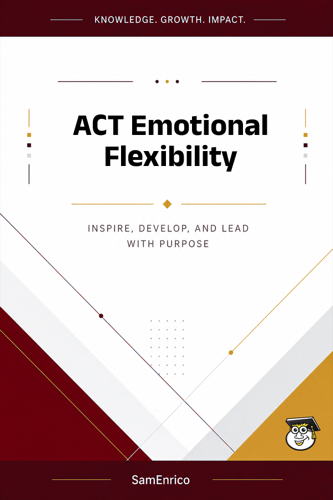
ACT Emotional Flexibility eBook
undefined
undefined
Formats
Free sample
Chapter 1: The Losing Battle--Most people wake up already losing.Before their feet touch the floor, the battle has begun. The alarm clock blares, and immediately—sometimes before the eyes even open—the mind starts its familiar war. I don't want to feel this tired. I shouldn't feel this anxious about the meeting. Why am I already dreading the day?
And just like that, the first strategy deploys: distraction. Scroll the phone. Check email. Plan breakfast. Anything to outrun the discomfort that arrived before coffee.By the time most people leave for work, they have already fought a dozen small emotional battles.
They have suppressed a wave of sadness. They have argued with a voice of self-doubt. They have numbed with caffeine, with news, with to-do lists, with the thousand tiny escapes that modern life makes available every second. And because these strategies work for about five to thirty minutes—just long enough to feel like they might be working—the person concludes: I am handling this. I am in control.They are not in control.
They are losing slowly, the way water loses to a leak in the hull. Not all at once. Not dramatically. But steadily, inexorably, with the quiet exhaustion of a lifelong war that was never winnable.This chapter is an intervention. It will name the war you have been fighting—possibly for decades—and it will offer a radical, uncomfortable, and ultimately liberating possibility: What if the goal was never to win?
What if the goal was to stop fighting?The Great Emotional Control Myth Every culture teaches its members how to feel. In Western societies, the lesson is subtle but relentless: good feelings are good; bad feelings are problems. Happiness is an achievement. Anxiety is a malfunction. Sadness is something to fix.
Anger is something to manage. Fear is something to overcome.These messages arrive from everywhere. Parents say, "Don't cry" to a scraped knee, teaching the child that tears are unacceptable. Schools enforce emotional discipline without teaching emotional literacy. Workplaces reward the perpetually cheerful and punish the visibly struggling.
Social media presents a gallery of curated joy, making private pain feel like personal failure. Self-help books promise to "eliminate negative thinking" and "conquer anxiety" as if emotions were enemy soldiers to be defeated.This is the Great Emotional Control Myth: the belief that emotional health means feeling good, that feeling good means being in control, and that being in control means suppressing, avoiding, or eliminating difficult feelings.The myth is seductive because it offers hope. If you just learn the right technique—positive affirmations, cognitive restructuring, deep breathing, thought stopping, distraction, meditation, medication, exercise, journaling, gratitude—you can finally feel the way you want to feel. You can be calm. You can be happy.
You can be in charge.But here is the truth that millions of therapy sessions and thousands of research studies have confirmed: The control strategies don't work long-term. Not because you are doing them wrong. Not because you lack willpower. Not because you are secretly broken. They don't work because they are trying to do something that cannot be done: control the uncontrollable.Emotions are not light switches.
You cannot simply decide to feel differently and have it happen reliably. Try this right now: for the next ten seconds, do not think of a pink elephant. Do not picture its floppy ears, its long trunk, its wrinkled gray-pink skin. Whatever you do, do not think of a pink elephant.What happened? If you are like most humans, you thought of a pink elephant immediately.
The instruction to suppress a thought makes that thought more present, not less. The same is true for emotions. Tell yourself "I will not feel anxious," and anxiety floods in. Tell yourself "I will not be sad," and sadness deepens its grip. The attempt to control is not the solution to the problem.
The attempt to control is the problem itself.Emotional Rigidity: The Cage You Built to Feel Safe When you try to control your emotions, you build a cage. The bars are made of avoidance behaviors—everything you do to escape or suppress what you feel. The more you struggle, the more bars you add. The cage gets smaller. Eventually, you are not even living your life anymore.
You are living a life organized entirely around not feeling certain things.Let us name this cage. It is called emotional rigidity.Emotional rigidity is the inability to respond to your inner experiences with flexibility and openness. It is not a personality flaw. It is a learned pattern—a set of strategies that once made sense (usually in childhood or during a difficult period) but have now become the problem themselves.Emotional rigidity shows up in predictable forms:Avoidance. You steer clear of situations that might trigger discomfort.
You don't apply for the promotion because it might cause anxiety. You don't have the difficult conversation because it might cause anger. You don't go to the party because it might cause social fear. Your world shrinks. The list of "safe" places gets shorter.
Eventually, avoidance becomes a full-time job.Suppression. You push feelings down. You smile when you want to cry. You say "I'm fine" when you are drowning. You tell yourself to "be professional" when grief is clawing at your chest.
Suppression works temporarily—for minutes or hours—but the suppressed feeling always returns, often stronger, often at the worst possible moment.Rumination. You overthink. You replay the conversation for the hundredth time. You try to "figure out" why you feel this way. Rumination feels like problem-solving, but it is actually a form of control: if you can just understand the feeling perfectly, you can finally get rid of it.
Spoiler: you cannot think your way out of feeling. Rumination is the hamster wheel of emotional rigidity—lots of movement, zero progress.Numbing. You use substances or behaviors to dull the edge. Alcohol, marijuana, prescription medications, food, pornography, gambling, social media scrolling, binge-watching, overworking, oversleeping—anything that temporarily changes your internal state. Numbing is not a solution; it is a lease on a problem.
The feeling you numbed today will be waiting for you tomorrow, with interest.Self-Criticism. You attack yourself for feeling. "What is wrong with me? Why can't I just get over this? Everyone else seems fine.
I am so weak." Self-criticism is a desperate attempt to control through shame—the belief that if you punish yourself enough, you will finally change. It does not work. It only adds another layer of suffering on top of the original pain.If you recognize yourself in any of these patterns, you are not alone. Every human being uses these strategies. They are not signs of failure.
They are signs of having a human brain that is trying to keep you safe. The problem is not that you use control strategies. The problem is that you have been taught that they are the only options.The Tug of War with a Monster Imagine you are in a tug of war with a monster. The monster is huge—ten times your size, with claws and teeth and no intention of letting go of the rope. The monster represents whatever difficult…
This is the end of the free sample. Get the eBook to keep going. Buy now
About this book
Details
- Author
- Ayala Kanisha
- Publisher
- SamEnrico
- Language
- English
- Genre
- Non-Fiction, Self-Help / ACT
- Released
- 2026-06-08
- Pages (approx.)
- 150
- Available as
- eBook, Audiobook

Read better in the ZLOADR app
Your eBooks on your phone or tablet. Sign in with your SamEnrico account and start reading.
More by Ayala Kanisha
 Military Morning DisciplineAyala Kanisha$11.99
 Mnemonic Device Selection GuideAyala Kanisha$11.99
 Vacation Disconnect GuideAyala Kanisha$11.99
 Burnout and Workload TriageAyala Kanisha$11.99
 HIIT Progress Tracker LogAyala Kanisha$11.99
 Jumia Payment Settlement GuideAyala Kanisha$12.99
 Silver Sulfadiazine GuideAyala Kanisha$11.99
 Persuasion For Real Estate AgentsAyala Kanisha$11.99
 Red Tails Over Berlin: The Tuskegee Airmen's Secret Mission in World War IIAyala Kanisha$11.99
 The Siege of Amida: Rome's Forgotten Last StandAyala Kanisha$11.99
 How to Produce Sauté PansAyala Kanisha$11.99
 Cocker Spaniel: Sweet & SoftAyala Kanisha$11.99
You may also like
 Hong Kong Handover 1997Dunn Johnnie$11.99
 Zumba For Postnatal Recovery CourseNeal Christian$11.99
 Zumba for BeginnersLadner Nikia$11.99
 YouTube Comment Mining GuideHumes Pandora$12.99
 Worry Box MeditationCarlin Rudy$11.99
 Workplace Stress MeditationNguyen Lynn$11.99
 Workplace Stress and Sleep RepairHawley Ivory$11.99
 Workplace Perfectionism CureDelaney Jeffry$11.99
 Workplace Injustice Anger GuideWallen Isabelle$11.99
 Work Addiction and Burnout LinkGreenwood Ester$11.99
 Women in Yoga and WellnessBeattie Galina$11.99
 Women in Stand Up ComedyChun Evangeline$11.99