
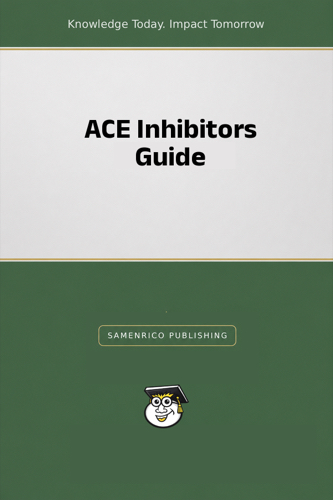
Non-FictionHealth & Wellness / Medication
ACE Inhibitors Guide eBook
undefined
by Bernal Anisa
undefined
Formats
Free sample
Chapter 1: The Silent Cascade...--–- The human body is a masterpiece of feedback loops, hormonal checks and balances, and finely tuned regulatory systems. But like any masterpiece, it has vulnerabilities—and one of its most powerful protective mechanisms can become a destructive force when it overreacts. This is the story of the Renin-Angiotensin-Aldosterone System, or RAAS, a name that sounds intimidating but represents something remarkably simple: your body's internal pressure control system. Understanding RAAS is not an academic exercise. It is the absolute prerequisite for understanding why ACE inhibitors work, why they save lives, and why they have become one of the most prescribed classes of medication in human history.
Without this foundation, the rest of this book is just a collection of facts. With it, you will see the entire picture with clarity.Imagine for a moment that you are standing in a garden hose. The water pressure feels just right—strong enough to reach the flowers, gentle enough not to burst the seams. Now imagine someone steps on the hose halfway down its length. Pressure builds behind the pinch.
The hose swells. The spray at the end weakens. Your body faces a similar dilemma every single day. Your blood pressure must remain high enough to push oxygen and nutrients into every capillary, every organ, every fingertip. But it must also remain low enough to avoid damaging the delicate lining of your arteries, your kidneys, your brain.
RAAS is the system that makes these constant adjustments, raising pressure when you stand up too quickly or lose blood, lowering it when you rest. It works silently, continuously, and almost always perfectly.But perfection has a dark side. In millions of people, RAAS becomes chronically overactive. It behaves as if the body is permanently bleeding out, even when it is not. It raises pressure relentlessly.
It scars the heart. It damages the kidneys. And this is precisely why blocking RAAS with ACE inhibitors is one of the most powerful interventions in modern medicine. To block something effectively, you must first understand it intimately. So let us begin.The kidney sits at the center of this story.
Nestled deep in the retroperitoneum, each kidney contains approximately one million microscopic filtering units called nephrons. Within each nephron, a specialized cluster of cells called the juxtaglomerular apparatus serves as the body's pressure sensor. These cells are exquisitely sensitive to three things: the pressure of blood flowing past them, the amount of sodium chloride reaching the distant part of the nephron, and signals from the sympathetic nervous system. When blood pressure falls—from dehydration, blood loss, or simply standing up—the juxtaglomerular cells release an enzyme called renin into the bloodstream. Renin is the first domino in a cascade that will ultimately raise pressure back to normal.But renin alone does nothing.
It is an enzyme without a substrate—a key without a lock. Its target is a large plasma protein called angiotensinogen, produced continuously by the liver and floating passively in the blood. Angiotensinogen is an inert precursor, a sleeping giant with no biological activity. When renin cleaves angiotensinogen, it releases a ten-amino-acid peptide called Angiotensin I. This molecule is still mostly inactive.
It has some weak vasoconstrictor properties, but nothing that would meaningfully change blood pressure. It is, in essence, a waiting messenger.The transformation happens in the lungs. The endothelium—the thin layer of cells lining every blood vessel—contains an enzyme called Angiotensin-Converting Enzyme, or ACE. ACE is densely concentrated on the surface of pulmonary endothelial cells because the lungs receive the entire cardiac output with every heartbeat, making them the ideal location for a systemic hormone factory. As blood passes through the lungs, ACE rapidly clips two amino acids from Angiotensin I, converting it into the eight-amino-acid peptide Angiotensin II.
Now the messenger has become the king.Angiotensin II is one of the most potent vasoconstrictors known to biology. It binds to AT1 receptors on vascular smooth muscle cells, causing them to contract. The effect is immediate and powerful. Arteries narrow. Resistance increases.
Blood pressure rises. In a healthy person, this response is lifesaving. In someone with chronic hypertension, it is destructive. But vasoconstriction is only the first act.Angiotensin II travels from the lungs to the adrenal cortex, the outer layer of the adrenal glands sitting atop each kidney. There, it stimulates the release of aldosterone, a steroid hormone with a deceptively simple job: tell the kidneys to hold onto sodium and water while excreting potassium and hydrogen ions.
Sodium retention drives water retention. Water retention increases blood volume. Increased blood volume raises blood pressure further. This is the volume side of pressure control, complementing the vasoconstriction side. Together, they form a two-pronged assault on low blood pressure—and, when overactive, a two-pronged assault on cardiovascular health.Aldosterone has another effect that is less often discussed but critically important.
It promotes fibrosis—the inappropriate deposition of collagen—in the heart, blood vessels, and kidneys. Over years of uncontrolled activation, aldosterone turns flexible, compliant tissues into stiff, scarred structures. The heart struggles to fill. The arteries lose their ability to expand and contract. The kidneys slowly harden and fail.
This is not an acute crisis. It is a slow, silent, decades-long process that most patients never feel until the damage is already extensive.Angiotensin II does not stop at vasoconstriction and aldosterone release. It also acts directly on the kidneys to increase sodium reabsorption in the proximal tubule, bypassing aldosterone entirely. It stimulates the release of antidiuretic hormone (ADH) from the posterior pituitary, telling the kidneys to concentrate urine rather than dilute it, further conserving water. It activates the sympathetic nervous system, increasing heart rate and cardiac output.
It promotes inflammation in the vessel wall, contributing to the formation of atherosclerotic plaques. It stimulates the production of growth factors that cause cardiac myocytes to enlarge—a process called hypertrophy that thickens the heart wall but reduces its efficiency. And it promotes the migration and proliferation of vascular smooth muscle cells, narrowing arteries over time.Every one of these effects is adaptive in the short term. If you are bleeding from a wound, you want vasoconstriction, sodium retention, water conservation, sympathetic activation, and even vascular remodeling. You want to survive.
But in chronic hypertension, heart failure, and diabetic kidney disease, these same adaptations become maladaptive. They are the wrong response to the wrong problem. The body thinks it is hemorrhaging when it is actually just living with high blood pressure or a weak heart. And so it makes everything worse.This brings us to the central clinical insight of the past fifty years. In conditions where RAAS is chronically overactive, blocking the cascade at the ACE enzyme produces profound benefits.
Reduce Angiotensin II production, and you reduce vasoconstriction. Lower aldosterone, and you reduce sodium and water retention, easing the workload on the heart. Decrease growth factor stimulation, and you slow or even reverse cardiac remodeling. The result is lower blood pressure, improved cardiac output, preserved kidney function, and reduced mortality.But ACE inhibitors do more than lower blood pressure. This is a point so important that it deserves its own emphasis.
Blood pressure reduction alone does not explain the full benefit of these drugs. In landmark clinical trials, ACE inhibitors reduced…
This is the end of the free sample. Get the eBook to keep going. Buy now
About this book
Details
- Author
- Bernal Anisa
- Publisher
- SamEnrico
- Language
- English
- Genre
- Non-Fiction, Health & Wellness / Medication
- Released
- 2026-06-08
- Pages (approx.)
- 150
- Available as
- eBook, Audiobook

Read better in the ZLOADR app
Your eBooks on your phone or tablet. Sign in with your SamEnrico account and start reading.
More by Bernal Anisa
 Marina Transaction AnalysisBernal Anisa$11.99
 Innovation for DevOps EngineersBernal Anisa$11.99
 Dave Stockton Putting GeniusBernal Anisa$11.99
 Medical School AnkiBernal Anisa$11.99
 Texas Forensic Science CommissionBernal Anisa$11.99
 Sober Companion ServiceBernal Anisa$11.99
 Arachnophobia GuideBernal Anisa$11.99
 The Silk and Steel: Europe's First Supermodels and the Birth of Fashion as ArtBernal Anisa$11.99
 The Golden Compass of the Sahara: The Legendary Expedition of Ibn BattutaBernal Anisa$11.99
 How to Start a Embrocation Business (Beginners Guide)Bernal Anisa$11.99
 How to Produce Pedal-powered ThreshersBernal Anisa$11.99
 Automated Invoice RemindersBernal Anisa$12.99
You may also like
 Hong Kong Handover 1997Dunn Johnnie$11.99
 Zumba For Postnatal Recovery CourseNeal Christian$11.99
 Zumba for BeginnersLadner Nikia$11.99
 YouTube Comment Mining GuideHumes Pandora$12.99
 Worry Box MeditationCarlin Rudy$11.99
 Workplace Stress MeditationNguyen Lynn$11.99
 Workplace Stress and Sleep RepairHawley Ivory$11.99
 Workplace Perfectionism CureDelaney Jeffry$11.99
 Workplace Injustice Anger GuideWallen Isabelle$11.99
 Work Addiction and Burnout LinkGreenwood Ester$11.99
 Women in Yoga and WellnessBeattie Galina$11.99
 Women in Stand Up ComedyChun Evangeline$11.99