
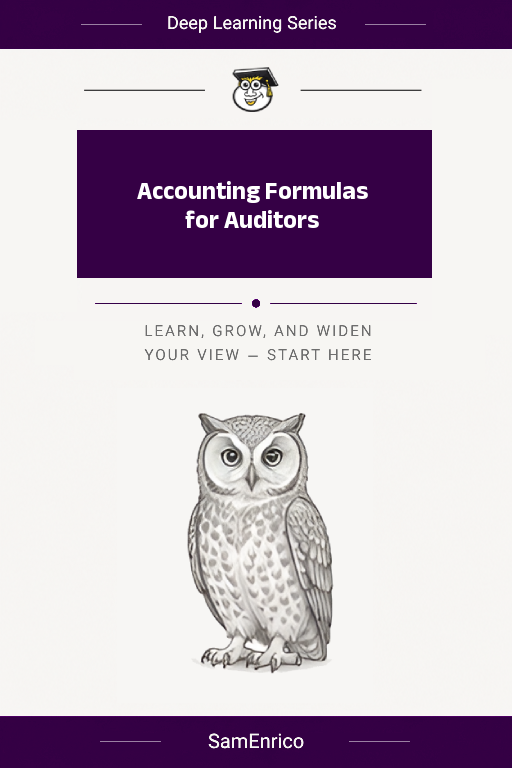
Non-FictionAudit GuideProfessional Tutorial
Accounting Formulas for Auditors
Focus on analytical procedure formulas used in aud
Focus on analytical procedure formulas used in audits. Includes materiality calculations, ratio analysis, and substantive testing shortcuts.
Formats
About this book
Free sample
Chapter 1: The Expectation Equation–- It was 3:47 on a Thursday afternoon when Sarah Chen, a third-year audit senior at a mid-tier firm, realized she was about to lose her license. The PCAOB inspection team had just asked to see her workpapers for the analytical procedures on the Johnson Manufacturing audit. She had run the ratios. She had documented that revenue "appeared reasonable." She had noted that gross margin "seemed consistent with prior year." And she had absolutely no formula, no calculation, no statistical basis for any of those conclusions. She had eyeballed it.
And now she was going to pay for it.Sarah's story is not unique. It plays out in inspection rooms across the country every year. The PCAOB's 2024 Inspection Report noted that over 38% of audits with deficiencies had at least one failure related to analytical procedures—specifically, the failure to develop a sufficiently precise expectation. The auditors had used words like "appears," "seems," and "feels" instead of numbers, ranges, and probabilities. They had treated analytical procedures as a check-the-box compliance exercise rather than a mathematical tool for detecting misstatement.This chapter exists to ensure you never become Sarah Chen.Welcome to the foundation of every effective analytical procedure: the Expectation Equation.
This single formula separates auditors who catch fraud from auditors who get caught by inspectors. It transforms analytical procedures from a vague "does this look right?" into a precise, statistically defensible, and PCAOB-inspector-proof calculation.The Core Problem: Why "Looks Reasonable" Is Not Enough Before we dive into the formula, we need to understand why subjective expectations fail. Human beings are pattern-recognition machines, but we are also biased, overconfident, and easily fooled. When an auditor looks at a financial statement line item and thinks "that looks reasonable," they are relying on a mental model that is:Implicit – You can't document what you didn't write down Unquantified – "Reasonable" could mean a 1% variance or a 20% variance Unreliable – Recency bias, anchoring, and confirmation bias all distort your judgment Consider this experiment from the auditing literature: When presented with the same set of financial statements, auditors who were told…
This is the end of the free sample. Get the eBook to keep going. Buy now
Contents
- Chapter 1
- Chapter 2
- Chapter 3
- Chapter 4
- Chapter 5
- Chapter 6
- Chapter 7
- Chapter 8
- Chapter 9
- Chapter 10
- Chapter 11
- Chapter 12
Details
- Author
- Culbertson Marceline
- Publisher
- SamEnrico
- Language
- English
- Genre
- Non-Fiction, Audit Guide, Professional Tutorial
- Released
- 2026-06-01
- Pages (approx.)
- 155
- Available as
- eBook, Audiobook

Read better in the ZLOADR app
Your eBooks on your phone or tablet. Sign in with your SamEnrico account and start reading.
More by Culbertson Marceline
 The Joy of WorkCulbertson Marceline$11.99
 Kids Sharing BedroomsCulbertson Marceline$11.99
 Self Doubt At Work HandbookCulbertson Marceline$11.99
 Assertive vs Aggressive ExamplesCulbertson Marceline$11.99
 Mindfulness for Working Parents GuideCulbertson Marceline$11.99
 The Fall of Angkor: The Khmer Empire's Last StandCulbertson Marceline$11.99
 Understanding Myofibrillar LysisCulbertson Marceline$17.99
 SAP SWOT Analysis Library GuideCulbertson Marceline$12.99
 How to Become a Label PinkerCulbertson Marceline$11.99
 Building a House for Habitat for HumanityCulbertson Marceline$11.99
You may also like
 Hong Kong Handover 1997Dunn Johnnie$11.99
 Zumba For Postnatal Recovery CourseNeal Christian$11.99
 Zumba for BeginnersLadner Nikia$11.99
 YouTube Comment Mining GuideHumes Pandora$12.99
 Worry Box MeditationCarlin Rudy$11.99
 Workplace Stress MeditationNguyen Lynn$11.99
 Workplace Stress and Sleep RepairHawley Ivory$11.99
 Workplace Perfectionism CureDelaney Jeffry$11.99
 Workplace Injustice Anger GuideWallen Isabelle$11.99
 Work Addiction and Burnout LinkGreenwood Ester$11.99
 Women in Yoga and WellnessBeattie Galina$11.99
 Women in Stand Up ComedyChun Evangeline$11.99