
Non-FictionStudent's ShortcutBalance Sheet
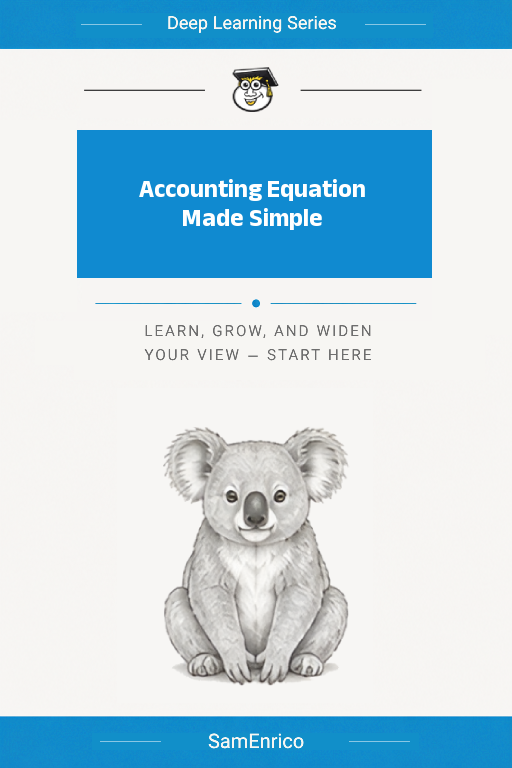
Accounting Equation Made Simple eBook
Learn Assets = Liabilities + Equity through real w
Learn Assets = Liabilities + Equity through real world examples and practice problems.
Formats
Free sample
Chapter 1: The Mirror Test--–- You think you know how much money you have. You are almost certainly wrong.Not because you cannot add or subtract. Not because you are bad with numbers. Not because you have made some embarrassing accounting error that would cause a professional to wince. No, you are wrong for a much simpler and more unsettling reason: the number in your bank account is a liar.Let that sink in for a moment.
Every time you log into your banking app and see that balance—whether it makes you feel secure or anxious or hopeful—you are looking at a partial truth at best and a dangerous illusion at worst. That number tells you how much cash the bank holds for you at that exact second. But it tells you nothing about what you truly own. It tells you nothing about what you truly owe. And most critically, it tells you nothing about whether you are actually building wealth or simply running in place while believing you are moving forward.This chapter is not about accounting in the dusty, green-visored, calculator-tapping sense of the word.
This chapter is about a mirror. It is about holding that mirror up to your financial life and seeing, for perhaps the first time, the difference between your gross reality and your net truth.Consider the following scenario, which will feel familiar to millions of people.You buy a house. The price is 400,000.Youputdown400,000. You put down 400,000.Youputdown40,000—ten percent—and borrow the remaining $360,000 from a bank. You move in, paint the walls, plant some flowers, and feel the warm glow of homeownership.
You are a homeowner. You own a house.Do you, though?Let us check that bank balance again. You had 60,000insavingsbeforethepurchase.Youwroteacheckfor60,000 in savings before the purchase. You wrote a check for 60,000insavingsbeforethepurchase.Youwroteacheckfor40,000 as the down payment. Your bank account now shows 20,000.Accordingtoyourbankingapp,yournetworthjustdroppedby20,000.
According to your banking app, your net worth just dropped by 20,000.Accordingtoyourbankingapp,yournetworthjustdroppedby40,000. That feels terrible. That feels like going backward.But you also now have a house. Or do you? The bank has a $360,000 claim on that house.
If you stopped making payments, the bank would take the house. The deed might have your name on it, but the bank holds a very large, very real key to the front door.So what do you actually own? You own the difference between what the house is worth and what you still owe. That difference—40,000inthisexample—isyourequity.That40,000 in this example—is your equity. That 40,000inthisexample—isyourequity.That40,000 did not disappear when you wrote the down payment check.
It transformed. It moved from being cash in your bank account to being ownership in a physical asset. Your net worth did not drop by $40,000. Your net worth stayed exactly the same. You simply exchanged one form of asset for another.This is the moment when most people's mental accounting breaks down.
And this is the moment when this book begins.The Great Deception of the Bank Balance Let us name the villain of this story. It is not greed. It is not poor financial education, though that certainly plays a role. The villain is what we will call the Single-Entry Fallacy.A single-entry system is what you use when you track your money in a checkbook register or a basic spreadsheet. You record when money comes in.
You record when money goes out. You subtract the out from the in. And then you look at the remaining number as if it tells you something meaningful about your financial health.It does not.The Single-Entry Fallacy convinces you that cash is the only thing that matters. It convinces you that spending cash on something that retains value—a house, a car, equipment for a business—is the same as spending cash on something that disappears instantly—a dinner out, a streaming subscription, a pair of shoes you will wear twice. It convinces you that a loan is simply a negative number rather than a relationship between what you own and what you owe.This fallacy is not merely academic.
It destroys businesses. It keeps people trapped in cycles of financial anxiety. It causes entrepreneurs to make catastrophic decisions because they look at their bank balance, see a number that scares them, and act out of fear rather than out of understanding.Let me tell you about a real business owner I will call Sarah. Sarah ran a small catering company. She was profitable by every reasonable measure.
Her customers loved her food. Her costs were under control. She had more orders than she could handle.But Sarah only looked at her bank balance.Every Monday morning, Sarah logged into her business account. Some Mondays, the balance was high because several large customers had paid their invoices over the weekend. Those Mondays, Sarah felt rich.
She hired extra staff. She bought new equipment. She expanded.Other Mondays, the balance was low because customers were slow to pay. Those Mondays, Sarah felt poor. She cut back on marketing.
She postponed necessary repairs. She considered laying people off.The same business. The same profitability. The same future prospects. Completely different emotional and operational states based entirely on the random timing of customer payments.Sarah eventually ran her business into the ground.
Not because she was bad at cooking or customer service. Not because her prices were wrong or her quality declined. She failed because she was looking at the wrong number. She was flying a plane by looking at the altimeter and ignoring the fuel gauge.Sarah needed the mirror that this chapter is about to hand you.Your Personal Balance Sheet: The First Mirror Before we talk about businesses—and we will spend most of this book talking about businesses—you need to perform a small but profound exercise. You need to calculate your personal net worth.This is not a test.
There is no grade. There is no judgment. You do not need to show this number to anyone unless you want to. But you need to see it. You need to hold the mirror up and look.Here is what you do.Take out a piece of paper.
Or open a blank document on your computer. Draw a vertical line down the middle. On the left side, write the word "ASSETS" at the top. On the right side, write the word "LIABILITIES" at the top.Under ASSETS, list everything you own that has value. Be honest but also be realistic.
Include:Cash in checking and savings accounts The current market value of any real estate you own (not what you paid for it, not what you hope it is worth—what a buyer would reasonably pay today)The current resale value of any vehicles you own (check Kelley Blue Book or a similar service)Retirement account balances (401k, IRA, pension values)Investment account balances (stocks, bonds, mutual funds)The cash surrender value of any life insurance policies The current value of any business ownership Valuable personal property (jewelry over $500, art, collectibles, musical instruments, firearms—but be brutally honest about value)Money owed to you (loans you made to friends or family that you realistically expect to be repaid)Do not include:Your phone (unless…
This is the end of the free sample. Get the eBook to keep going. Buy now
About this book
Details
- Author
- Livingston Josie
- Publisher
- SamEnrico
- Language
- English
- Genre
- Non-Fiction, Student's Shortcut, Balance Sheet
- Released
- 2026-05-29
- Pages (approx.)
- 160
- Available as
- eBook, Audiobook

Read better in the ZLOADR app
Your eBooks on your phone or tablet. Sign in with your SamEnrico account and start reading.
More by Livingston Josie
 Remote Work for DepressionLivingston Josie$11.99
 Discord Server Overload SolutionsLivingston Josie$11.99
 Notion Workspace Switching GuideLivingston Josie$11.99
 Elder Parent Financial StressLivingston Josie$11.99
 Power Posing for SuccessLivingston Josie$11.99
 Suture vs Steri Strip DecisionLivingston Josie$11.99
 Jet Lag GuideLivingston Josie$11.99
 Unidentified Remains Forensic ArtLivingston Josie$11.99
 The Oxy Express: How a Small Town Became Ground Zero for America’s Opioid CrisisLivingston Josie$11.99
 How to Start a Metals (wholesale) Business (Beginners Guide)Livingston Josie$11.99
 A Collector's Handbook to the Rover Meteor 16HPLivingston Josie$11.99
 How to Produce 100% Cashmere YarnLivingston Josie$11.99
You may also like
 Hong Kong Handover 1997Dunn Johnnie$11.99
 Zumba For Postnatal Recovery CourseNeal Christian$11.99
 Zumba for BeginnersLadner Nikia$11.99
 YouTube Comment Mining GuideHumes Pandora$12.99
 Worry Box MeditationCarlin Rudy$11.99
 Workplace Stress MeditationNguyen Lynn$11.99
 Workplace Stress and Sleep RepairHawley Ivory$11.99
 Workplace Perfectionism CureDelaney Jeffry$11.99
 Workplace Injustice Anger GuideWallen Isabelle$11.99
 Work Addiction and Burnout LinkGreenwood Ester$11.99
 Women in Yoga and WellnessBeattie Galina$11.99
 Women in Stand Up ComedyChun Evangeline$11.99