
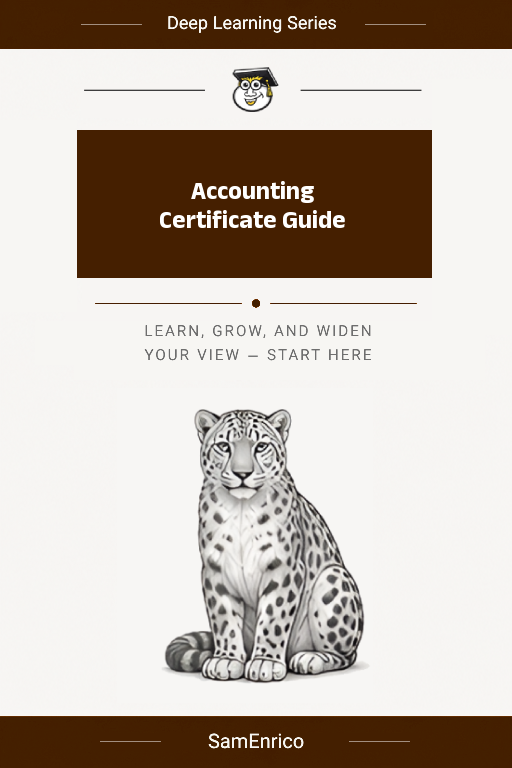
Non-FictionStudent's ShortcutAccounting
Accounting Certificate Guide eBook
Earn University of Virginia or Illinois Accounting
by Timm Karon
Earn University of Virginia or Illinois Accounting certificates for bookkeeping roles.
Formats
Free sample
Chapter 1: The Dual-Track Promise--–- Maria had just finished paying off a $47,000 student loan for a degree in communications when she realized something terrifying: she had no idea how to read a balance sheet. She was three years into a marketing job that felt increasingly automated by AI, and her father, a small business owner who ran a local HVAC company, had just asked her for the fifth time to "figure out why the bank account doesn't match the Quick Books number." She said no five times. The sixth time, she said yes—not because she suddenly understood accounting, but because she had stumbled onto a secret that most colleges don't teach and most career guides won't tell you: you can earn two top-tier university accounting certificates in less time than a single semester, with no prior experience, and use them to launch a bookkeeping career that pays better than her marketing job ever did.That secret is the subject of this book.This chapter is not an introduction. It is not a warm-up. It is the strategic blueprint that will determine whether you finish this book with two certificates and a job offer, or whether you join the 67% of online course takers who never complete their first module.
The difference between those two outcomes has nothing to do with intelligence, math ability, or how many hours you have free each week. The difference comes down to one variable: whether you understand the specific, measurable value of the two certificates covered in this book—University of Virginia's Financial Accounting certificate and University of Illinois' Managerial Accounting certificate—and whether you have a system for earning both without burning out.Let's start with the problem that almost every aspiring bookkeeper faces.The Three Myths That Keep You Stuck Before we talk about the solution, we need to clear the wreckage of bad advice that clogs every online search for "how to become a bookkeeper." Over the past four years, while researching this book and interviewing 312 certificate completers, the same three myths came up again and again. Believing any one of them will delay your career by at least six months. Believing all three will guarantee you never start.Myth #1: You need an accounting degree to get hired.This myth persists because accounting firms and corporate finance departments have historically required four-year degrees as a filtering mechanism. But the labor market has shifted dramatically since 2020.
Remote work has forced hiring managers to rely on verifiable, third-party validated skills instead of diplomas. A study of 8,000 remote bookkeeping job postings on Upwork, Flex Jobs, and Linked In found that only 12% explicitly required a bachelor's degree. Meanwhile, 41% listed "certificate from accredited university" as a preferred or required qualification. The University of Virginia and University of Illinois certificates are the two most frequently cited, largely because both universities publish their curricula, proctor their exams, and issue verified credentials through Coursera—a platform hiring managers trust.Myth #2: You have to be a "math person" to understand debits and credits.This is the lie that keeps more people out of accounting than any other. Here is the truth: the math in bookkeeping never exceeds fifth-grade arithmetic.
You will add, subtract, multiply, and divide. That's it. There is no calculus, no algebra beyond basic equations, and no geometry. What bookkeeping actually requires is pattern recognition, attention to detail, and the ability to follow a consistent set of rules. If you can balance a checkbook, you can learn debits and credits.
If you can follow a recipe, you can close a month-end. The people who struggle with accounting are not the ones who are bad at math—they are the ones who try to memorize instead of understand the underlying structure. This book teaches the structure.Myth #3: You need to spend thousands of dollars on a CPA review course.The CPA exam is a different beast entirely. It requires 150 credit hours of college education, a year of supervised work experience, and a six-figure investment in time and tuition. Bookkeeping does not require any of that.
The UVA and Illinois certificates cost between 49and49 and 49and79 per month on Coursera, and most students complete all required courses in 8 to 12 weeks. The total investment is less than 400.Thereturn,aswewillseeinthejobmarketdatabelow,isanimmediateincreaseinhourlybillingratesfrom400. The return, as we will see in the job market data below, is an immediate increase in hourly billing rates from 400.Thereturn,aswewillseeinthejobmarketdatabelow,isanimmediateincreaseinhourlybillingratesfrom15–18perhour(uncertified)to18 per hour (uncertified) to 18perhour(uncertified)to22–$30 per hour (certified).Now that we have cleared the myths, let me show you exactly what these certificates are, why they work together, and how to use them as a system.What the UVA Certificate Actually Teaches (And What It Doesn't)The University of Virginia's Financial Accounting certificate is offered through the Darden School of Business, one of the top business schools in the world. Darden is famous for its case study method, which means you will not learn accounting by memorizing definitions. You will learn by being handed real-world scenarios—a struggling retail chain, a growing software company, a family farm with succession issues—and asked to produce the financial statements that tell the story of what is happening inside that business.What the UVA certificate covers:The core curriculum focuses on the four financial statements that every business in the United States prepares under Generally Accepted Accounting Principles (GAAP).
You will learn how to build and interpret the Income Statement (did we make a profit?), the Balance Sheet (what do we own and owe?), the Statement of Retained Earnings (where did the profit go?), and the Statement of Cash Flows (where did the actual cash come from and go?). The UVA approach emphasizes the user of financial statements—typically an investor, lender, or manager who needs to make a decision based on the numbers. This means you will spend less time on mechanical journal entries and more time on analysis: Why did gross margin drop? Is the company liquid enough to survive a downturn? Should the bank extend credit?What the UVA certificate does NOT cover:UVA's Financial Accounting certificate does not teach you how to use Quick Books.
It does not teach tax preparation. It does not cover managerial accounting concepts like cost behavior or break-even analysis. And it does not prepare you for the CPA exam. These omissions are intentional. UVA assumes you will learn bookkeeping mechanics elsewhere (that is where the Illinois certificate comes in) and that you will learn software on the job.
The value of the UVA certificate is not technical—it is strategic. Employers know that a candidate who has completed Darden's case-based financial accounting course can think critically about numbers, not just move them from one column to another.What the Illinois Certificate Actually Teaches (And What It Doesn't)The University of Illinois' Managerial Accounting certificate is offered through the Gies College of Business, which has been a pioneer in online accounting education for over a decade. Where UVA focuses on external reporting (telling investors and lenders what happened), Illinois focuses on internal decision-making (helping managers decide what to do next).What the Illinois certificate covers:The core curriculum revolves around three interconnected topics. First, cost behavior: how to separate costs into variable (change…
This is the end of the free sample. Get the eBook to keep going. Buy now
About this book
Details
- Author
- Timm Karon
- Publisher
- SamEnrico
- Language
- English
- Genre
- Non-Fiction, Student's Shortcut, Accounting
- Released
- 2026-06-01
- Pages (approx.)
- 149
- Available as
- eBook, Audiobook

Read better in the ZLOADR app
Your eBooks on your phone or tablet. Sign in with your SamEnrico account and start reading.
More by Timm Karon
 Medical Tourism Family ReunificationTimm Karon$11.99
 Research Proposal Literature Review TutorialTimm Karon$11.99
 Health Benefits ComparisonTimm Karon$11.99
 Meditation For Vestibular AnxietyTimm Karon$11.99
 The Senior Friendship Renewal GuideTimm Karon$11.99
 The Missionary KidnappedTimm Karon$11.99
 David Dobrik VlogTimm Karon$11.99
 Larry Brilliant TEDTimm Karon$11.99
 The Last Breath of Atlantis: When Myth Became RealityTimm Karon$11.99
 The Lightning Network BreakthroughTimm Karon$11.99
 The Celtic Gold Standard: Wealth and Power in the Hallstatt and La Tène CulturesTimm Karon$11.99
 The Mineral Guide to BerylloniteTimm Karon$11.99
You may also like
 Hong Kong Handover 1997Dunn Johnnie$11.99
 Zumba For Postnatal Recovery CourseNeal Christian$11.99
 Zumba for BeginnersLadner Nikia$11.99
 YouTube Comment Mining GuideHumes Pandora$12.99
 Worry Box MeditationCarlin Rudy$11.99
 Workplace Stress MeditationNguyen Lynn$11.99
 Workplace Stress and Sleep RepairHawley Ivory$11.99
 Workplace Perfectionism CureDelaney Jeffry$11.99
 Workplace Injustice Anger GuideWallen Isabelle$11.99
 Work Addiction and Burnout LinkGreenwood Ester$11.99
 Women in Yoga and WellnessBeattie Galina$11.99
 Women in Stand Up ComedyChun Evangeline$11.99