
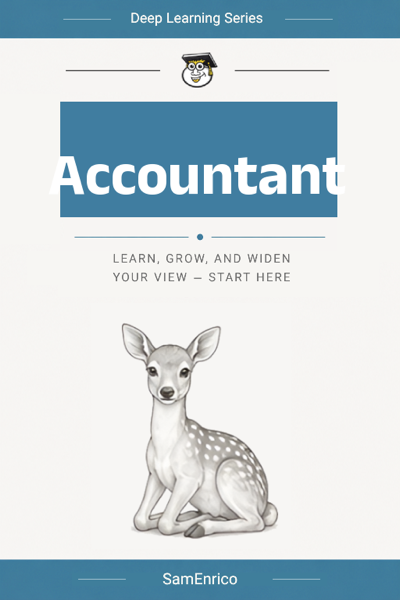
Non-FictionInformativeEducational
Accountant eBook
A Coursebook on Accountant
A Coursebook on Accountant
Formats
Free sample
Chapter 1: The Language of Money--The first time a business owner told me, “But I have plenty of cash in the bank—how can I be losing money?” I realized something profound. Accounting is not about math. It is about translation. That business owner was not stupid. He was fluent in deposits and withdrawals but illiterate in the language that separates a healthy business from a bankrupt one.
Accounting is that language. And like any language, once you learn it, you stop seeing the world the same way.This book exists because of a simple truth: most people who run businesses, invest in them, or work within them cannot read the financial story their own organization is telling. They see numbers. They miss the narrative. They understand profit but not cash flow.
They recognize revenue but not the liabilities creeping up behind it. They think accounting is backward-looking compliance when, in fact, it is the most powerful forward-looking tool ever invented.The modern accountant is not a bookkeeper with a green visor and a calculator. The modern accountant is a strategic partner—someone who translates the chaos of daily transactions into a coherent story that drives decisions, exposes risks, and reveals opportunities. This book will teach you that language. Not by memorizing rules, but by understanding why those rules exist and how they fit together.
By the time you finish this chapter, you will never look at a balance sheet the same way again.Why Most People Get Accounting Completely Wrong Let us start with a confession. I hated my first accounting class. The professor spoke in terms that felt deliberately obscure. Debits and credits seemed arbitrary. The trial balance felt like a religious ritual with no practical purpose.
I memorized enough to pass and promptly forgot most of it. Sound familiar?Here is what no one told me then: accounting is not about rules. It is about relationships. Every single thing you will learn in this book—from the simplest journal entry to the most complex consolidation—is trying to answer one question: Where did the value go?That question matters because value is invisible. You cannot see a brand.
You cannot touch customer loyalty. You cannot hold depreciation in your hand. But you can measure all of these things indirectly through the accounting system. The system forces discipline. It forces honesty.
It forces you to acknowledge that every action has at least two consequences, and those consequences must balance.This is the profound insight that separates accounting from arithmetic. Arithmetic is about getting the right number. Accounting is about telling the right story. Two companies can have identical profits but completely different futures because of how that profit was earned—on credit or for cash, from one-time gains or recurring operations, by deferring maintenance or investing in growth. The numbers alone do not tell you which is which.
The accounting tells you. But only if you know how to read it.The Accounting Equation: Your New Best Friend Every system needs a foundation. For accounting, that foundation is astonishingly simple:Assets = Liabilities + Equity That is it. The entire multi-trillion dollar global economy, every publicly traded company, every corner store, every nonprofit, every government—all of them can be described with these three categories. Learn this equation.
Internalize it. Dream about it. Because once you understand it, you understand the structure of every business on earth.Let us define each term.Assets are what the business owns or controls that have future economic value. Cash in the bank. Inventory on the shelf.
Equipment on the floor. Buildings. Patents. Accounts receivable (money customers owe you). If you can sell it, use it to produce value, or collect it, it is probably an asset.
Assets are the resources the business has to work with.Liabilities are what the business owes to others. Loans from the bank. Accounts payable (money you owe suppliers). Unearned revenue (cash you took from a customer before delivering the product). Taxes owed but not yet paid.
If someone else has a legal claim to the business's resources, that claim is a liability.Equity is what is left over for the owners. It is the residual interest. If you sold every asset for its recorded value and paid off every liability, whatever remains belongs to the owners. Equity grows when the business earns a profit (retained earnings) or when owners invest more cash. Equity shrinks when the business loses money or when owners take money out (dividends or draws).Here is the magic: the equation must always balance.
Every transaction affects at least two accounts, and the total on the left must equal the total on the right. Borrow 10,000fromthebank?Cash(asset)goesupby10,000 from the bank? Cash (asset) goes up by 10,000fromthebank?Cash(asset)goesupby10,000, and Loans Payable (liability) goes up by $10,000. Both sides increase equally. Buy inventory with cash?
Inventory (asset) goes up, Cash (asset) goes down. Total assets unchanged. The equation stays balanced.This self-checking mechanism is not a coincidence. It is the genius of double-entry bookkeeping, invented by an Italian mathematician named Luca Pacioli in 1494. Yes, the system you will learn today is over five hundred years old.
Yes, it still works perfectly. No, computers have not replaced it. They have automated it, but the underlying logic is unchanged because the logic is not arbitrary—it reflects reality. Every action has consequences that balance. The accounting equation simply captures that truth.The Three Financial Statements and Why You Need All of Them The accounting equation is the skeleton.
The financial statements are the face, the voice, and the heartbeat. There are three primary statements, and each answers a different question. If you only look at one, you are missing the story.The Balance Sheet (The Photograph)The balance sheet shows what the business owns, owes, and what is left over at a single moment in time. Think of it as a photograph. It captures the financial position on December 31st, or June 30th, or whatever date you choose.
The balance sheet is organized around the accounting equation, with assets on one side and liabilities plus equity on the other.The balance sheet answers: What does the business have right now, and who has claims on it?A strong balance sheet has plenty of assets relative to liabilities (solvency), liquid assets relative to short-term obligations (liquidity), and a reasonable relationship between debt and equity (leverage). A weak balance sheet shows the opposite. You can have a profitable business that still fails because its balance sheet is a mess—too much debt, not enough cash, inventory that cannot be sold.The Income Statement (The Movie)If the balance sheet is a photograph, the income statement is a movie. It shows what happened over a period of time—a month, a quarter, a year. It subtracts expenses from revenues to calculate profit (or loss).
The income statement answers: How profitable was the business during this period?Here is where most people get confused. The income statement does not show cash flow. It shows revenues when they are earned, not when cash is received. It shows expenses when they are incurred, not when cash is paid. This is called accrual accounting…
This is the end of the free sample. Get the eBook to keep going. Buy now
About this book
Details
- Author
- Durham Tamisha
- Publisher
- SamEnrico
- Language
- English
- Genre
- Non-Fiction, Informative, Educational
- Released
- 2026-05-06
- Pages (approx.)
- 149
- Available as
- eBook, Audiobook

Read better in the ZLOADR app
Your eBooks on your phone or tablet. Sign in with your SamEnrico account and start reading.
More by Durham Tamisha
 Mindfulness For Anger MBSR GuideDurham Tamisha$11.99
 Burnout Prevention for Doctors CourseDurham Tamisha$11.99
 Restless Leg Syndrome and AcupunctureDurham Tamisha$11.99
 Earle's Submarine ConstructionDurham Tamisha$11.99
 Workplace Stress for Night ShiftDurham Tamisha$11.99
 The Phantom Gold: How a Single Race Redefined Olympic DopingDurham Tamisha$11.99
 Understanding Kleeblattschaedel SyndromeDurham Tamisha$17.99
 Text To Video Generation PrimerDurham Tamisha$12.99
 SaaS Churn Reduction GuideDurham Tamisha$12.99
 How to Start a On-line Directory Publishing Business (Beginners Guide)Durham Tamisha$11.99
You may also like
 Hong Kong Handover 1997Dunn Johnnie$11.99
 Zumba For Postnatal Recovery CourseNeal Christian$11.99
 Zumba for BeginnersLadner Nikia$11.99
 YouTube Comment Mining GuideHumes Pandora$12.99
 Worry Box MeditationCarlin Rudy$11.99
 Workplace Stress MeditationNguyen Lynn$11.99
 Workplace Stress and Sleep RepairHawley Ivory$11.99
 Workplace Perfectionism CureDelaney Jeffry$11.99
 Workplace Injustice Anger GuideWallen Isabelle$11.99
 Work Addiction and Burnout LinkGreenwood Ester$11.99
 Women in Yoga and WellnessBeattie Galina$11.99
 Women in Stand Up ComedyChun Evangeline$11.99